Toshiba, Next Kraftwerke launch virtual power plant joint venture into Japanese market

November 11, 2020
LinkedIn
Twitter
Reddit
Facebook
Email
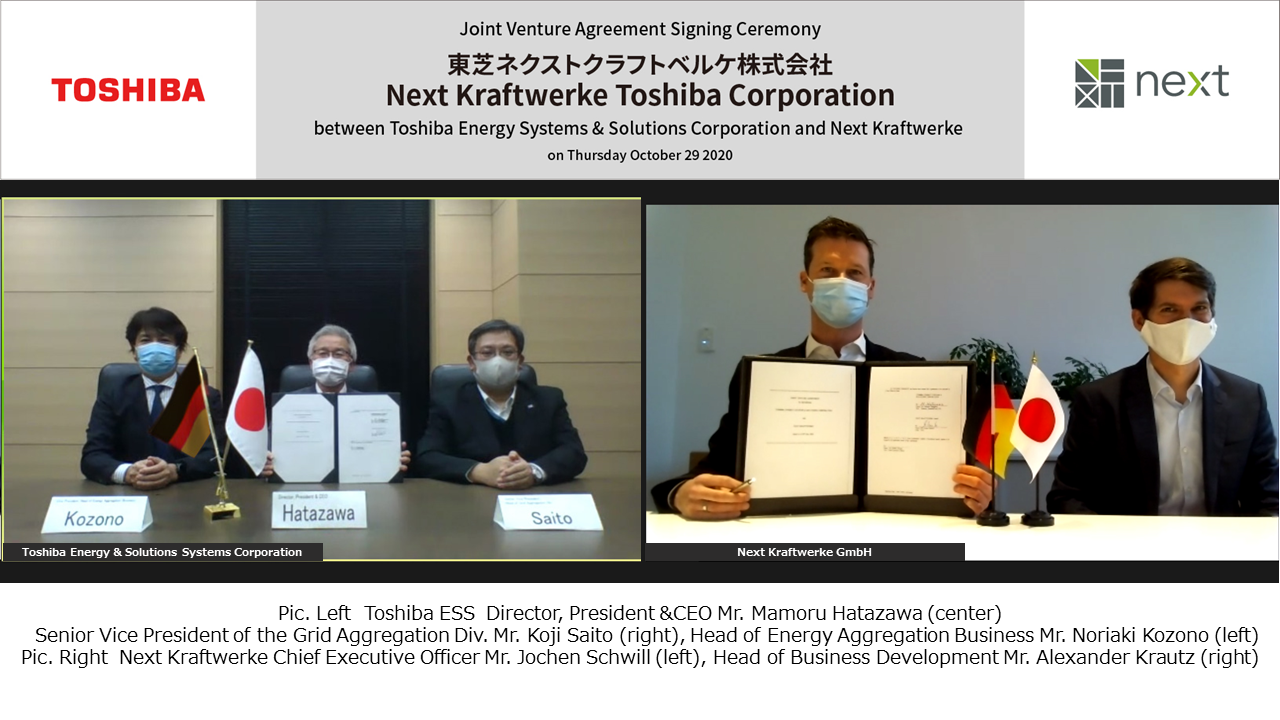
An online signing ceremony was held to mark the creation of the JV. Image: Next Kraftwerke Toshiba Corporation.

A collaboration to study the potential for virtual power plants (VPPs) between Japanese electronics giant Toshiba and German aggregator and power trader Next Kraftwerke has led to the formation of a joint venture (JV) between the two.

Our sister site Current± reported back in October last year that the pair had signed a Memorandum of Understanding (MoU) to investigate the potential for VPPs, which aggregate together various distributed energy resources (DERs) to create a single larger asset for the grid.

Toshiba’s Energy Systems & Solutions Corporation (Toshiba ESS) has now agreed with Next Kraftwerke to form Next Kraftwerke Toshiba Corporation to start the JV, which will begin operation later this month and offer up VPP solutions to third-parties based in Japan.

Toshiba said that the launch is a response to the growing need for resources to step in to help power generation companies or electricity retailers balance the supply and demand of energy on the grid at 30 minute intervals.

This article requires Premium SubscriptionBasic (FREE) Subscription

Try Premium for just $1

  • Full premium access for the first month at only $1
  • Converts to an annual rate after 30 days unless cancelled
  • Cancel anytime during the trial period

Premium Benefits

  • Expert industry analysis and interviews
  • Digital access to PV Tech Power journal
  • Exclusive event discounts

Or get the full Premium subscription right away

Or continue reading this article for free

Both companies own technologies which can forecast power generation and demand, carry out energy market transactions and control distributed energy resources, all of which can be used to reduce imbalance risks, to optimise trading opportunities and enhance customers’ profits in electricity spot markets and control reserve markets.

Japan recently committed to a national decarbonisation policy goal of achieving net zero emissions by 2050. The country experienced a solar boom in the wake of the Fukushima nuclear disaster of 2011 as it introduced new large-scale, commercial and residential feed-in tariffs to encourage renewable energy adoption – in addition to residential tariffs that already existed from 2009.

However the past couple of years have seen Japan’s lawmakers largely put the impetus for deploying more renewables – primarily solar – onto the industry, which is tasked with coming up with effective business models to incentivise deployment.

Japan’s electricity market is also undergoing a long deregulation process in which dozens of new retailers have emerged, while the process of unbundling generation from transmission is also taking place: Japan’s grid and electricity supply have traditionally been the domain of 10 regional grid operator-utilities.

Meanwhile, a large and growing behind-the-meter energy storage market has grown as households buy battery systems to ensure their security of supply in the country which has been shown to be prone earthquakes and other natural disasters.

A market for control reserve will open up next year, while a trading scheme for renewables opens up the year after that, while renewables generators will become responsible for integrating their share of energy onto the grid while keeping it balanced. Kaz Iguchi, business development head at Tokyo-headquartered residential solar PV and energy storage company Sharing Energy, a startup among those looking to make a success of Japan’s deregulated energy market, told Energy-Storage.news recently that as rules change in the next couple of years, peer-to-peer (P2P) energy trading using solar and batteries is likely to become a scalable business model in Japan.

The Toshiba Next Kraftwerke JV will be headquartered in Kawasaki, Japan, offering up Next Kraftwerke’s software-as-a-service solution, called NEMOCS. The platform allows operators of DERs to monitor, manage and dispatch their systems remotely. While the JV will focus initially on the Japanese market, both separate companies’ international sales channels could be leveraged to allow overseas expansion in future, the pair said.

The new company has been established with share capital of 180 million, while Toshiba ESS takes a 51% voting ratio and Next Kraftwerke the remaining 49%.
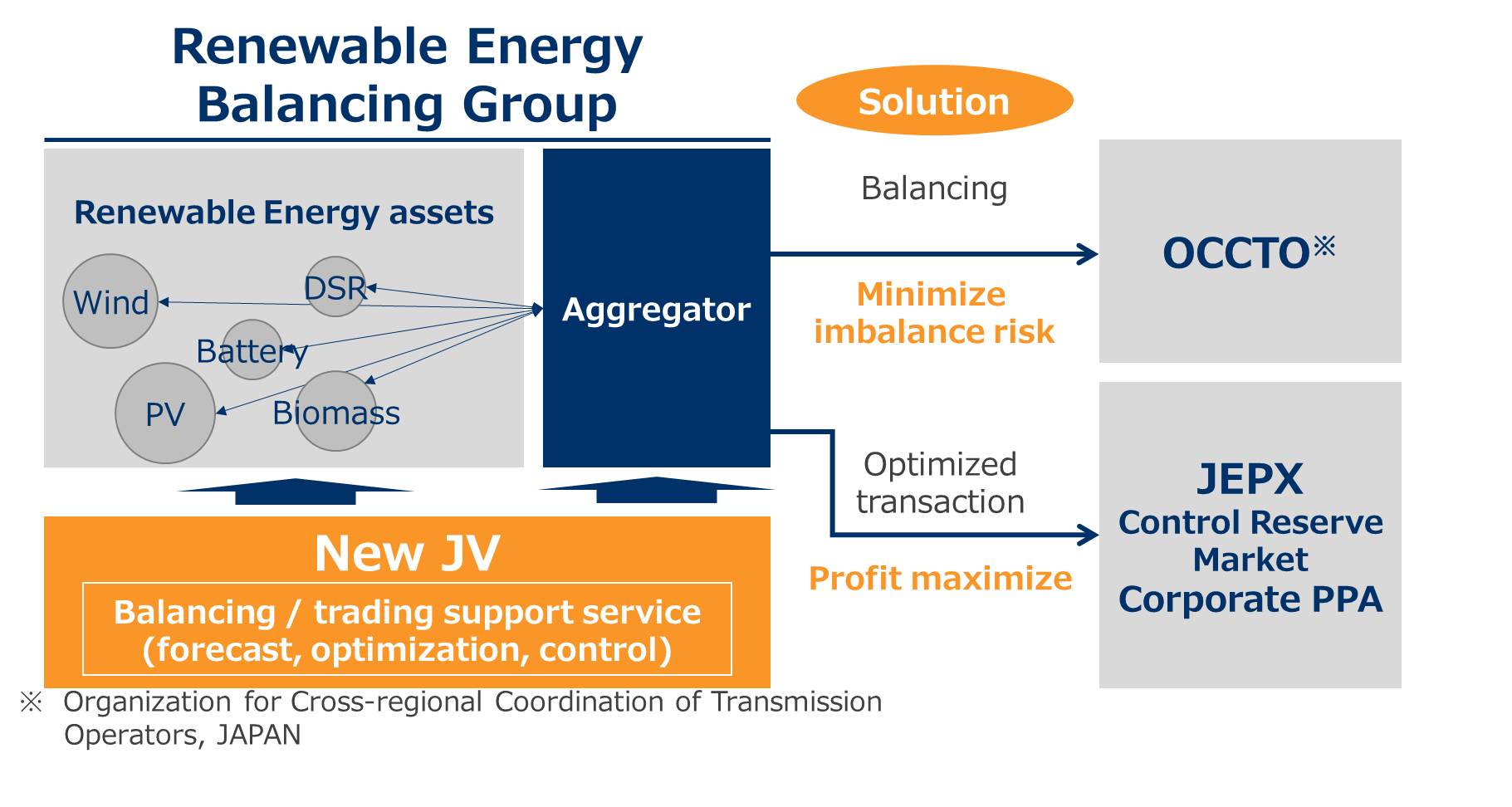
Business model for the new JV. Image: Toshiba.
17 March 2026
1pm EST / 6pm GMT
The energy storage market is at an inflection point. Physical market revenues alone can no longer sustain the business case that drove earlier waves of storage deployments. Financial sophistication is no longer optional; it’s the difference between marginal and exceptional performance. As physical market revenues compress across US power markets, energy storage operators face a critical challenge; traditional arbitrage and ancillary service strategies are no longer sufficient to maintain target returns
17 March 2026
Sydney, Australia
As we move into 2026, Australia is seeing real movement in emerging as a global ‘green’ superpower, with energy storage at the heart of this. This Summit will explore in-depth the ‘exponential growth of a unique market’, providing a meeting place for investors and developers’ appetite to do business. The second edition will shine a greater spotlight on behind-the-meter developments, with the distribution network being responsible for a large capacity of total energy storage in Australia. Understanding connection issues, the urgency of transitioning to net zero, optimal financial structures, and the industry developments in 2026 and beyond.
17 March 2026
Westgate Las Vegas Resort & Casino
With 200 speakers, 65 sessions, 240 exhibitors, and 5,000+ attendees, EV Charging Summit & Expo is North America’s largest and most influential event dedicated to the electrification of transportation infrastructure. This is where innovation, policy, finance, and technology come together to shape the future of mobility. From commercial to government sectors, attendees will explore real-world solutions, cost-saving technologies, and scalable strategies driving EV charging forward. Use code ESN20 to receive 20% off full registration.
24 March 2026
10am ET / 3pm GMT
Grid-forming (GFM) technology is rapidly moving from a specialist ‘nice-to-have’ solution to a baseline expectation in many markets as power systems shift toward inverter-dominated generation. For project developers, that change impacts everything from early-stage feasibility and interconnection strategy to EPC specification, commissioning, and long-term operational performance. In this webinar, Ben Braun (Fluence) and Till Stehr (Modo Energy) will translate the rapid evolution of GFM requirements in Europe and beyond into practical guidance you can apply to your next pipeline decision, turning compliance into opportunity. 
24 March 2026
Dallas, Texas
SolarPLUS USA brings together the developers, investors, utilities, and system operators shaping the next phase of America’s clean energy build-out. As solar, storage, and hybrid technologies rapidly converge, the Summit provides a focused platform to tackle grid constraints, revenue optimisation, project financing, and the commercial models defining firm, flexible renewable power. Join us to explore the opportunities and challenges driving the Solar+ era across the US market.
24 March 2026
Dallas, Texas
The Energy Storage Summit USA is the only place where you are guaranteed to meet all the most important investors, developers, IPPs, RTOs and ISOs, policymakers, utilities, energy buyers, service providers, consultancies and technology providers in one room, to ensure that your deals get done as efficiently as possible. Book your ticket today to join us in 2026!

Read Next

February 27, 2026
US energy storage and battery technology startup Lyten has completed its acquisition of Northvolt’s business operations in Sweden and announced its immediate plans.
Premium
February 27, 2026
We caught up with the CEO of owner-operator BW ESS, Erik Strømsø, about the firm’s next deployment plans, tolling trends, procurement and LDES, with its 11.5-hour Bannaby BESS in Australia further proof of lithium-ion’s long-duration potential.
February 27, 2026
Iron-sodium battery manufacturer Inlyte Energy and data centre operator NTS Colocation are partnering to deploy 2MW of iron-sodium battery capacity by 2028.
February 26, 2026
Energy Storage Summit 2026 finished yesterday, having brought the industry together for its first major meeting of the year.
February 26, 2026
Trina Storage, the BESS arm of Trinasolar, has made a commitment to invest in Gore Street Capital’s new EU-focused private BESS fund.