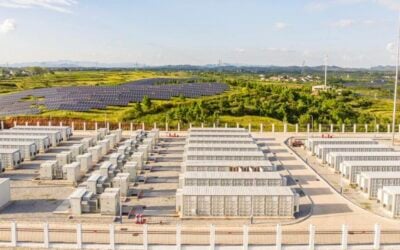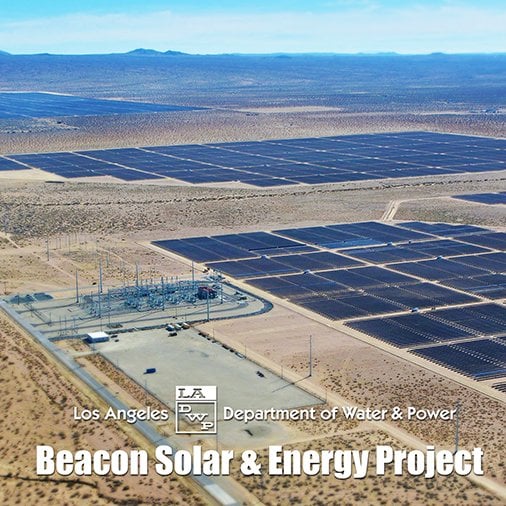
Los Angeles Department of Water and Power (LADWP) announced Wednesday that it has selected Doosan GridTech and its partner, KTY Engineering, to provide LADWP’s first battery energy storage system (BESS) with a capacity of 20MW at its Beacon Solar Plant in Kern County, California.
The Beacon Solar Plant was selected as the site of the BESS due to its heavy concentration of PV arrays. Doosan’s turney design includes thirteen transformer/PCS/lithium-ion battery strings, redundant auxiliary power systems, and 100% redundant HVAC systems.
The design also allows for preventative maintenance — which is a necessary requirement when dealing with the harsh Mojave Desert environment.
Doosan’s partner, KTY Engineering, will provide project management, construction management, on-site QA/QC, commissioning management, and engineering support services.
Try Premium for just $1
- Full premium access for the first month at only $1
- Converts to an annual rate after 30 days unless cancelled
- Cancel anytime during the trial period
Premium Benefits
- Expert industry analysis and interviews
- Digital access to PV Tech Power journal
- Exclusive event discounts
Or get the full Premium subscription right away
Or continue reading this article for free
When the project was announced in August, LADWP said the batteries will allow better utilisation of 600MW of solar PV installed in the area, as well as some 135MW of wind generation. At the time LADWP said Beacon Energy Storage System would cost around US$19.2 million, adding flexible reserve and system balancing to the local grid and mitigating for the variable nature of renewable energy generation output from its “strategic location”.
Under California policy, LADWP has been given a target to procure some 178MW of energy storage by 2024, the largest target given to a municipal utility in the state, behind only the three main investor-owned utilities of Southern California Edison (SCE), Pacific Gas & Electric (PGE) and San Diego Gas & Electric (SDG&E) which between them have a much bigger 1.325GW target in the same timeframe.
Daejin Choi, CEO of Doosan GridTech, said: “We are honored that LADWP has chosen us to deliver their first battery energy storage system. The Beacon system will be our sixth BESS delivered in just a three-year period, making us a market leader in utility-integrated storage systems. Through these projects, we are demonstrating that competitively priced turnkey systems based on an open standards software architecture are a winning proposition for utilities and other front-of-the meter customers.
“Turnkey delivery provides simplicity of purchase and a higher degree of short-term risk management, while an open standards-based software architecture ensures long-term risk management in the form of flexibility across both technology options and suppliers.”