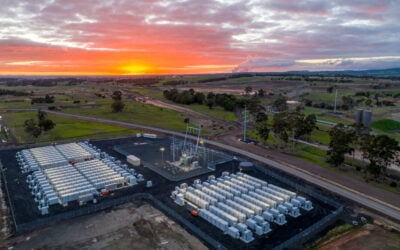
Groundbreaking ceremony held in October for New England’s first utility-scale battery project. Image: NEC ES.
The north-eastern US state of Massachusetts will introduce a procurement target for energy storage resources, with the state’s department of energy resources (DOER) collecting views from stakeholders.
DOER commissioner Judith Judson wrote to lawmakers last week, stating that since the passing of a law, “An act relative to energy diversity” in August by Governor Charlie Baker, the department had given itself until the end of 2016 to decide whether or not to introduce targets for electricity companies.
Judson wrote that after considering and reviewing some 150+ pages of comments from stakeholders including energy storage companies like Alevo, Advanced Microgrid Solutions and Stem, the DOER had ruled “that it is prudent for the Commonwealth to set targets for energy storage systems”.
In September, the DOER published a report, ‘State of Charge’ through the US$10 million Massachusetts Energy Storage Initiative, which analysed the energy storage industry and looked at how the New England state could best implement energy storage, whether that be from targeted programmes or policy support.
Try Premium for just $1
- Full premium access for the first month at only $1
- Converts to an annual rate after 30 days unless cancelled
- Cancel anytime during the trial period
Premium Benefits
- Expert industry analysis and interviews
- Digital access to PV Tech Power journal
- Exclusive event discounts
Or get the full Premium subscription right away
Or continue reading this article for free
That study recommended the development of 600MW of energy storage by 2025, which would lead to more than US$800 million in cost savings to ratepayers. Among other things, DOER found over 40% of residents’ electricity spending, equivalent to US$3 billion per year, went on the top 10% most expensive hours for electricity supply.
According to Judson’s letter, with the DOER considering a range of policy measures to enable a storage market, a public commentary period has now commenced, open until 5pm on 27 January. The state will then adopt energy storage procurement targets by 1 July which will determine how much needs to be installed by 2020.