German mechanical engineering company Manz has supplied a lithium-ion battery production line to a research centre for the commercial production of the batteries, initially for the e-mobility sector, at the Center for Solar Energy and Hydrogen Research Baden-Wuerttemberg (ZSW) in Ulm.
The new research platform was opened last week with an inauguration ceremony attended by the German federal minister for education and research, Dr Prof Johanna Wanka. It has been described as a strategic project of Germany’s national e-mobility programme and will involve a number of other private companies in partnership with the federal ministry of education and research.
The goal of the project is to develop and produce efficient batteries for e-mobility and electric vehicles (EVs) competitive with the international industry. Research will focus on the whole industrial process, including development of new active materials. The centre aims to improve capacity and safety of batteries, as well as increasing their service life and allowing companies to lower production costs.
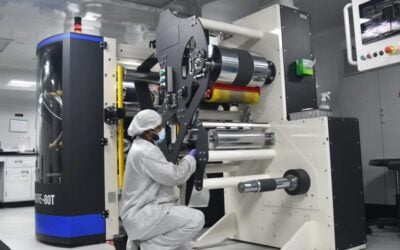
Manz provided a fully automated production line for the industrial production of the batteries, which the company describes as the “central component” of the new facility. Other companies that have partnered with the state of Baden-Wuerttemberg and the Federal Ministry of Education and Research on the project include BMW, Daimler, Robert Bosch, SGL Carbon and Siemens. Research and development activities will happen in earnest in January. Various other research institutes in Germany have undertaken R&D, testing and accreditation activities in energy storage recently.
Try Premium for just $1
- Full premium access for the first month at only $1
- Converts to an annual rate after 30 days unless cancelled
- Cancel anytime during the trial period
Premium Benefits
- Expert industry analysis and interviews
- Digital access to PV Tech Power journal
- Exclusive event discounts
Or get the full Premium subscription right away
Or continue reading this article for free
BMW will be among the companies participating. Pictured is the company’s new plug-in hybrid sports car, the BMW i8. Image: Fergus March.
Although the project will focus on batteries for e-mobility, lithium-ion batteries are used in a wide range of applications, including many modern systems for pairing energy storage with solar PV. A report by Lux Research in July predicted that a boom in EV sales would contribute to driving the energy storage market to US$50 billion by 2020.
Additionally, speaking to PV Tech Storage for a feature article at the beginning of this year, technology analyst Sam Jaffe of Navigant Research said that lithium-ion is likely to remain the clear leader in the battle of battery technologies, in the short term at least. However Jaffe said he believed that while the price, performance, cycle life and safety of Li-ion positions it well in the short term, the lead that Li-ion enjoys in the race could very well be usurped over the next five to 10 years by newer chemistries and technologies.
“The lead [of lithium-ion] is getting wider rather than shorter as the manufacturing scale builds up,” Jaffe says. “From a chemistry perspective, lithium-ion overall is clearly in the lead. Within the lithium-ion space, the sub-chemistry that’s in the lead, or most popular, is lithium manganese spinel (LMO), that’s what’s in the Chevy Voltz and the Nissan Leaf – most electric vehicles.”
Jaffe explained that with a low combustibility and good power-to-energy ratio for short-term applications, lithium iron phosphate, often used in residential energy storage systems of the kind paired with solar, is also in a good position among the many subchemistries of lithium-ion. Jaffe also singled out lithium titanate as one to watch for its “very long” lifespan.
Solar Media editor Peter Bennett talked to BMW about its new i8 and i3 hybrid cars in the Next Energy News Show, hosted on Next Energy News, a new site for distributed generation, primarily focused on the UK.