The costs of certain long-duration energy storage (LDES) technologies are expected to decline by around 37% on average by 2030, according to a new study.
The technical report, produced by the US non-profit Electric Power Research Institute (EPRI) for trade association the Long Duration Energy Storage Council (LDES Council), was published yesterday (21 January).
Based on cost data relating to real-world projects, provided by LDES Council member companies, EPRI’s study, Cost Benchmarking for Long Duration Energy Storage Solutions, found that many LDES technologies are expected to decline in cost as technology development continues and manufacturing scales up.
EPRI researchers even found that at longer durations, some long-duration technologies could scale more efficiently than short-duration energy storage, dependent on system design and the applications they are used for.
Try Premium for just $1
- Full premium access for the first month at only $1
- Converts to an annual rate after 30 days unless cancelled
- Cancel anytime during the trial period
Premium Benefits
- Expert industry analysis and interviews
- Digital access to PV Tech Power journal
- Exclusive event discounts
Or get the full Premium subscription right away
Or continue reading this article for free
While long-duration energy storage appears a natural fit for enhancing the reliability and flexibility of electricity grids, particularly, but not necessarily limited to, high renewable energy penetration environments, their high upfront capital cost is considered a significant barrier to investment and adoption.
When assessed in terms of total plant cost (TPC) capex, EPRI found that a 100MW, 10-hour duration intraday electrochemical energy storage plant ranged from US$220/kWh to a high of US$572/kWh as of 2025.
That same system is projected to cost within a range of US$244/kWh to US$358/kWh by 2030.
Meanwhile, although 2025 data was not provided for multi-day energy storage systems, which are only just now emerging onto the market from providers like Form Energy and Noon Energy, by 2030, costs for a 10MW, 100-hour duration (1,000MWh) multi-day energy storage system are expected to range between US$26/kWh and US$38/kWh.
By way of comparison, BloombergNEF’s (BNEF’s) Energy Storage Systems Cost Survey 2025, published in December, found that in 2025, the global average price of a turnkey Li-ion battery energy storage system (BESS) was US$117/kWh. With cost reductions expected to continue, BNEF offered 2035 average 4-hour duration turnkey BESS cost forecasts of US$41/kWh in China, US$101/kWh in Europe and US$108/kWh in the US (with systems outside China assumed in BNEF’s calculations to also be using China-made batteries then, just as they mostly are today).
EPRI assessed LDES Council member technologies from five broad technology categories: intraday electrochemical, intraday compressed gas, intraday pumped heat, multi-day and thermal energy storage (TES).
European Union policymakers urged to create LDES framework
In related news, industry groups, including the LDES Council, urged European policymakers to create a suitable framework for deploying long-duration technologies.
In a letter sent today to five senior European Commission (EC) figures responsible for industrial strategy, equitable energy transition, net zero emissions policies, trade and economy, the call was made by LDES Council, Energy Storage Europe and six other organisations representing clean energy technologies, electrification and sustainable development.
The signatories defined LDES as “a class of technologies capable of storing energy in chemical, electrochemical, mechanical, or thermal forms, and releasing electricity over multi-hour to multi-day, weekly, or seasonal durations”.
“By converting variable renewable generation into firm, time-shifted supply, LDES sustains system adequacy during extended low-renewable events. This reduces reliance on fossil backup capacity, lowers curtailment, defers grid reinforcement, and enables industrial electrification—supporting security of supply in high-renewables systems at least cost,” the letter went on to say.
“Despite its strategic value, LDES deployment in Europe remains far below system needs. This reflects structural gaps across planning, market design, investment frameworks, taxation, and delivery conditions.”
The letter was accompanied by the publication of Policy Options to Anticipate Europe’s Long-Duration Energy Storage Deployment, a position paper by Energy Storage Europe (formerly known as EASE).
The 44-page document details the four key recommendations made in the eight supporting organisations’ joint letter urging its addressees, who included Commissioner for Trade and Economic Security, Interinstitutional Relations and Transparency, Maroš Šefčovič, to enable recognition of the “strategic value” of LDES in European Union (EU) planning and market frameworks.
The absence, or underrepresentation, of LDES in key documents such as National Energy and Climate Plans (NECPs) and energy system resource adequacy assessments reinforces investment barriers, Energy Storage Europe argued.
“Europe’s power system is changing faster than the frameworks that govern it. Long-duration energy storage is critical to managing multi-hour and multi-day system stress, but current planning and market arrangements remain largely duration-blind,” Energy Storage Europe junior policy officer Carolina Cruz told Energy-Storage.news today.
“Aligning adequacy assessments, grid tariffs, and market mechanisms with the physical realities of a high-renewables system is now a priority.”
The groups called on the EU to:
- Embed LDES in system planning and resource adequacy assessments
- Reform ancillary services and system stability markets and grid fee and tax frameworks, in line with the EU’s own Electricity Market Design Reform
- Align capacity mechanisms with European Resource Adequacy Assessment outcomes and the Clean Energy State Aid Framework
- Deploy targeted investment instruments and enable long-term contracting.
Some frameworks for LDES procurement have already been rolled out in regions already experiencing high shares of variable renewable energy (VRE) in their electricity mix, including California in the US, various Australian states and the UK.
One interesting side note is that while LDES technologies are often synonymous with emerging, non-lithium alternative technologies such as flow batteries, lithium-ion (Li-ion) BESS is also being considered an option by some technology providers, utilities and grid planners to provide storage at durations far exceeding the typical 1-hour to 4-hour systems being deployed today.
Some, although not all, California procurements were won by Li-ion project proposals, as was the case in Australia, and a future mix of energy storage durations could potentially include combinations of different tech, including lithium batteries and non-lithium alternatives.
In the UK, meanwhile, regulator Ofgem has formulated a ‘cap and floor’ revenue underwriting scheme to incentivise investment in LDES. However, while that procurement process is currently ongoing, BESS asset developer-owner-operator Zenobē is making a legal challenge to the cap and floor scheme’s framework, arguing that by allowing subsidised LDES projects to access the same markets as short-duration technologies, Ofgem risks “creating an uneven playing field that undermines the investment case for [short-duration] technologies”.
As reported yesterday by our colleagues at Solar Power Portal, Zenobē has told the UK’s Competition Appeal Tribunal that the framework, as it stands, could distort competition and allow LDES to “crowd out” other types of energy storage. Zenobē and a group of other leading UK BESS asset owners lodged their complaints early last year. The company’s founder, James Basden, spoke with Energy-Storage.news about the subject for an in-depth report in April.
Developing the specific mechanisms may therefore hold some challenges and complexity, but Energy Storage Europe’s Carolina Cruz told Energy-Storage.news this morning that ultimately there will be economic imperatives to adopt LDES technologies, particularly as Europe strives to stimulate economic recovery and reindustrialisation and enable data centre development, all while increasing shares of renewables.
“For industry and data-intensive sectors, access to firm, clean power over extended periods is becoming increasingly important. Long-duration energy storage provides that firmness while supporting system reliability and cost efficiency. By participating in electricity and flexibility markets—through demand-side flexibility, long-term contracting, or behind-the-meter storage—industrial consumers can reduce exposure to price volatility, secure cleaner power profiles, and actively contribute to system stability,” Cruz said.
“Long-duration energy storage allows industrial and data-intensive consumers to move from passive electricity buyers to active market participants. By shifting consumption, storing low-cost renewable electricity, and participating in flexibility or capacity markets, industry can hedge against price volatility while supporting system reliability in high-renewables power systems
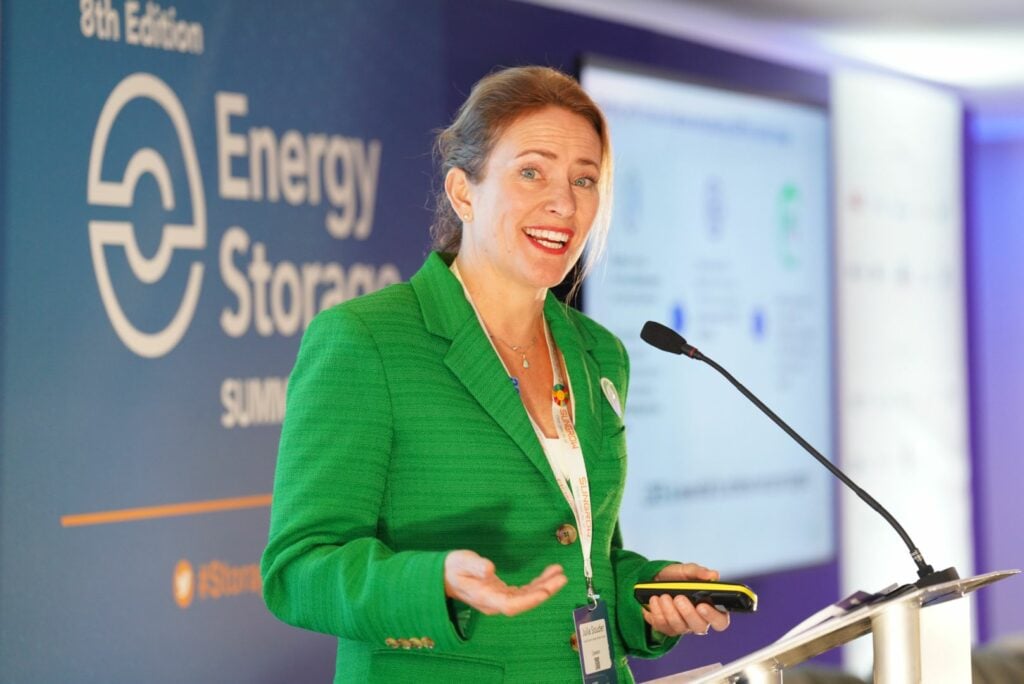
Energy-Storage.news publisher Solar Media is hosting the Energy Storage Summit EU 2026 in London, UK, on 24-25 February 2026 at the InterContinental London – The O2. See the official website for more details, including agenda and speaker lists. Plus, ESN Premium users can get a 30% discount on tickets.
This article has been amended to correct the spelling of Energy Storage Europe junior policy officer Carolina Cruz.