LG ES Vertech, the US-based system integrator subsidiary of LG Energy Solution (LG ES), plans to deliver 50GWh of projects this year, ESN Premium has heard.
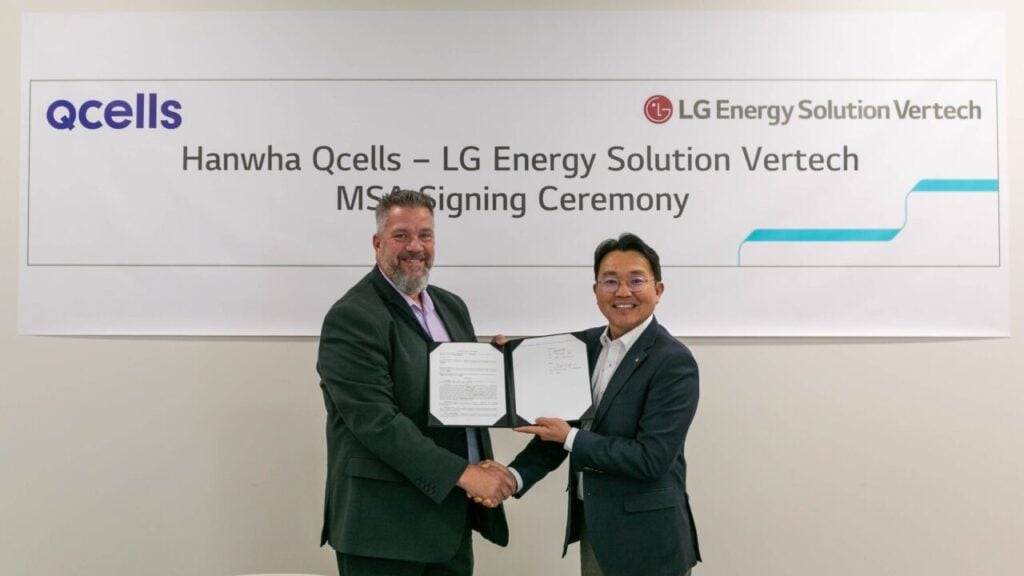
LG ES Vertech and the engineering, procurement and construction (EPC) arm of solar PV and smart energy solutions company Qcells announced a multi-year partnership last week (3 February).
LG ES Vertech would supply 5GWh of US-made energy storage products and lifecycle services to its fellow South Korean-owned company (Qcells is part of the Hanwha Group) in support of Qcells EPC projects running from 2028-2030.
This could include some integration of Qcells solar PV equipment and LG ES Vertech battery storage at some sites, although Qcells told Energy-Storage.news yesterday that while such opportunities will be sought, “we won’t necessarily always integrate both on the same projects.”
Try Premium for just $1
- Full premium access for the first month at only $1
- Converts to an annual rate after 30 days unless cancelled
- Cancel anytime during the trial period
Premium Benefits
- Expert industry analysis and interviews
- Digital access to PV Tech Power journal
- Exclusive event discounts
Or get the full Premium subscription right away
Or continue reading this article for free
The Qcells spokesperson noted that the 5GWh deal is separate from a 4.8GWh battery purchase agreement signed with LG ES Vertech in May 2024 for projects being developed across the US.
Parent company LG ES had already established a partnership with Hanwha in 2023 amid reports that Qcells was looking to expand its BESS EPC operations in the US.
In response to a series of questions from Energy-Storage.news about that agreement, an LG ES Vertech spokesperson provided some clarity on its plans and current activities.
‘US manufacturing is the best way forward in the ESS market’
The grid-scale battery energy storage system (BESS) integrator was officially launched in late 2023. South Korean battery manufacturer LG ES completed the acquisition of NEC Energy Solutions, a former market leader in utility-scale BESS integration, a year earlier, after NEC Corporation pulled the plug and exited the business.
LG ES Vertech onboarded its IP, including controls and dispatch software platforms. The integrator has since announced other multi-gigawatt-hour deals with US developers, including Excelsior Capital and Terra-Gen.
In its most recent financial results, parent company LG ES said it is targeting 90GWh of energy storage system (ESS) product orders in the US in 2026.
While it would keep total battery cell production capacity relatively flat at around 300GWh worldwide, the manufacturer is ramping up its lithium iron phosphate (LFP) cell capacity, focusing on the US, primarily by repurposing factory lines originally intended for, or already producing, electric vehicle (EV) battery cells.
In short, while the US was already looking to build up domestic supply chains through incentivising investments and raising tariffs on Chinese imported batteries under the Biden Democratic administration, the Republicans under Donald Trump last year changed the eligibility rules for production tax credit (PTC) and investment tax credit (ITC).
The passing of HR 1, aka the ‘One, Big, Beautiful Bill Act’ (‘OBBBA’) put in place thresholds for the amount of material assistance a manufacturer or developer can receive from so-called foreign entities of concern (FEOC)—in this case, Chinese or Chinese-owned companies—in order to avail of the PTC and ITC incentives. This has put South Korean battery manufacturers, including LG ES, Samsung SDI and SK On, which had already invested in US production lines for EV batteries, in the driving seat, so to speak.
“LG Energy Solution has been betting on the US market for some time now, and we feel very strongly that US manufacturing is the best way forward in the ESS market,” the spokesperson told ESN Premium.
“Building out our domestic supply chain is core to the value proposition we are bringing to market, and we believe our early adoption of this approach sets us apart. Many companies in the industry have been working to localise supply chains for years now, and we don’t see that slowing down anytime soon.”
They added that companies not already focusing on domestic content will “continue to face increasing challenges,” while developers of projects that rely on Chinese manufacturers may need to change their approach.
LG ES Vertech is itself continuing to focus on the US and is not acting as a system integrator in any other markets. The spokesperson said that the US ESS market enjoys “very high demand” and “strategically fits well” with LG ES’ manufacturing and EV division activities. The company will, however, continue to evaluate and assess opportunities in other markets as they expand, they said.
Vertical integration touted as key to success in US market
In the LG ES results release and accompanying presentation and earnings call, the company said its ESS order backlog stood at 140GWh by the end of 2025 and it targets 90GWh of new orders this year, primarily from utility and developer customers in the US, where it plans to have 50GWh of a total annual 60GWh of annual ESS sector production capacity by the end of 2026.
The LG ES Vertech spokesperson clarified that the 90GWh figure pertains to both full system and battery supply-only deals and reflects the growth that LG ES is seeing in the US market.
“We plan on producing and delivering 50GWh of energy storage projects in 2026, with a much larger pipeline following that in 2027-2030,” the LG ES Vertech spokesperson told the site.
“Most of these projects are in the high hundreds of MWh to multi-GWh project size range and include a combination of system integration, software and lifecycle services,” they said, adding that at this stage, details of specific projects cannot be shared.
There has been some comparison recently between the strategies and successes of vertically integrated system integrators that develop and make their own components, including cells, and pureplay system integrators that rely on OEMs.
In interviews last year, LG ES Vertech CEO Jaehong Park said that while Vertech is not LG ES’ only customer, the system integrator never has to worry about having sufficient cell supply due to their close integration.
Asked this week how it will remain competitive against system integrators that could choose different suppliers to work with, the company spokesperson said there are several reasons why the group’s vertical integration “is a key puzzle piece to our success in the market.”
“It provides us direct access to a battery supply chain that we are able to influence directly as the demands of our customers shift, and as the regulations and geopolitics of our target market shifts. Our connection with our parent company also enables us to create software and services formulated with actual data from our products, proprietary data that would otherwise be quite difficult to access,” the LG ES Vertech spokesperson said.
“Being vertically integrated also means we can benefit from our parent organisation’s deep experience in manufacturing, long-term bankability, and also allows us to quickly scale our supply as we balance the ESS and EV sides of the business. These advantages are not small and are not going anywhere. Fundamentally, we believe a vertically integrated supplier substantially reduces risk, which is enormously valuable to projects that commonly stretch past the billion-dollar investment level and need to show robust bankability to get financed.”
The Energy Storage Summit USA will be held from 24-25 March 2026, in Dallas, TX. It features keynote speeches and panel discussions on topics like FEOC challenges, power demand forecasting, and managing the BESS supply chain. ESN Premium subscribers can get an exclusive discount on ticket prices. For complete information, visit the Energy Storage Summit USA website.
This article has been edited since publication to accurately reflect LG ES’ production figures.