Developer-investor Hexa Energy Services has inaugurated what is thought to be Japan’s first operational battery storage project with a capacity market contract.
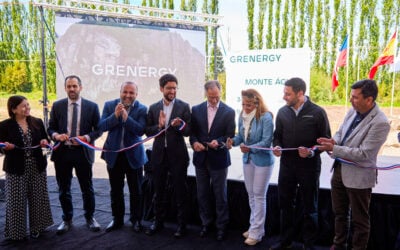
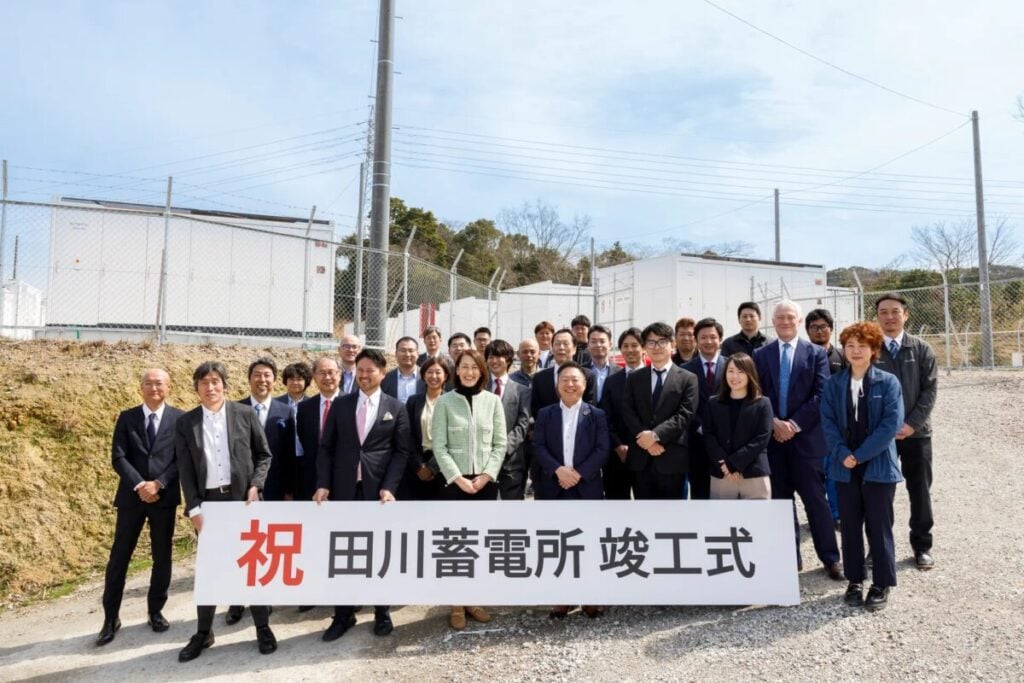
Hexa Energy Services, a developer of solar PV assets in Japan that later diversified into battery energy storage systems (BESS), held a completion ceremony on 24 March for its 30MW/130MWh Tagawa BESS in Fukuoka, Kyushu, in southern Japan. Tagawa BESS is co-located with a 2MW solar PV plant.
The company was a successful bidder in the first annual staging of the Japanese Long-Term Decarbonization Power Auction (LTDA), held in the 2023 financial year (FY2023). Hexa was awarded 455MW of capacity, which was about a third of the total awarded to energy storage resources, including BESS and pumped hydro energy storage (PHES).
Tagawa BESS, which is connected to the high-voltage grid, began commercial operation in November last year ahead of last week’s official celebration, with a Hexa Energy Services spokesperson describing it as a “significant milestone for Japan’s power infrastructure sector.”
Try Premium for just $1
- Full premium access for the first month at only $1
- Converts to an annual rate after 30 days unless cancelled
- Cancel anytime during the trial period
Premium Benefits
- Expert industry analysis and interviews
- Digital access to PV Tech Power journal
- Exclusive event discounts
Or get the full Premium subscription right away
Or continue reading this article for free
“Operating in the Kyushu region—where solar power penetration is high, and output curtailment remains a growing concern—the facility will contribute to enhancing grid stability,” the spokesperson said.
Hexa Energy Services, owned by global infrastructure investor I Squared Capital, is also working to deliver other BESS projects in Hokkaido, northern Japan, and Mie Prefecture, western Japan.
French financial institution Societe Generale acted as mandated lead arranger and hedge provider for Tagawa BESS, using what it described in a September announcement as a tailored financing package and claiming it was the first financial close on a Japanese standalone BESS project by a non-Japanese bank.
Long-Term Decarbonization Auctions offer 20-year fixed payments
Japan held its first capacity market auctions in 2020 and later opened the market to low-carbon sources through the separately run LTDA. The LTDA’s design differs from the usual single-year capacity market in that it is aimed at securing long-term investment in low-carbon resources, rather than securing capacity to meet grid demand, as noted in analysis undertaken collaboratively by consultancies Cornwall Energy Insight and Shulman Advisory.
The LTDA offers a fixed 20-year revenue stream for newly developed assets through a pay-as-bid auction administered by the Organization for Cross-regional Coordination of Transmission Operators (OCCTO).
In the FY2023 first staging, 1.1GW of BESS and 557MW of pumped hydro projects were successful in the competitive solicitation, from a total of 9.8GW of capacity that included relatively low-carbon liquified natural gas (LNG) bids winning the largest share (5.7GW).
An indicative target of 1GW for energy storage was raised following huge interest from developers, in fact energy storage was the most oversubscribed technology, with the other technologies eligible including nuclear, hydroelectric and LNG.
In the subsequent FY2024 auction, 1.3GW of capacity was awarded to 25 BESS projects, including one 47MW BESS project of 6-hour duration.
While battery operators are allowed to operate their assets in other market opportunities such as the Japan Power Exchange (JEPX), they must return 90% of additional profits from merchant revenues to OCCTO under the contract terms.
This has led to some analysts including Shulman Advisory and Japan’s Renewable Energy Institute noting that the LTDA may have limited commercial appeal for developers.
Nonetheless, those that have participated in it, such as international developer-investor Eku Energy, have said that the fixed revenue structure is welcome and the LTDA’s existence in itself an indication of strong policy support towards promoting energy storage uptake (ESN Premium article).
Another potential challenge for BESS operators is that the bulk of energy storage LTDA contracts are awarded to 3-6-hour duration and 6-hour duration resources. Japan’s Ministry of Economy, Trade and Industry (METI) has indicated that it may limit participation to 6-hour resources in future auctions.
Merchant projects are expected to earn good returns in current market environment
In terms of business models available to energy storage developers in Japan, in mid-2025, BloombergNEF energy storage analyst Isshu Kikuma said in a deep dive series on Japan for ESN Premium that while the long-term contracted LTDA is one option, “some market players are only looking into the merchant opportunities, looking for the price upside,” while others are seeking tolling agreements as an “in between” option.
However, his BNEF colleague Umer Sadiq noted in the same interview series that developers should nonetheless be cautious about Japan’s track record of frequent changes to market and regulatory conditions, as well as long lead times for grid connections and permitting, and relatively high labour and equipment costs compared with other markets.
Currently, high ancillary services prices and JEPX trading have led to the development of a fleet of relatively small (2MW-10MW) projects by various market players. One source commented that a 10MW system in Japan right now can earn as much in some cases as a 100MW asset in more mature, saturated markets.
HD Renewable Energy, headquartered in Taiwan, and partner Manoa Energy put into action what is thought to be the country’s largest merchant BESS at the end of last year, a 50MW/104MWh asset in Hokkaido.
Claiming its Helios 50MW BESS is expected to earn around JP¥2 billion (US$12.8 million) in power trading revenue over its first year of making 48 daily transactions in JEPX and the balancing market, EPRX. HDRE does however also seek to bid the project into a capacity market contract in future.
A few days ago, HDRE said it secured project financing for Helios 50MW worth around JP\5.4 billion through a green project bond, arranged by Japanese financial services groups Nomura Capital Investment and Nomura Securities.