“When we started back in two years ago, there was a lack of understanding in the market about how the grid-forming inverters operate,” said Ghasem Jahedi, principal grid engineer at AGL.
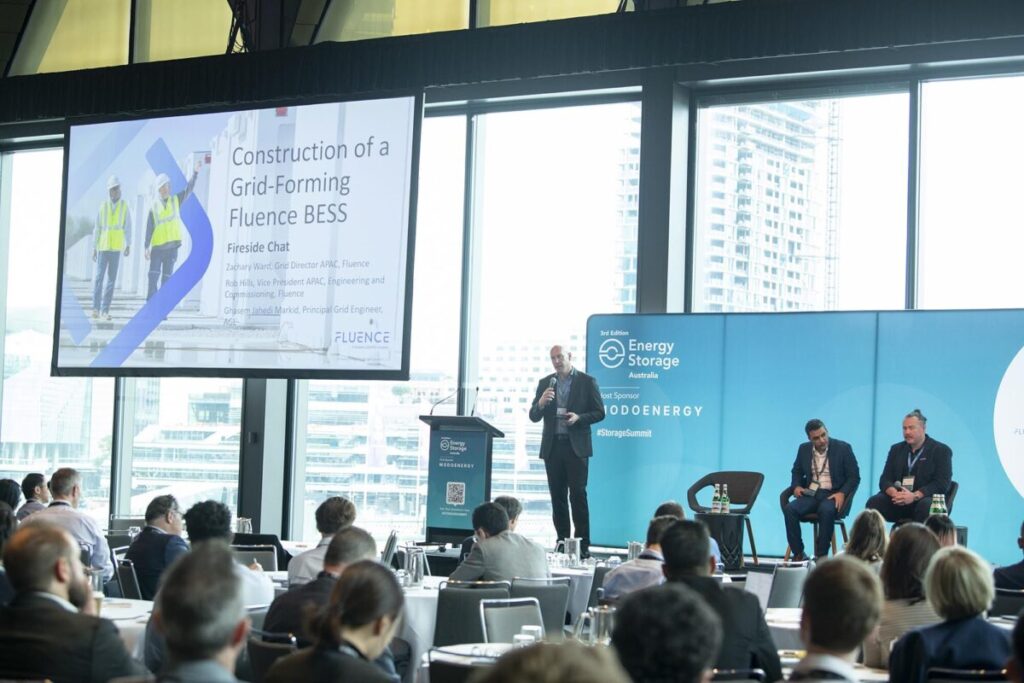
Speaking at the Energy Storage Summit Australia 2026 this week, representatives from AGL and Fluence discussed the technical challenges, commissioning innovations and hard-won lessons from the 500MW/1,000MWh Liddell grid-forming battery energy storage system (BESS).
As reported by Energy-Storage.news last year, the Liddell BESS, located on the shores of Lake Liddell, roughly 220km north of the state capital, Sydney, and 120km west of Newcastle, registered with AEMO’s Market Management System in September.
The panellists noted that the project required “benchmarking” of inverter technology, still unfamiliar to regulators and grid operators.
Try Premium for just $1
- Full premium access for the first month at only $1
- Converts to an annual rate after 30 days unless cancelled
- Cancel anytime during the trial period
Premium Benefits
- Expert industry analysis and interviews
- Digital access to PV Tech Power journal
- Exclusive event discounts
Or get the full Premium subscription right away
Or continue reading this article for free
On the panel discussion, Jahedi said the project secured funding from the Australian Renewable Energy Agency (ARENA) specifically to demonstrate grid-forming inverter capabilities that can provide system strength services without relying on traditional synchronous machines.
“We got funding from ARENA, mainly to demonstrate the grid-forming capabilities for the Liddell BESS project,” Jahedi said.
“We selected this, not necessarily focusing on the market objectives that we achieved through grid-following inverters in the previous project. So here we try to target both market service requirements and the system strength services, and also other grid-forming capabilities in one go.”
Indeed, the Liddell BESS was aided in its development via an AU$35 million (US$24.8 million) grant awarded by ARENA as part of its Advancing Renewables Program and a Long-Term Energy Service Agreement (LTESA), arranged by ASL (formerly AEMO Services) on behalf of the NSW government.
Navigating regulatory gaps and battery sizing requirements
Zac Ward, APAC grid director at Fluence, which supplied the technology for the project, identified a particular challenge in reconciling the characteristics of grid-forming technology with existing access standards designed primarily for grid-following systems.
“What I found challenging was still needing to meet certain access standards, which are maybe not appropriate for the grid-forming,” Ward said.
“We all know about the requirements on the spot and the rise time, settle times and things like that. And it’s sometimes a very challenging spot to be in, where everyone in the room can see that this is correct in terms of what we expect from a synchronous machine. However, that’s not good enough still.”
The knowledge gap necessitated stakeholder engagement with transmission network service providers (TNSPs), the Australian Energy Market Operator (AEMO), original equipment manufacturers (OEMs), and other project stakeholders.
One critical technical insight that emerged centred on the often-overlooked importance of battery sizing for grid-forming applications, particularly regarding synthetic inertia provision.
“When we’re talking about fault currents and reactive current, that’s looking at the inverter. But you also need to look at the oversizing of the battery, and that doesn’t just mean putting more capacity behind the inverter,” Ward said.
“Also means you need to look at your C rates and how quickly we need that power.”
This observation underscores that grid-forming capability isn’t solely about inverter specifications; the entire system architecture must be designed holistically.
The team also discovered new requirements for larger projects.
“Regarding the size of the project, there are new requirements on the Transmission Network Service Provider (TNSP) to install more power plant controllers (PPCs) if the sizing is going higher than 350MVA,” Jahedi said.
Island commissioning unlocks delivery acceleration
One of the most innovative outcomes from the project was the team’s use of island commissioning, a capability enabled by the grid-forming technology itself, to accelerate project delivery.
“When we’ve got everyone on the same page, we’re actually able to then look at things like commissioning in island, which actually unlocked a very big opportunity in terms of how we commissioned the plant, because it gives you another tool in your toolbox,” Ward said.
Island commissioning is a testing method in which a battery storage system operates independently of the main electricity grid in an isolated “island” mode, allowing engineers to test and validate the system’s performance, controls, and grid-forming capabilities without requiring grid connection or risking disruption to the broader network.
This approach is particularly valuable for grid-forming battery storage systems because they can create and maintain their own voltage and frequency references, mimicking the behaviour of a synchronous generator, which enables them to power up and operate in isolation, whereas traditional grid-following battery systems require an existing grid signal to function.
Island commissioning accelerates project delivery by enabling testing in parallel with other construction activities, troubleshooting issues in a controlled environment, and advancing commissioning work even when the grid connection is delayed or temporarily unavailable.
In the case of the Liddell BESS, the flexibility proved particularly valuable when unexpected challenges arose, enabling the team to set up isolated testing environments while maintaining project progress.
Rob Hills, vice president APAC engineering and commissioning at Fluence, joined Ward and Jahedi on the panel to discuss the commissioning innovations that emerged from the project’s technical requirements.
Lessons learned for Australia’s coal transition
The panel shared several critical lessons that will inform future grid-forming BESS projects across Australia’s National Electricity Market (NEM).
“One of the most important things is to agree on the Generator Performance Standard (GPS) requirements and wording from the beginning,” Jahedi said.
Rather than addressing different project objectives sequentially, the team found value in parallel processing.
“We found that if you do this in parallel, it is better for the project,” Jahedi added.
In a candid moment, the panellists reflected on what they might approach differently. Jahedi identified early inverter capability testing as a priority: “One thing that I believe I could have done differently is to maybe do more benchmarking or more testing on the grid-forming capability of the inverters.”
Ward advocated for a more risk-based approach to regulatory compliance: “I think the conversation shouldn’t be on ‘You must do it this way.’ But actually, ‘You tell us what the risk profile is and what’s the probability of failure, and then we demonstrate that,’ rather than to fit their box.”
The lessons learned are already being applied to subsequent projects. Jahedi noted that “there are new services introduced recently by AEMO for the type two services they are looking for,” suggesting that grid-forming battery storage systems may capture additional revenue streams beyond traditional services, potentially improving project economics and accelerating deployment across the NEM.