
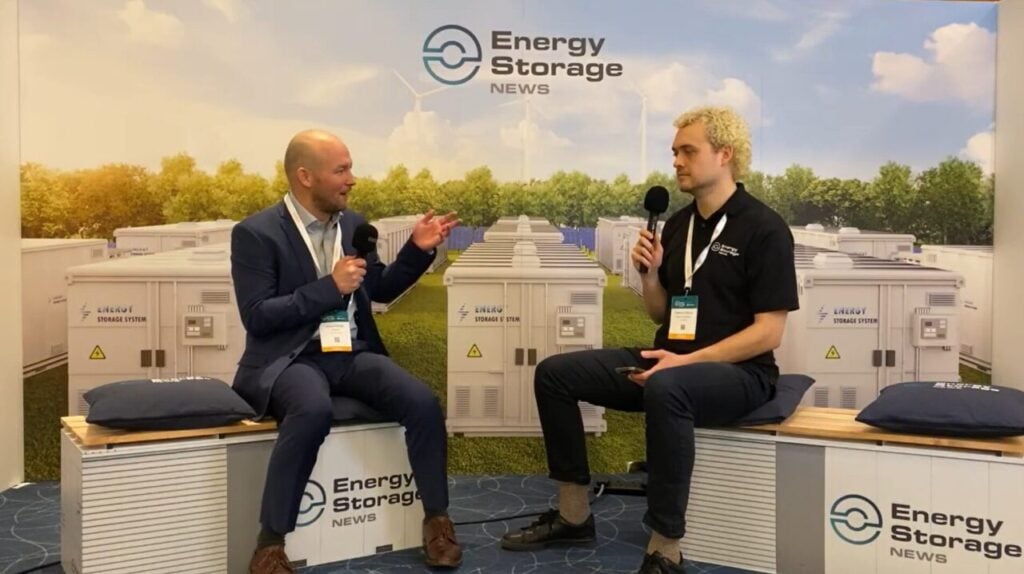
Joshua Murphy, head of energy storage for IPP Econergy, sat down with Energy-Storage.news for a video interview to discuss various business and financial topics at the Energy Storage Summit 2026 in London last month.
The firm’s first operational battery energy storage system (BESS) is the 50MW/102MWh Swangate project in the UK, but it is building or late-stage developing projects in Germany, Poland and Romania with around 500MWh set to come online this year. It acquired two projects in Germany last year, the first of which will come online next year.
“In Romania, we have a pretty significant operating pipeline of solar PV and we’re going through a hybridisation strategy to add battery storage to all of those,” Murphy says (the full video recording and write-up is further down, available to ESN Premium users).
“In Poland, we have a mix of standalone solar, standalone battery projects, some with capacity market (CM) contracts, and we’re running a similar hybridisation strategy for our operational solar projects there too.”
Try Premium for just $1
- Full premium access for the first month at only $1
- Converts to an annual rate after 30 days unless cancelled
- Cancel anytime during the trial period
Premium Benefits
- Expert industry analysis and interviews
- Digital access to PV Tech Power journal
- Exclusive event discounts
Or get the full Premium subscription right away
Or continue reading this article for free
Financing and tolls: your project needs to stand out
With BESS technology now very mature and well understood, the primary challenge discussed by owner-operators is often around how you commercialise and finance projects and the mix between merchant and contracted revenue structures. We ask Murphy how this looks different in Econergy’s different markets.
“So the UK is super liquid, extremely mature, lots and lots of banks that are willing to finance in all scenarios, whether you have a merchant offtake, a floor or a toll,” he says.
“We’ve just recently closed financing for Dalmarnock, one of our Scottish assets and we took the route of a floor with EDF and we financed that project with Santander. But we have the flexibility in the UK to choose different banks and choose our offtake structure similar to Germany. It’s super liquid.”
“We can go and get a super high floor or a really good toll for between 7-10 years for a high value in Germany, whether we want to go 50% or 100% toll, we have that flexibility there.”
“Then you’re taking a really highly contracted asset to a bank and they really enjoy that and they really like to finance that, taking UK and Germany as examples as the more liquid markets in terms of tolls.”
However, many say that there is a supply-demand imbalance in the BESS toll space, with many more project owners seeking tolls than there are counterparties able to provide them at a good price.
We put this to Murphy who agrees that those counterparties are currently able to ‘pick and choose’ the best projects, so your project needs to stand out.
“The toll provider has a choice of which projects to take on because as you can imagine, there are lots of battery owners and operators and big investors, they want contracted revenues,” Murphy says.
“We’re currently closing a toll in Germany for our a large 100MW project and part of the attractiveness of that project to the toll providers, which is why they were so interested in the project, was its early commercial operation date (COD). So being connected Q1 next year is pretty attractive for these kind of guys.”
Germany: ‘government won’t jeopardise billions of investment’
Lots of companies are actively or seeking to invest in BESS in Germany, but there are three major regulatory hurdles facing developers and operators there.
First, the BKZ fee presents an upfront capital challenge, with costs ranging in the thousands, tens or hundreds of thousands of euros per megawatt before any construction begins—substantially higher than comparable UK projects. This creates an immediate financial barrier to entry, though in general operators say they can bake this in to their models relatively easily.
Grid connection conditions on the other hand are increasingly problematic, however. Grid operators frequently impose ‘grid-neutral’ connections via flexible connection agreements (FCAs) that limit operational capabilities.
Sometimes these restrictions often aren’t defined early in development and there are over 500 distribution network operators (DNOs) in Germany, each applying slightly different approaches. The real impact here depends on the specific restrictions, Murphy explains.
A one-hour ramp rate – how quickly a BESS is allowed to go from zero to full power output – would kill a project’s economics entirely, for example.
But the big one in Germany is the potential reversal of charge-discharge grid fee exemptions for BESS which expire in August 2029. That has created significant investment uncertainty, with billions of euros in capital currently on hold, something discussed with other delegates at the Summit event in London.
However, Murphy remains optimistic that the German government won’t implement changes so drastic as to jeopardise the billions of investments set to go into its infrastructure.
BESS procurement
The conversation then moved on to how the company’s procurement of BESS has changed and what recent events means for BESS pricing in the short-term.
Particularly of note is the question of going down the EPC ‘wrap’ route, where one parties provides a full BESS, EPC and civil works solution, or whether you procure those individually. The latter is more cost-effective but much more complicated, a ‘pain in the arse’ as one operator put it recently.
Econergy: “We’ve now closed more than 10 battery supply contracts, maybe more actually, with multiple vendors. So we have a very, very deep understanding of the the different types of contracting that we need to do with different counterparties. We have full knowledge of the risks that are involved with either going down the single contract or two contract approach,” Murphy says.
“And we make sure that once we’ve moved from the contracting phase, because it’s great to have the contract in place, but to then delivering the project once you’ve contracted is also very important. The delivery teams understanding the contract structures is also very important,” Murphy says.
…and pricing
The price of lithium carbonate recently spiked leading some to talk about a short-term increase in prices ater years of sustained falls.
Murphy notes that short-term lithium carbonate price spikes don’t immediately impact BESS pricing, however, particularly for buyers ordering significant equipment quantities with strong supplier relationships.
An impact on BESS pricing would only come are a sustained high spot for lithium prices, say six months, he adds. Metal price fluctuations are also relevant drivers beyond lithium carbonate alone.
The most immediate pricing concern is China’s VAT rebate removal, something echoed by other interviewees at the event. Murphy says the actual impact will depend on whether manufacturers absorb costs or pass them through to customers, as well as the dynamics in China’s domestic market, the largest in the world.