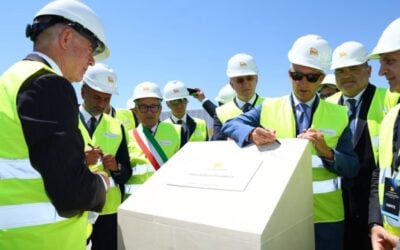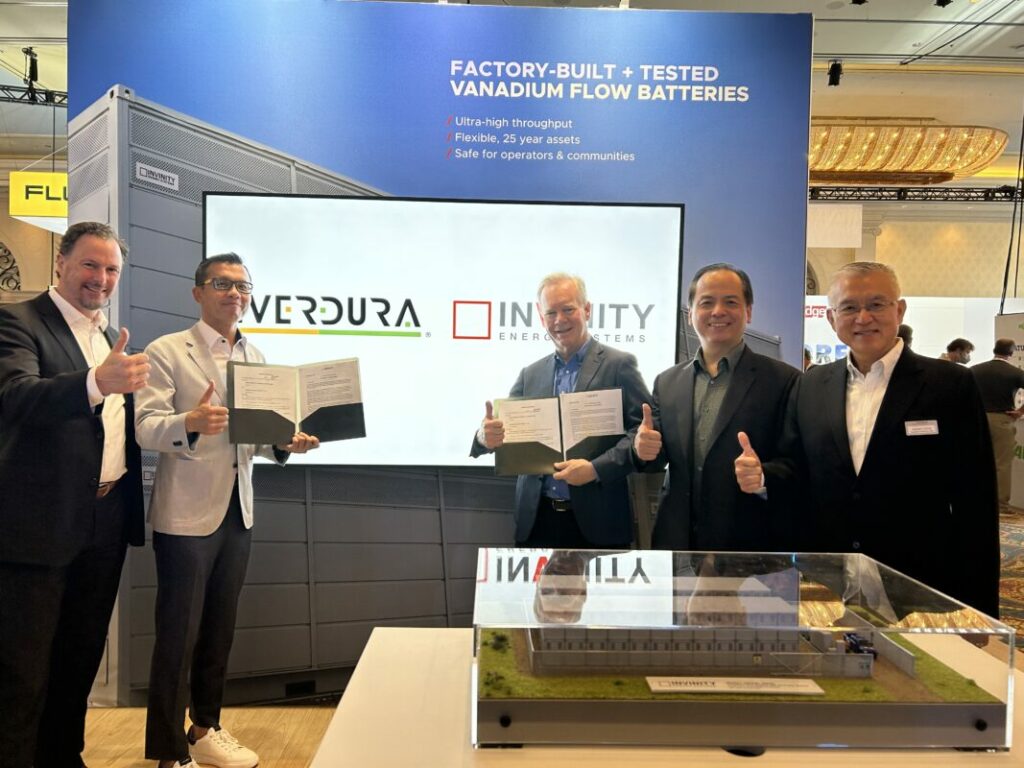
Flow battery maker Invinity Energy Systems signed a deal for the newest iteration of its product with customer Everdura at RE+ in Las Vegas last week.
Invinity said on Thursday (14 September) that Everdura Technology Company, a Taiwan-based industrial technology group, has adjusted the terms of a previously agreed supply deal.
While the two strategic partners had made an agreement in late 2022 for an initial 15MWh order, the newly inked revised terms mean that Everdura is now the first customer to order Mistral, the latest generation of Invinity’s vanadium redox flow battery (VRFB) solution.
It was and remains the single biggest customer order the Anglo-American flow battery company has received to date. When first signed in December 2022, Invinity claimed there is also a potential for 225MWh of follow-on deals over three years, with Everdura acting as Invinity’s reseller in Taiwan.
Try Premium for just $1
- Full premium access for the first month at only $1
- Converts to an annual rate after 30 days unless cancelled
- Cancel anytime during the trial period
Premium Benefits
- Expert industry analysis and interviews
- Digital access to PV Tech Power journal
- Exclusive event discounts
Or get the full Premium subscription right away
Or continue reading this article for free
Initially Everdura will deploy a single 14.4MWh Mistral array, which Invinity is expected to ship to a site in Central Taiwan in late 2024. The industrial tech group will install the system and use it to deliver the Enhanced Dynamic Regulation Reserve (E-dReg) ancillary service to the Taiwanese grid.
Taiwan has become one of Asia’s relatively early adopters of battery storage for ancillary services in the last couple of years. Flow batteries are not commonly being used for ancillary services such as frequency response, but Invinity’s participation in a lithium-vanadium hybrid project in Oxford, UK, delivering frequency regulation to the grid while highlights a real-world example that it can be done.
London Stock Exchange-listed technology company Invinity was among flow battery specialists showcasing their products, projects and capabilities at the RE+ show, which is the biggest annual clean energy trade event in the US.
As reported by Energy-Storage.news last week, Invinity, iron flow battery player ESS Inc, and zinc bromine electrolyte flow battery maker Redflow emphasised the claimed technical benefits and advantages of flow batteries (Premium access).
Among these were the durability of the systems for long life usage even for deep and often frequent cycling regimes, as well as their ability to scale up to large capacities and durations of storage and the opportunity they offer to decouple from lithium battery supply chains.
One other aspect is safety. One source close to the company told Energy-Storage.news that customers at RE+ from Taiwan and South Korea in particular were showing interest in flow batteries as an alternative to lithium-ion.
This is due to the fact that flow batteries do not go into thermal runaway as lithium devices can and the source claimed that the customers they had heard from viewed the technology as a viable alternative for that reason. A comment on the latest deal from Everdura chairman Darren Yen appeared to corroborate that view.
“The need for large-scale, non-lithium energy storage in Taiwan and the broader Asian region has never been clearer,” Yen said.
In a presentation at the show, Invinity’s North America sales head Jan Petrenko said that during testing for safety, attempts to set on fire the company’s VRFB – part of the standard testing for energy storage systems – had been unsuccessful.
Everdura, Invinity to explore Taiwan manufacturing potential
The deal signed at RE+ triggers a scheduled payment to the flow battery maker which will enable it to begin ordering long lead time components and start manufacturing battery modules for the Everdura project. Invinity added in a stock exchange release that it expects to realise higher gross margins for its improved Mistral product compared to previous iterations.
Everdura’s parent company, Everbrite Technology Co, became a strategic investor in Invinity in March this year with a £2.5 million (US$3.05 million) participation in the manufacturer’s placing and open offer of shares which raised a total of around £23 million.
Meanwhile, in addition to the revised terms of the project supply agreement, Everdura and Invinity also signed a memorandum of understanding (MoU) to jointly explore possibilities to manufacture flow batteries in Taiwan. Both parties expect this to become a “definitive, binding commitment,” Invinity announced to the stock market.
“Our confidence in Invinity’s products to meet the requirements of this growing market is demonstrated by our intention to develop a manufacturing partnership with them. We are looking forward to great success with Mistral and a growing and prosperous relationship with Invinity,” Everdura chairman Darren Yen said.