
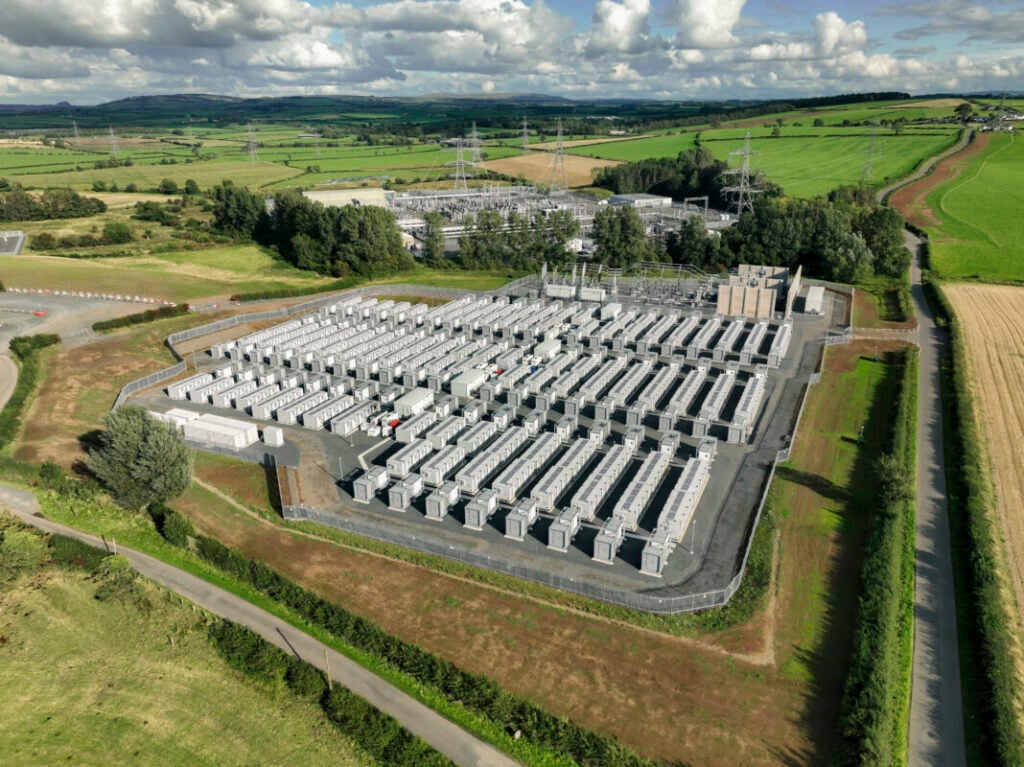
Energy-Storage.news speaks to Laurence Copson, energy storage specialist (US markets & policy), at BESS and EV solutions firm Zenobē Energy, ahead of the upcoming Energy Storage Summit USA.
Earlier this year, the Trump administration, together with a bipartisan group of governors, US Secretary of Energy Chris Wright, and Secretary of the Interior Doug Burgum, called on PJM to “temporarily overhaul its market rules to strengthen grid reliability and reduce electricity costs for American families and businesses by building more than US$15 billion of reliable baseload power generation.”
This move underscored the evolving landscape of the renewables and energy storage sector. PJM, the nation’s largest Regional Transmission Organisation (RTO), covers parts of 13 US states and the District of Columbia, including Washington, DC. It is also the location of Virginia’s “Data Centre Alley”, the world’s biggest cluster of data centres, which has generated significant demand for power.
Data centre development is widely agreed to be the biggest driver of rising electricity demand in PJM; however, views on how to address the impacts on energy supply and electricity costs diverge, and raise questions about how market landscapes will continue to evolve.
Try Premium for just $1
- Full premium access for the first month at only $1
- Converts to an annual rate after 30 days unless cancelled
- Cancel anytime during the trial period
Premium Benefits
- Expert industry analysis and interviews
- Digital access to PV Tech Power journal
- Exclusive event discounts
Or get the full Premium subscription right away
Or continue reading this article for free
Copson speaks on energy storage policy and market dynamics in the US, focusing on behind-the-meter (BTM) versus front-of-the-meter (FTM) battery deployment strategies, interconnection bottlenecks, and the role of data centres in driving storage demand. He explores PJM’s capacity market challenges, policy reforms like the reliability backstop procurement, and how political pressures are shifting cost allocation toward data centres while potentially undermining traditional market mechanisms.
Energy-Storage.news: How are demand forecasts changing the calculation between BTM and FTM deployment strategies for developers and investors?
Laurence Copson: Taking the demand forecasts on their own, these are obviously huge, and there’s some uncertainty over quite what level we’re talking about in terms of how many more gigawatts of power will be needed by 2030, 2035. It gets more uncertain the further you go out. But it’s definitely a case of a rising tide for both BTM and FTM.
Historically, FTM has been the game in town. BTM has seen some interesting businesses pop up doing very crucial stuff in cities and places where it’s harder to get big FTM grid-scale projects, but 90-plus percent of all the megawatts that have been developed have been FTM.
I think it’s the data centre wave now that’s coming, and the need for these data centres to get onto the electric system—there’s a whole combination of tools, and they’re seeing behind-the-meter storage as one way to accelerate that grid connection. But then, is it truly behind-the-meter if they’re building almost co-located batteries? From what I’ve heard from these data centre players and their plans, when they talk about these things publicly, the batteries are often being electrically interconnected, not so that they’re purely hiding behind the meter, but they’re almost in a hybrid configuration.
These hyperscalers have different strategies going on. Google seems to be going most clearly down the green route, and they’ve been making noises about how they’re going to build some of these huge battery systems. What might be used as a bridge to getting interconnection for a data centre for the first few years can then flip into just an FTM battery, doing all the things that you’d expect an FTM battery to do in a few years’ time.
So this is an opportunity for BTM or hybrid BTM batteries like no other that we’ve seen recently in terms of pure scale. However, this is not purely a BTM play. There is large market opportunity for FTM batteries to bilaterally contract with data centers and Utilities, for example through Storage PPAs. In addition, PJM is currently devizing a backstop reliability procurement to meet forecasted capacity shortfalls, which is a significant route to market opportunity for FTM storage in this region.
What do you think is the biggest bottleneck for grid-scale storage development right now, and why does that exist?
Interconnection everywhere remains the big bottleneck, but not just for batteries—it’s anything new that wants to connect to the electricity grid. In certain spots in America, permitting is still just as big an issue as interconnection. Certain states, certain areas, are really hard to develop in. You see perfectly good projects that have gone through long, complicated interconnection processes come out the other end with fantastic grid connection agreements ready to sign, and then they just go, “There’s no way we can get permitting here.”
Often, it’s crucial spots on the grid where you just know there’s going to be a battery there at some point over the next 20 years, but that town is holding out because of concerns over fire safety or general reluctance. I know the Northeast and Mid-Atlantic better, and in some of those states, there’s home rule for town planning. Others have introduced legislation, like in Maryland, where permitting will ultimately be decided at the state level. They’ve passed the Renewable Energy Certainty Act , and they’re still giving the town the power to have its say, but they won’t have ultimate veto power.
Often I hear battery developers talk about it as if it’s almost a battery problem, but it’s not. It’s just the sheer level of the amount of things that want to be electric infrastructure, whether it’s data centres, batteries, new gas generation, all coming into a bottleneck of study timelines, interconnection processes that were moved from serial to cluster, and they’re often doing those cluster studies for the first time now.
I speak to procurement people behind the scenes on those interconnection timelines and there are obviously hard constraints around long-lead items like breakers, transformers etc.- So it’s not just process, there’s hard material constraints as part of that.
The thing that definitely isn’t a constraint is capital. In some markets, like ERCOT, lenders are reluctant to lend much more, because of merchant exposure. But lenders are queuing up to invest in projects with high levels of contracted revenue. Revenue is increasingly not a bottleneck, as projects see stronger tolls, higher PPA prices, and capacity markets that are sending strong signals, and states willing to procure storage.
So the revenue is increasingly there, and capital is waiting to go. We would be building tens of gigawatts more batteries a year with the market potential that there is if there weren’t such a bottleneck on interconnection and planning.
Which US markets are of most interest, and which states have more policy drivers versus those that maybe have more blockers?
If you take the eastern half of America, or the Mid-Atlantic and Northeast more specifically, most of the policy that’s happening is favourable to new storage, particularly in Democrat-controlled states where they’re passing storage programmes and mandates of some kind. They’re thinking, “Okay, how do we get this stuff built? What kind of contracts do we need to provide here that can help storage get built with revenue certainty that isn’t going to cost the state too much?”
In PJM at the state level now, particularly in the eastern states, a lot of it’s being driven by states realising they have a capacity crunch that’s sometimes even more severe than the PJM-wide capacity crunch. In the past, Maryland had higher capacity prices than the RTO-wide PJM price, so there’s a big incentive for the politicians to try and insulate their ratepayers from those capacity shortfalls in the future. And one of the levers they can pull is, “Okay, let’s build a few gigawatts of battery storage quickly,” because it’s the quickest way to increase capacity.
What specific reforms do you think would have the most immediate impact on accelerating storage deployment over the next year?
The PJM response to the capacity shortfall that’s been going on for about a year now, but it’s really accelerated since the White House and all 13 governors signed this bipartisan letter to urge PJM to basically provide contracts with 15-year price certainty for new generation. The suite of processes currently underway is called the Critical Issue Fast Path (CIFP) on Large Load Additions. Really, the interesting one is the reliability backstop procurement.
This has been live as a process for about a month now. They’re trying to figure out, as they project forward the capacity shortfall, which is about 30GW by 2030, rising to about 55GW by 2035, how to provide contracts and run technology-neutral, cost-competitive procurements with locational signals and all of the right cost allocation that will be politically accepted. It’s a massive challenge for PJM to try and propose something here that everyone can accept to plug this capacity shortfall.
If storage can be in there—maybe it’s 4, 6, 8 hours where the capacity accreditation is stronger over the next 15 years—it will compete alongside new natural gas to be built. We all know that the new natural gas delivery timelines are pretty long now. So if they want to be getting capacity online for 2030, 2031, they’re going to need to have storage as one of the crucial technologies in this mix.
That single thing feels like the largest opportunity for storage to play in. If you’re developing a storage project that’s in a good position to then participate in one of these procurement rounds when they launch it, and assuming they stay on their accelerated path, I think this falls in the next 12 months.
Looking at this year and next, is there a trend you’re seeing in energy storage policy or the US markets that you think is maybe being overlooked?
It feels like we’re now going into this 5, 10, maybe 15-year load growth period, assuming no AI bubble bursts and that there’s a modest amount of electrification in the economy and households. It is crucial in this period of load growth that we have policy that works for all parties – for the right type of new generation to be built, the right investments to be made, and for ratepayers so they don’t see their bills go up by 10% every year. And trust me, when you have ratepayer bills go up for more than five years, like in the UK where I’m from, things really start to fray politically.
Obviously, this is not being ignored as a topic. But I do think that not enough attention has been given to the fact that the solutions, in a market such as PJM, is pointing to a combination of subsidies and emergency procurements for new capacity. I’m not saying “subsidise” in an inefficient way—I think a lot of this is the correct direction to go down.
But we’ve built a market that’s been in place since it was liberalised in the ’90s and 00s, and now we’re somewhat abandoning market principles during this first major test of whether the market works. What you could end up with, in 10, 15 years’ time, is a large amount of subsidised/contracted projects that aren’t participating normally in the capacity market because they’re on contracts which say, “No, you’re bidding in zero to the capacity market.”
I make a parallel with the UK, where they’ve contracted most new generation on Contracts for Difference (CfDs – the UK’s low-carbon generation support scheme) such that soon, most generation participating day-to-day in the wholesale market will be zero marginal cost, price takers. These types of interventions fundamentally change how markets operate and the investment signals that are produced.
And all that means is that, if you do these big interventions, on the other side of it will be the outcomes of more command-and-control, centrally planned decisions, as opposed to a market that’s being determined more by bilateral contracts.
The danger of this, in a market like PJM, is that if we don’t let the capacity market properly function, because of politically imposed price caps and subsidies from state/PJM procurements, then it undermines market expectations and forecasts of future capacity prices. Fundamentally, because of the major capacity shortfall, the desired outcome of these policy interventions in PJM will be to suppress future capacity market prices. For PJM, they have the hard task of striking the balance between crisis-fighting and preserving the market’s integrity and investment signals.
Copson will be a speaker at the event’s Policy Pathways for Meeting Load Growth discussion, along with Huiyi Jackson of Edison Electric Institute, Marshall Coover of Texas Energy Buyers Alliance, Aaron Klien of Lincoln International, and Matthew Bos of Advanced Energy United. The discussion will be moderated by Daniel Spitzer, partner at Hodgson Russ LLP.
The Energy Storage Summit USA 2026 will be held from 24-25 March 2026, in Dallas, TX. It features keynote speeches and panel discussions on topics like FEOC challenges, power demand forecasting, and managing the BESS supply chain. ESN Premium subscribers can get an exclusive discount on ticket prices. For complete information, visit the Energy Storage Summit USA website.
This article has been updated since it was originally published to add additional context around Copson’s answers.