
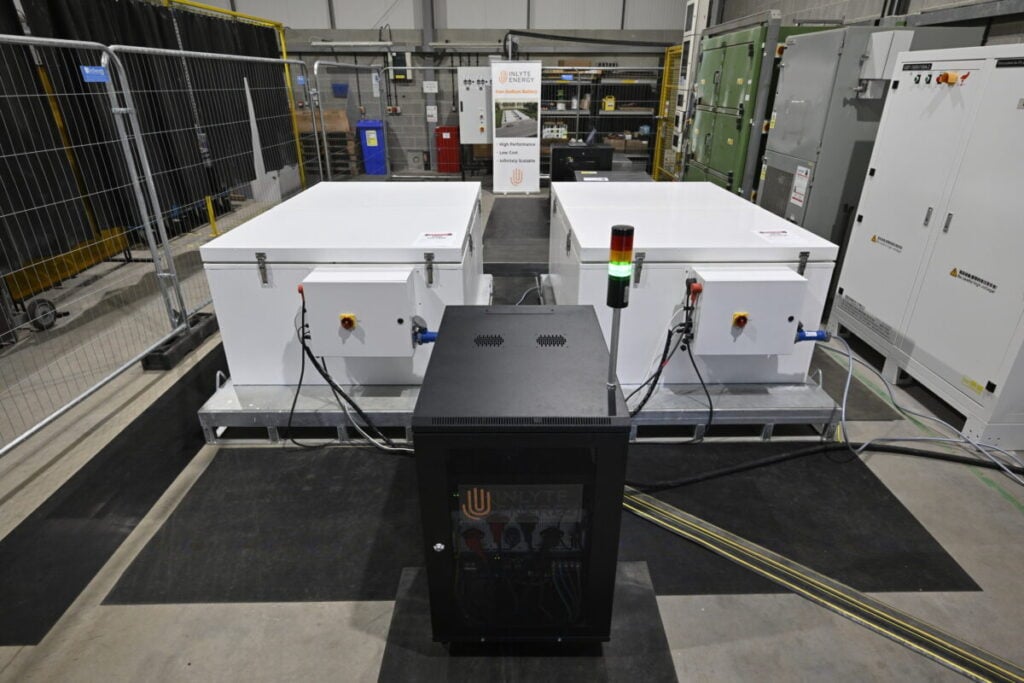
US-based iron-sodium battery manufacturer Inlyte Energy has successfully completed a factory acceptance test of its first field-ready battery at its facility near Derby, UK, witnessed by representatives from US utility Southern Company.
The tested modules have a storage capacity over 300kWh each, which Inlyte states are the largest sodium metal chloride (SMC) battery cells constructed to date.
Notably, Inlyte’s system uses SMC battery technology, also known as ZEBRA batteries, which have been in use for over 40 years.
Responding to Energy-Storage.news’s request for comment, CEO Antonio Baclig said, “Inlyte Energy’s technology is an iron-sodium battery, which falls under the category of SMC batteries, also known as ZEBRA batteries, which have a 40+ year history. This technology utilises the conversion chemistry of iron and sodium chloride, with solid beta-alumina as the electrolyte and molten NaAlCl4 as a catholyte.”
Try Premium for just $1
- Full premium access for the first month at only $1
- Converts to an annual rate after 30 days unless cancelled
- Cancel anytime during the trial period
Premium Benefits
- Expert industry analysis and interviews
- Digital access to PV Tech Power journal
- Exclusive event discounts
Or get the full Premium subscription right away
Or continue reading this article for free
Baclig continued, “Inlyte Energy has reinvented the SMC battery for low-cost grid storage, with a breakthrough in the use of cathodes made from abundant iron powder.” The batteries operate without flammable organic components and can function in extreme temperature conditions.
“The SMC class of batteries has excellent safety as it eliminates flammable organic components to mitigate fire and explosion risks. The system is also highly durable, capable of operating in extremely hot or cold climates,” Baclig noted.
Initial testing projects a battery life of at least 7,000 cycles (approximately 20 years) with over 80% round-trip efficiency at the system level.
Southern Company will install Inlyte’s first energy storage systems (ESS) at its Energy Storage Test Site in Wilsonville, Alabama early this year. When asked about the project size, Baclig confirmed: “The 80kW/1.5MWh demonstration project outside Birmingham, Alabama, will provide key performance data under real-world operating conditions—exactly what utilities need before committing to large-scale procurement.”
“Energy storage is essential for creating a reliable and flexible energy grid,” said Steve Baxley, Southern Company energy storage and use research and development manager. “As the grid evolves toward longer-duration storage, developing solutions that are both low-cost and safe is critical to ensuring affordable, dependable service for customers.”
In June 2025, the US Department of Energy’s (DOE’s) Office of Electricity (OE) announced funding of up to US$15 million for three storage technologies. As part of this funding, Inlyte received US$4.1 million for its ‘Iron and Sodium Long Duration Battery for Multi-day Resilience and Renewable Shifting in High Wildfire Risk Zone’ project.
This project sees Inlyte, with its partners, developing and demonstrating an iron and sodium long-duration energy storage (LDES) system to improve energy resiliency at the Alliance Redwoods site in Occidental, California.
Regarding the California project, Baclig stated: “The project is in the detailed planning phase right now with the start of construction expected in approximately one year.”
When asked about manufacturing capabilities, Baclig explained: “Inlyte Energy currently manufactures battery modules starting from raw materials at its pilot manufacturing line near Derby, UK. The production capacity at this line is currently 10MWh annualy. Inlyte plans to increase capacity in the UK in 2026 and build a US commercial manufacturing facility of 2GWh annual capacity for production in 2027. We are looking at sites for this US facility with final site selection early 2026.”
Regarding scaling plans, Baclig noted: “As a battery technology that uses abundant materials, Inlyte’s batteries have a ‘domestic anywhere’ supply chain that support further scale-up in the US, with no need for materials from FEOC countries, and in other regions of the world.”
The company has partnered with HORIEN Salt Battery Solutions, which claims over 25 years of experience in SMC battery production and has deployed more than 1GWh of storage systems.
The DOE forecasts that the US grid will require more than 225GW of LDES by 2050. Global energy storage market projections from BloombergNEF show growth from US$70 billion in 2025 to over US$150 billion by 2030.
“To win the future we need abundant and secure supplies of energy in the US, and at the same time we need to make costs go down, not up,” said Baclig. “We can’t do that by building the same thing as China. We need to make better technologies, with batteries that are fundamentally lower cost, safer, and longer lasting. By leveraging a breakthrough in the use of iron in the proven SMC battery, Inlyte can scale rapidly.”