
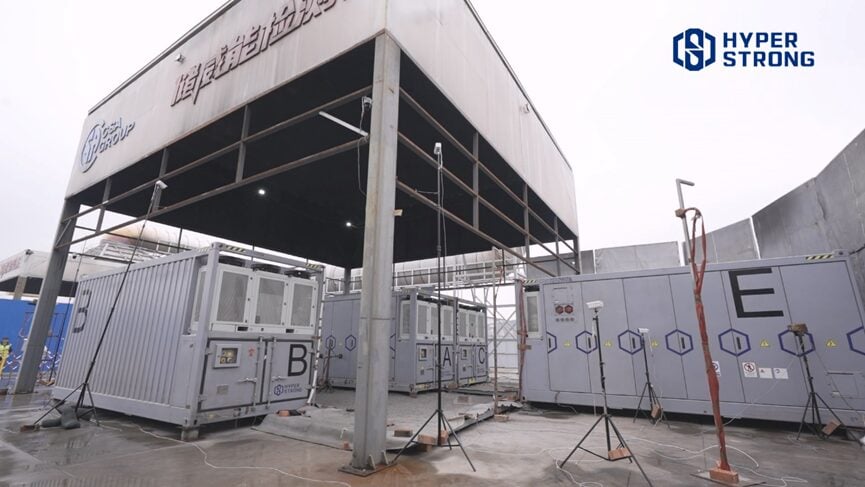
HyperStrong’s flagship energy storage product, the HyperBlock III energy storage system, has successfully passed large-scale fire testing, witnessed throughout by the CSA Group and a North America-registered Fire Protection Engineer (FPE).
In addition to inviting overseas clients to observe the onsite testing, the company also hosted an industry-first global live broadcast, with more than 40 clients attending virtually from around the world.
The test simulated a real-world field configuration by deploying five HyperBlock III units in a “back-to-back and side-by-side” arrangement to accurately replicate heat transfer and temperature distribution between containers under real-world fire scenarios. All units were tested at 100% State of Charge (SOC) with no intervention from the fire suppression system. The test strictly adhered to the CSA/ANSI C800:2025 and UL9540A (latest draft version) installation-level requirements.
After 16 hours of intense combustion, the enclosure’s structural integrity remained intact. The enclosure doors feature a self-developed reinforced connection and locking mechanism, ensuring high structural strength and reliable closure under extreme conditions. This design effectively withstands the impact of high-temperature combustion and thermal expansion within the enclosure, maintaining stable closure throughout the entire test.
During the test, the fire intensity peaked 3 hours after ignition, with the internal temperature reaching 1,400°C. However, there were no signs of burning on the liquid-cooling units or electrical control cabinets on the side of the burned unit, and the temperature fluctuations within the four neighbouring energy storage units remained stable. The peak cell temperature in the back-to-back unit was just 56°C, while the peak cell temperatures in the other neighbouring units all remained below 35°C. In addition, there were no thermal runaway or fire spread incidents during the test.
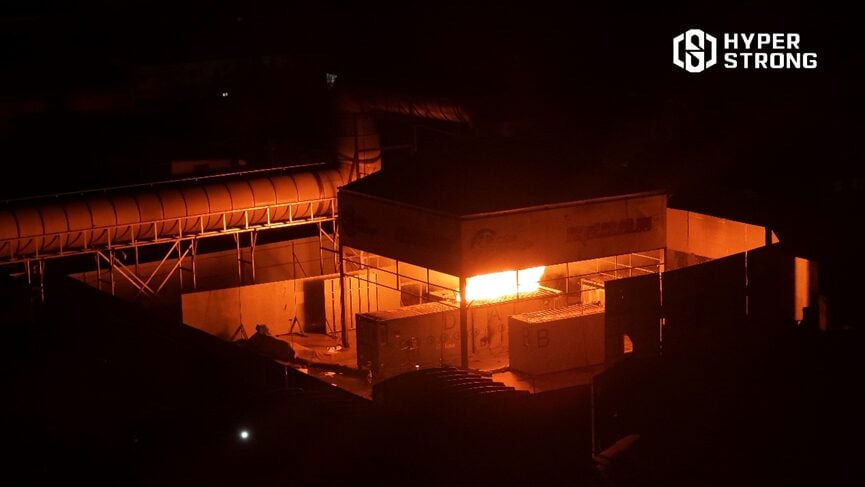
The HyperStrong AI Platform demonstrated its indispensable value during the test—the battery management system (BMS) in the four neighbouring containers operated stably throughout the combustion and uninterrupted data communication links were maintained, with temperature and voltage data synchronously uploaded from thousands of cells to the AI platform at millisecond intervals. The platform can automatically identify abnormal temperature trends and issue warnings.
The results demonstrated that the HyperStrong AI Platform not only enables data-driven emergency decision-making through early alerts, but also preserves comprehensive logs for post-event analysis, supporting continuous system improvement in real-world operations.
CTO Dr. Qian Hao commented: “Safety is the lifeline of the energy storage industry and the foremost principle in HyperStrong’s product development. Before this test, we have conducted precise simulation calculations and combustion behaviour validation at the cell, module, cluster and full-system levels, systematically verifying the thermal resistance and isolation design across the entire architecture.”