
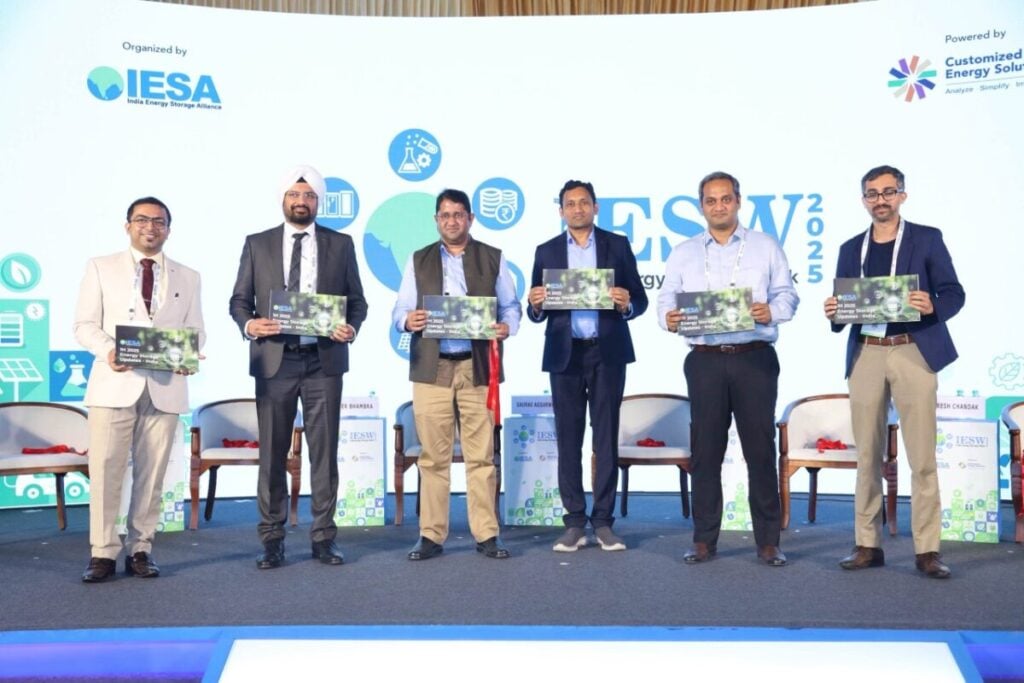
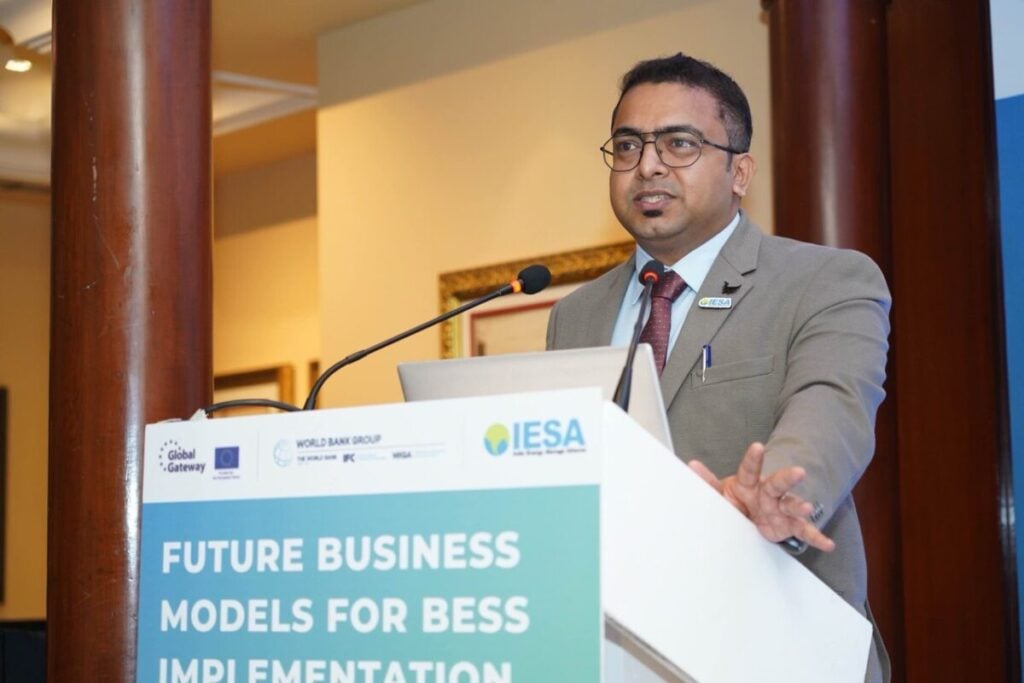
India Energy Storage Alliance president Debmalya Sen talks us through the highlights and challenges of the past year, as India gets to grips with market development and acceleration.
“It was the best of times; it was the worst of times…
the age of wisdom, the age of foolishness,
the epoch of belief, the epoch of incredulity,
the season of Light, the season of Darkness,
the spring of hope, the winter of despair”
-Charles Dickens, ‘A Tale of Two Cities’
India’s energy storage system (ESS) market grew from 122GWh to 224GWh cumulative, a 1.8X times increase year-over-year (YoY), with a total of 60GWh projects under execution, 80GWh under various stages of tendering and 35GWh under the awarded stage.
Try Premium for just $1
- Full premium access for the first month at only $1
- Converts to an annual rate after 30 days unless cancelled
- Cancel anytime during the trial period
Premium Benefits
- Expert industry analysis and interviews
- Digital access to PV Tech Power journal
- Exclusive event discounts
Or get the full Premium subscription right away
Or continue reading this article for free
The total pipeline of battery energy storage system (BESS) projects stands at 92GWh, increasing by 74GWh (from just 19GWh in 2024), while the pumped storage projects (PSP, or pumped hydro energy storage – PHES) pipeline stands at 132GWh, up from just 50GWh that participated in competitive bidding in 2024. Projects commissioned stands at 0.8GWh, with 2026 promising to be a big year with regard to commissioning. India is projected to have 5 GWh of projects coming online in 2026!
A total of 69 tenders, accounting to a total capacity of 102GWh, were issued during the year, a 35% jump from 2024 and almost double the count of tenders issued in 2024 and almost equal to the cumulative of all tenders issued from 2018 to 2024 in terms of capacity. Commissioning capacity during the year stood at 0.5GWh in 2025.
Kudos to all the actors who worked, discussed, deliberated, researched, negotiated, visited sites, factories, consulted, constructed and decided to build this ESS story for India. To put the story in a single paragraph would be a crime; hence, I decided to write about everything that happened throughout the year, from January to December 2025.
When policy and regulations took centre stage
The year’s first policy-level enabler came via the cabinet-approved National Critical Minerals Mission. In the Union Budget, 35 additional capital goods for battery manufacturing were included in the customs-exempted list. Tax on all battery chemistries was streamlined to 18%.
In March, Grid India shared its Short Term Resource Adequacy Plan 2025-26, projecting a requirement for 4GW/17GWh BESS and 3GW/16GWh PSP by 2025-26. National Committee on Transmission (NCT), for the first time, conducted a study to consider BESS as an alternative to HVDC transmission line investment for Rajasthan.
The Ministry of Power (MoP) ushered out many enablers throughout the year to promote BESS deployment. First, after the success of the first 13.2GWh tranche of Viability Gap Funding (VGF) Capex support, the MoP shared a second tranche of VGF to support 30GWh of standalone BESS for a total amount of INR5400 Cr (US$593.5 million) (INR16 lacs/MWh per project) of which 25GWh capacity is allotted to states and 5GWh to the power producer NTPC.
The ministry made further amendments to the guideline later, to include the software application of energy management systems (EMS) to be domesticated, allowing 4-hour 1-cycle (6,300 cycles contract period) as part of VGF and further in December through another amendment, to have 20% domestic content value addition in BESS availing of VGF support.
MoP also extended the Inter-State Transmission System (ISTS) charge waiver for PSP and solar with BESS to 2028, while standalone BESS ISTS charges will be effective from June 2026 and under the shared electricity amendment rules issued in 2025, defined an asset class for ESS and its usage. Draft amendments proposal includes ESS to be utilised either as independent energy stage systems or as part of generation, transmission, distribution, or owned, based or operated by any of the above.
The government ministry also shared PSP tariff-based competitive bidding guidelines and amended the guidelines for Firm and Dispatchable Renewable Energy (FDRE). A plan is also in the works to utilise BESS for thermal power plants.
The Central Electricity Authority (CEA) followed suit, inviting comments on the prioritisation of identifying critical imported items and the support required for their indigenous development.
CEA shared draft safety regulations for BESS, proposed construction standards for renewable energy (RE) plants, including ESS, started stakeholder discussions of minimal domestic value addition in BESS and its preparedness and finally an advisory (personally, I wish this was a mandate!) on incorporating a minimum 2-hour storage equivalent to 10% of installed solar project capacity in all future solar tenders.
States also brought about policy and regulatory support for BESS development. Assam Energy Regulatory Commission released guidelines for the procurement and dispatch of BESS. Rajasthan mandated BESS for Captive projects exceeding 100% contract demand and also issued a draft regulation for BESS deployment.
Bihar’s Policy for Promotion of Bihar New and Renewable Energy Sources 2025 proposed ESS Target of 6.1GWh by 2030 (4.5GWh BESS and 1.6GWh PSP), Odisha and MP shared pumped hydro policy. Andhra Pradesh shared draft BESS regulations and planning, procurement, and deployment regulations. Rajasthan mandates 5% ESS (at least 2-hour storage) for renewable energy projects above 5MW and shared BESS Guidelines for the state. Uttarakhand included BESS in RE Tariff Regulations
Projects commissioned, awarded and tariffs approved
However, the year had started on a discouraging note with the commission’s rejection of Solar Energy Corporation of India’s (SECI’s) ESS 1 tariff adoption petition and an underwhelming response to SECI’s peak power-specific FDRE tender (only 0.2GW was awarded out of 2GW capacity).
What followed was impressive, though, with 11 projects totalling 5.5GWh BESS and 4.3GW FDRE capacity receiving tariff approvals.
The needle of commissioned projects started to move too, five projects (two standalone, one solar-plus-BESS and two Round-the-Clock renewable energy) got commissioned in 2025, a total of 547MWh of project commissioning, bringing up the cumulative installed number to 758.4MWh as of the end of 2025.
Amidst all this news, Adani announced a strategic entry into BESS with one of the world’s largest single-location BESS projects – 1126MW/ 3,530MWh site planned for commissioning by March 2026 and NTPC awarded a state-of-the-art long-duration energy storage (LDES) project to Triveni turbines with Energy Dome’s innovative CO2 battery technology at NTPC Kudgi.
The year ended on another high, with Juniper installing India’s first 60MWh merchant BESS project.
Ever-falling tariffs in competitive solicitations
Every new tender auction in the year saw new organisations entering the BESS landscape in India. A total of 50 first-time bidders emerged as winners in the auctions held in 2025, with each tariff lower than the previous one.
After each auction, the questions were asked along the lines of: “How is this possible? What battery costs are they considering at this tariff level?”
Let’s take a closer look at tariffs:
Solar + 2-hour BESS saw tariff discovery of INR3.09/kWh (as tendered by NHPC). There was just one tariff discovery in this category; since then, all have transferred to 4-hour energy storage tenders.
Solar + 4-hour BESS saw tariff discovery of INR 3.32/kWh (SJVN), which dropped to INR3.13 (NHPC). RUMSL awarded 600MW Solar with 220MW/880MWh BESS at INR 2.70-2.76/kWh (2 cycles, one cycle charging by the electric distribution company, or DISCOM).
Standalone BESS of 2-hour duration saw tariff discovery of INR2.21 lacs/MW/month (RVUNL), which increased to INR2.45 lacs/MW/month in Telangana and 2.49 (KPTCL) (both projects remain at the awarded stage as of the time of writing), INR2.46 (TNGECL), INR2.54 (KPTCL), NVVN (Rajasthan) found the tariff coming down to INR2.16, which further reduced to INR2.08 (NHPC – AP).
This was the result of the tenders under VGF 1, under VGF 2 with lower support the tariff which was talked about most was RVUNL’s 2GWh tender, which saw 11 winners at INR1.77 lacs/MW/month and MSEDCL’s 2GWh tender at INR1.65 lacs/MW/month, increasing slightly to INR1.85 in GUVNL’s tender and finally to INR1.48 lacs/MW/month in APTRANSCO’s tender.
A standalone BESS of 2-hour duration without VGF support found a tariff of INR2.80 lacs/MW/month (the project has since received tariff approval from the commission).
A tender from NVVN in Uttar Pradesh discovered a tariff of INR6.64/kWh for 250 MW/ 1,000MWh standalone BESS with charging in the developers’ scope, the first of its kind.
FDRE activity remained muted all through 2025. The FDRE Round-the-Clock (RTC) model saw tariffs of INR4.82-4.91/kWh (SJVN), INR 5.06/ kWh (SECI). An FDRE Peak-Specific model discovered a tariff of INR6.74/kWh in an SJVN tender. An FDRE peak assurance model saw a tariff of INR4.74/kWh in a Tata Power Distribution (Tata Power-D) tender.
While there was no tariff discovery for pumped hydro in 2025, JSW and UPPCL signed a 1.5GW/12GWh PSP power purchase agreement (PPA) at INR77.2 lacs/MW/year, located at Sonbhadra District, Uttar Pradesh.
Tender engineering
Tenders in 2025 saw multiple innovations and experiments, from 4-hour, 1-cycle standalone tenders to solar + BESS (2 hrs, 2 cycles), to 1.5-cycle standalone BESS, and finally, demanding grid-forming inverters and, for the first time, thermal generation-plus- BESS. Some also offered freebees like auxiliary power, evacuation networks separate from charging power and land, while one demanded charging power in the developers’ scope; tenders certainly did innovate in 2025.
A total of 69 tenders, totalling 102GWh capacity, were shared during the year, with GUVNL starting and closing the tenders, and NTPC hosting the highest number of tenders, followed closely by SECI.
Among states, Tamil Nadu led the tendering scene in India, followed by GUVNL. In terms of ESS tender capacity, SECI emerged as the leader, followed by UPPCL. In terms of converting tenders to the execution stage, it was Rajasthan that took the lead.
Looking forward
Asking why nothing is happening on the ground when so many tenders are being released and awarded is a little misplaced. The momentum for tenders picked up in mid-2023, when the VGF was shared by the MoP. Since then, many tenders have been shared and awarded, and many have progressed to execution as well.
A single project has an 18–24-month timeline to be commissioned under the tender clause, so 2026 will be the year when a number of projects enter the operational phase. All eyes, therefore, will remain there, whether the performance of these projects is in line with what was committed before. The next challenge is financing these projects, especially the ones with low tariffs. At present, only a few projects have received financing from the plethora of tenders. Of course, whether all projects see the light of the day will often be questioned till they are delivered.
This year, 2026, will be closely watched for the emergence of BESS in the commercial and industrial (C&I) market, opening new opportunities. Right now, the excitement is growing, but not many projects are happening. This is about to change very rapidly. India has already seen one merchant BESS come up through Juniper. We do expect a few more projects to take the early mover call in this market.
In January 2026, Rajasthan is all set to launch a tender for the largest Solar + BESS project for India in Pugal Solar Park. Adani is getting ready to commission India’s largest BESS project in Gujarat in March.
We will also see the commissioning of at least one pumped hydro project and the potential opening of a new market for thermal generation-plus-BESS, if NTPC’s project in this area tastes success, then this will be the beginning of a whole new market for BESS.
In an environment where China has been slowly tightening trade and implementing measures to curb the cost decline of batteries (export bans, wage increases, etc.), the question remains: will the assumptions underlying the ultra-low tariff projects be valid?
In an environment where China has been slowly tightening trade and implementing measures to curb the cost decline of batteries (export bans, wage increases, etc.), the question remains: will the assumptions underlying the ultra-low tariff projects be valid? How much of a cushion do the tariffs have?
Globally, metal prices are rising, according to the latest trends. They did increase in mid-year, too, but battery costs did not increase in response. The volatility then was absorbed, but will that continue to be the case? The trajectory of falling battery costs has been levelling off for some time now, and the way the curve goes from here, up or down, will be decided by many things.
Our domestic cell-to-pack/cell-to-container manufacturing and assembly space is also growing; will this create an opportunity to play in this volatile market? With the new Ministry of Power amendment requiring projects availing of VGF support to include 20% Capex investment in domestic content, will this be an opening of the doors of opportunity for local companies?
So many questions… One thing is for sure, the battery market loves to break assumptions and medium- to long-term forecasts remain questionable. Let’s wait and see how 2026 shapes things, and be ready for whatever comes our way.
About the Author
Debmalya Sen is the president of India Energy Storage Alliance (IESA). He works closely with the government and private sector to provide key recommendations on energy storage and is also a recognised subject-matter expert in energy storage by the Central Electricity Authority. Before joining IESA, Debmalya was the India Lead of the World Economic Forum, and a management consultant in KPMG, where he led advisory work on energy storage and renewables. Debmalya is also a mentor selected by ESMAP (World Bank) for energy storage, and he mentors young women engineers interested in pursuing a career in the energy storage domain.