Recent developments from India’s emerging energy storage sector highlight a broadening of interest in diverse technologies and applications.
NTPC Renewable Energy invites bids for 100MWh flow battery
This morning, NTPC Green Energy, a subsidiary of major state-owned power producer NTPC announced in a regulatory filing the start of commercial operation of 165MW of generation capacity at Khavda-II, a solar PV plant complex in Gujarat.
Also known as Gujarat Hybrid Renewable Energy Park, the complex will comprise a total of nearly 5GW of solar generation across Khavda-I and Khavda-II, with a 130MW phase of Khadva-I recently achieving the start of commercial operation in January.
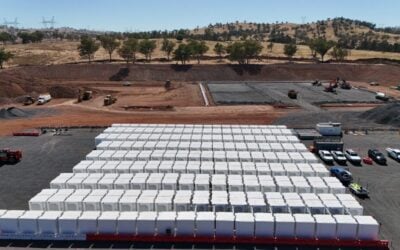
Alongside this, NTPC Green Energy’s own subsidiary, NTPC Renewable Energy, is seeking to deploy a 100MWh vanadium redox flow battery (VRFB) long-duration energy storage (LDES) system at the Khavda hybrid park.
Try Premium for just $1
- Full premium access for the first month at only $1
- Converts to an annual rate after 30 days unless cancelled
- Cancel anytime during the trial period
Premium Benefits
- Expert industry analysis and interviews
- Digital access to PV Tech Power journal
- Exclusive event discounts
Or get the full Premium subscription right away
Or continue reading this article for free
Flow batteries store energy in tanks of liquid electrolyte, with separate power stacks. This means that, unlike lithium-ion (Li-ion) batteries, where the energy and power are both within the cell, flow batteries enable the decoupling of energy and power.
What this means in effect is that the energy capacity of a flow battery can be scaled up simply by increasing the size of the electrolyte tanks, lowering the cost of increasing the system’s duration.
The company announced that it would be tendering for the large-scale non-lithium battery system in November last year. Earlier this month (7 February), NTPC Renewable Energy issued an invitation for bids (IFB) for an engineering, procurement and construction (EPC) package for the VRFB’s development and delivery on a turnkey basis.
The output of the facility is listed at 16.7MW, meaning that at 100MWh, the VRFB will have a 5.9-hour discharge duration at maximum rated output. It will be integrated with the solar plant through a 33kV pooling substation.
In the document’s explanation of scope of work, NTPC Renewable Energy said specifications should include detailed explanations of guaranteed annual battery energy storage system (BESS) degradation, round trip efficiency (RTE) including auxiliary power consumption and other metrics.
Bidders must apply for the entire project capacity, with the asset to be designed for an expected 25-year lifetime, with the bidder taking on the first ten years of operations and maintenance (O&M).
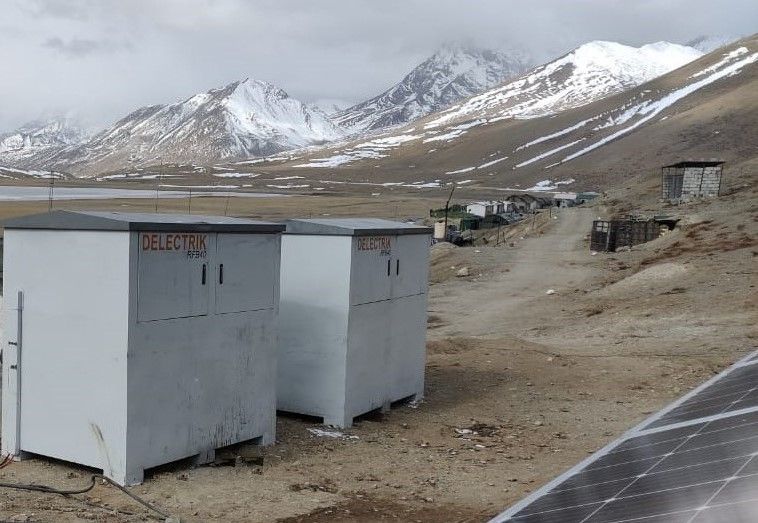
The move follows an initial tender for a 3MWh, 5-hour duration VRFB system (600kW output) held in June 2024 by parent company NTPC. Deployed at an NTPC R&D centre in Greater Noida, Uttar Pradesh, the contract was awarded in September 2024 to India-headquartered flow battery manufacturer Delectrik, which co-developed the system with Rays Power Infra.
That system was paired with a microgrid at the NTPC Energy Technology Research Alliance (NETRA) R&D hub.
NTPC is also testing another potentially scalable non-lithium technology—the CO2 Battery from Italian tech company Energy Dome—piloting a 20MW/160MWh system at one of its thermal generation plants in Bijapur, Karnataka.
Energy Dome is partnering with Indian company Triveni Turbines on the project, while NETRA will assess the project. The CO2 Battery stores energy in compressed carbon dioxide gas, which is liquified during charging and evaporated during discharging.
“As a public-owned enterprise, [NTPC’s vision is] quite linked to the strategy and the wider vision of India, which is that they don’t necessarily see lithium-ion as the panacea,” Ben Potter, Energy Dome chief operating officer (COO), said in an interview with ESN Premium last year.
Central Electricity Authority (CEA) issues 100GW pumped hydro roadmap guidance
As Potter referenced in that interview, India is seeking a diversity of energy storage resources. The country seeks to integrate 500GW of non-fossil fuel resources, largely wind and solar, by 2030, and then continue to decarbonise and enhance the stability of its energy system towards a net zero carbon emissions target by 2070.
The Ministry of Power’s Central Electricity Authority (CEA) has modelled long-term projections of energy storage requirements in India: 62GW by 2029-2031, 161GW by 2034-2035 and 476GW by 2046-2047, by which time there is expected to be 2,187GW of non-fossil generation capacity deployed.
Alongside lithium-ion, and potentially other forms of battery energy storage system (BESS), pumped hydro energy storage (PHES) is seen as a key component in that mix, particularly for longer durations.
Last month (23 January), CEA published a roadmap for the deployment of 100GW of pumped hydro (or pumped storage projects, PSP, in official communications), by 2035-2036.
PSPs have emerged as a critical enabler of flexibility, balancing power and long-duration energy storage (LDES), CEA chair Ghanshyam Prasad wrote in the roadmap’s foreword.
Energy Dome’s Ben Potter noted in the 2025 interview that the CO2 Battery has certain operational profile characteristics similar to PHES, without the geographical, topographical and civil engineering requirements of pumped storage, meaning NTPC and other power companies could potentially view the Energy Dome tech as a complementary or alternative solution for long-duration energy storage requirements.
Grid-forming inverter manufacturer survey
Within the Li-ion BESS space, one of the bigger emerging global trends is the adoption of grid-forming (GFM) inverters. Through fairly simple hardware design advances and relatively complex software configuration, GFM inverters enable inverter-based energy technologies to deliver system stability services, such as inertia and short-circuit ratio.
As extensively detailed in Energy-Storage.news’ coverage, these services, especially inertia, have been delivered historically by the spinning mass of thermal power generation plant turbines. Rotating at a set frequency, typically 50Hz or 60Hz, this sets the operating frequency and voltage of the electricity grid.
Hence, grid-forming inverters, as opposed to the more common grid-following inverters, are increasingly considered vital to completely replacing the role of fossil fuels and enabling high penetration, or even 100%, renewable energy grids. For example, German transmission system operators (TSOs) have recently started paying fixed tariffs to battery storage operators for inertia services.
At the beginning of this month (3 February), CEA issued a request to all grid-forming inverter manufacturers in India to share details of their manufacturing capacity within the country.
Central Electricity Authority deputy director Veepin Kumar wrote in an open letter to all manufacturers of the technology that the increasing share of renewable energy, such as solar and wind, “necessitate the installation of grid-forming inverters to make the electricity grid stable and reliable.”
CEA asked for information on inverter size, in classes of 10kW, 100kW, 1MW and maximum size if different, for grid-forming and grid-following, as well as the tentative cost of manufacturing the equipment in India.
The call comes after India’s Union Budget for 2026-2027, issued in late January, included a new customs duty exemption for equipment and components used in the manufacture of lithium-ion batteries for stationary BESS applications. Previously, an exemption had only applied to cells destined for the electric vehicle (EV) market.
Links to CEA’s PSP roadmap and the letter to grid-forming inverter manufacturers can be found here.