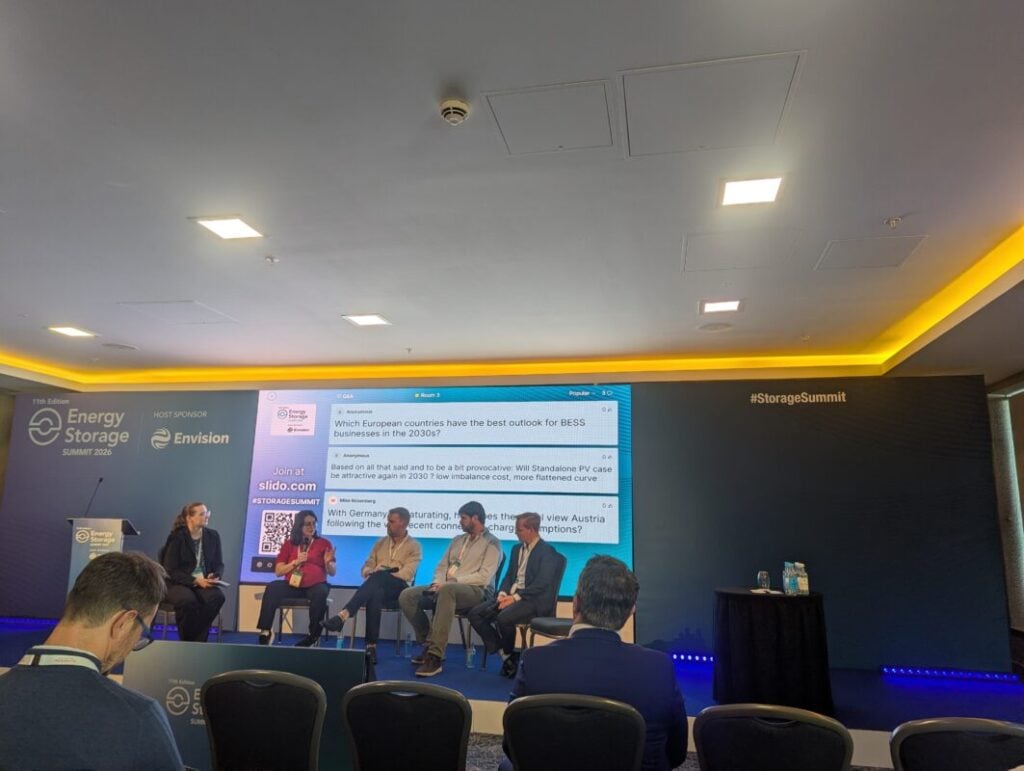
Constantly fluctuating power prices in Europe present opportunities for the continent’s battery energy storage system (BESS) developers, but business cases need to be flexible to keep up with changes in the industry.
This was the sentiment expressed by panellists speaking on day one of Solar Media’s Energy Storage Summit 2026, held this week in London, who gave a number of examples of fluctuations in European power prices as an example of the kind of opportunities for the BESS sector to provide flexibility in the continent’s energy mix.
“Volatility exists where we have the transition to renewables, or we have an amount of renewable penetration that’s quite high,” said Dan Moore, head of BESS asset management at Root Power. “Those markets are the most interesting ones—they’re certainly the most volatile ones.”
“Germany is the market, in Europe, that has the most sustained merchant opportunity, driven by the depth of its intra-day market [and] the depth of its trading opportunities,” said Alexa Strobel, head of strategy and analysis at Field Energy, starting a discussion on the power price environment that spanned several individual European countries.
Try Premium for just $1
- Full premium access for the first month at only $1
- Converts to an annual rate after 30 days unless cancelled
- Cancel anytime during the trial period
Premium Benefits
- Expert industry analysis and interviews
- Digital access to PV Tech Power journal
- Exclusive event discounts
Or get the full Premium subscription right away
Or continue reading this article for free
Strobel went on to explain that high solar generation—she said that Germany added 17GW of new solar capacity in 2025, compared to ”like 2GW of operational batteries” at present—drove spot prices to lows of -€450/MWh in May last year, and this trend is unlikely to stop as more renewable energy capacity is deployed across the continent.
“In Spain, we have a lot of volatility driven by PV, for sure, reaching quite a lot of negative hours a day, which is quite good when it comes to the location of BESS,” said Mikel Pino, head of energy storage Europe at Exus Renewables. “We have a lot of power purchase agreements (PPAs) with no settlement at zero or negative prices, so it’s painful!”
However, he said that, even should more storage capacity be deployed, the fact that Spain can see “quite flat, low prices all day”, the business case for BESS remains “quite difficult”; the mere presence of many low or negative pricing hours is not enough to justify a new BESS installation, but the business case for that BESS must be robust.
Building a BESS business case
Pino argued that deploying batteries in a manner in which they can be easily added to or expanded will be vital, as the rate of technological innovation in the BESS space continues to move quickly.
“We are building a 2-hour system, [and are] already prepared when it comes to foundations and electrical works to make an update to 4-hours quite easily,” he said. “You need to be quite careful on this saturation point; it already happened in the UK, that within the life cycle of a battery, the business case will change three, four, five or even ten times! You need to be prepared for that.”
The alignment of renewable energy generation capacity and battery capacity could happen sooner than expected in some countries, too. While Stober argued that many markets will see saturation happen “much slower” than in the UK, Koen Broess of Energy Storage NL (ESNL) said the mere announcement of longer-duration projects in some countries means their storage industries are entering a new phase of maturity.
“Saturation will happen, and probably sooner than most will expect,” he said. “The first 1GW 4-hour duration projects are being announced in Germany; if you build a project of this size, the solution of ancillary services will happen, for sure. Just make your business case not only dependent on ancillary services.”
Broess went on to suggest that developers could build batteries of different sizes, in order to participate in different parts of the market, and strengthen the business case of individual projects.
“If you build out 1- or 2-hour systems, you build them for ancillary systems,” he said. “If you build 4+ hour projects, you build them for trading and day-ahead market [involvement].”