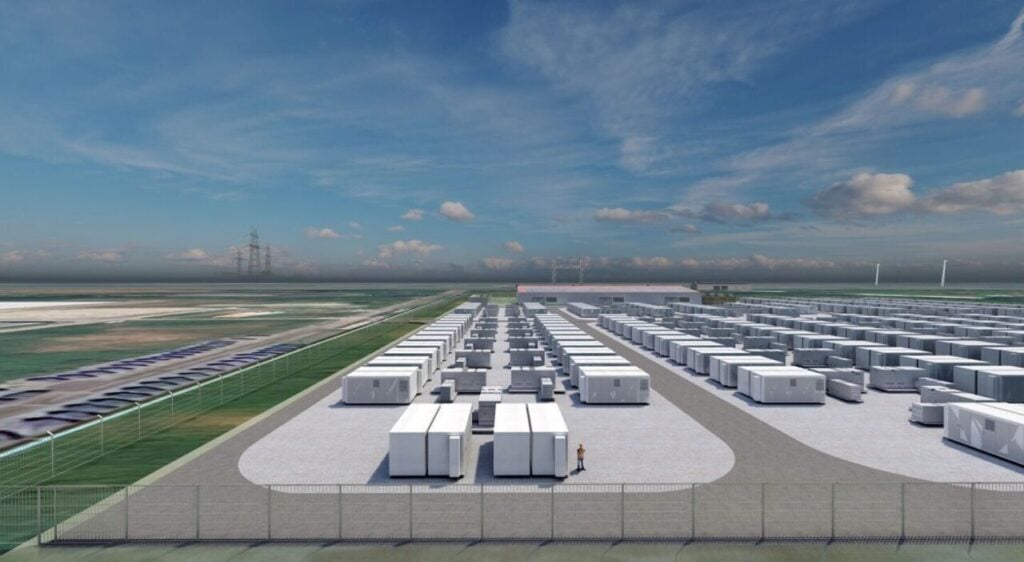
A trio of large-scale BESS announcements by major power firms of 700-800MWh capacity each in Germany show the country’s energy storage market moving into the new era of scale.
In summary:
- EnBW has taken a final investment decision (FID) on a 400MW/800MWh battery energy storage system (BESS) at its Philippsburg Energy Park, first proposed in July
- Enertrag and TSO 50Hertz have completed upgrades to the Bertikow substation to enable more renewables and accomodate a planned 200MW/800MWh BESS
- Vattenfall has received planning consent for a 254MW/700MWh BESS in Brunsbüttel, planned for commissioning ‘no later than 2028’
This scale is not new in Germany, with RWE and Eco Stor launching construction on 700MWh projects each at the turn of October/November, and LEAG enlisting suppliers for huge 1GW/4GWh and 400MW/1.6GWh projects later in the month. But the flurry of new announcements show that these scales of project are not isolated cases by the major market movers, but are now the norm.
Try Premium for just $1
- Full premium access for the first month at only $1
- Converts to an annual rate after 30 days unless cancelled
- Cancel anytime during the trial period
Premium Benefits
- Expert industry analysis and interviews
- Digital access to PV Tech Power journal
- Exclusive event discounts
Or get the full Premium subscription right away
Or continue reading this article for free
Large-scale BESS projects in Germany are capitalising on lucrative energy trading opportunities in its wholesale market, with nuclear generation already phased out, coal set to do the same by 2030 and new-build gas projects struggling to take off.
The announcements come as Wood Mackenzie posted a research note saying Germany would lead European BESS deployments this year with 3.5GW coming online, doubling to 7GW by 2034. But, revenues are set to decline over the next decade because of price cannibaliastion.
There are over 500GW of grid connection requests from BESS in the country. Most activity right now is focused on projects coming online by August 2028, when an exemption for charge-discharge grid fees for large-scale BESS is currently set to elapse.
EnBW FID on 400MW/800MWh BESS
EnBW said is Philippsburg BESS will be one of the largest in Germany and emphasised it will be built without any subsidies. The Philippsburg site currently hosts two decommission nuclear plants undergoing dismantling, and TSO TransnetBW has already built a large direct current (DC) converter in an adjacent section of the site. The BESS is located to bring wind power from northern Germany to demand centres in the southwest.
“This investment decision is a key step in making our energy system more flexible. Battery energy storage systems are indispensable when it comes to balancing the fluctuating supply of wind and solar power with actual electricity demand,” said Peter Heydecker, COO for sustainable generation infrastructure at EnBW.
The firm will launch construction on the BESS in early summer next year, for commissioning in 2027.
Substations upgrade for renewables and large-scale BESS
Enertrag and 50Hertz have concluded two years of construction on the Bertikow substation in the Uckermark region.
The substation will form the hub for more than 500MW of wind and solar in the region and forms the basis for a planned BESS of 200MW/800MWh, Enertrag said. Commissioning is planned for the third quarter of 2027.
The substation was converted from 220kV to 380kV and two new transformers of 400MVA and 45MVA replaced 50-year technology.
The modernisation enables lower-loss feed-in, reduces grid bottlenecks and minimises curtailments of renewable electricity, Enertrag said.
Vattenfall planning approval for 700MWh BESS
In related news, Sweden-headquartered Vattenfall has received planning approval from the Brunsbüttel city council for a 254MW/700MWh BESS in Schleswig-Holstein, Northern Germany.
The project will be built on another former nuclear power plant site which is also undergoing decommissioning.
Vattenfall plans to have the BESS operational by 2028 at the latest, though still needs to make an FID on the project.
Claus Wattendrup, head of solar and batteries at Vattenfall, said: “The Brunsbüttel site, with its available land and existing grid connection, offers excellent conditions for the construction of the battery storage facility.”
Kyon update on project
Developer-operator Kyon Energy has also provided an update on a 100MW/200MWh BESS that parent company TotalEnergies announced an FID and supply deal with another subsidiary Saft in mid-2024.
Kyon said this week that the delivery and installation of the BESS and medium-voltage power station was completed in October 2025, and electrical installation work began last month and will take several months to complete. Transformers are expected by the end of the year, allowing physical grid connection to be completed in Q2 2026, with commercial operation due in October 2026.
TotalEnergies, which also announced FID on a separate 321MW Kyon-developed German BESS portfolio last year, is reportedly considering selling a stake in Kyon and its pipeline, a report we looked at for an ESN Premium article last month.
Energy-Storage.news publisher Solar Media is hosting the Energy Storage Summit EU 2026 in London, UK, on 24-25 February 2026 at the InterContinental London – The O2. See the official website for more details, including agenda and speaker lists.