The US state of Georgia’s Public Service Commission (PSC) has approved state utility Georgia Power’s 2022 Integrated Resource Plan (IRP) that maps out how the company will deploy more renewables and energy storage technology over the next three years as well as strengthen the state’s network of transmission lines and grid infrastructure.
The approved 2022 IRP, which was filed with PSC back in February, will see the company deploy 2,300MW of new renewable energy resources over the next three years, with its long-term plan targeting a total of 6,000MW of additional renewable resources by 2035.
It will also see 500MW of battery storage rolled out. However, in announcing the filing of the plan in January, Georgia Power said it had actually requested the right to own and operate 1,000MW of battery storage by 2030.
In addition to the 500MW of new battery storage, a specific request by Georgia Power for the utility to be allowed to own and operate McGrau Ford Battery facility, a 265MW battery energy storage system (BESS) at a substation in Cherokee County, was also approved.
Try Premium for just $1
- Full premium access for the first month at only $1
- Converts to an annual rate after 30 days unless cancelled
- Cancel anytime during the trial period
Premium Benefits
- Expert industry analysis and interviews
- Digital access to PV Tech Power journal
- Exclusive event discounts
Or get the full Premium subscription right away
Or continue reading this article for free
McGrau Ford will be Georgia Power’s single largest BESS project to date. The company has filed its first request to own and operate BESS assets in its 2019 IRP. Three projects totalling 80MW were approved by the commission from that previous plan.
Progress has already been made on the first and largest in that portfolio, Mossy Branch, a 65MW/260MWh project in Talbot County, which got approval in October last year and a 13MW project with the US Army at Fort Stewart near Savannah.
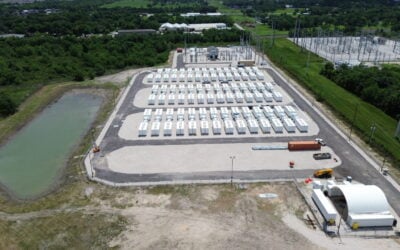
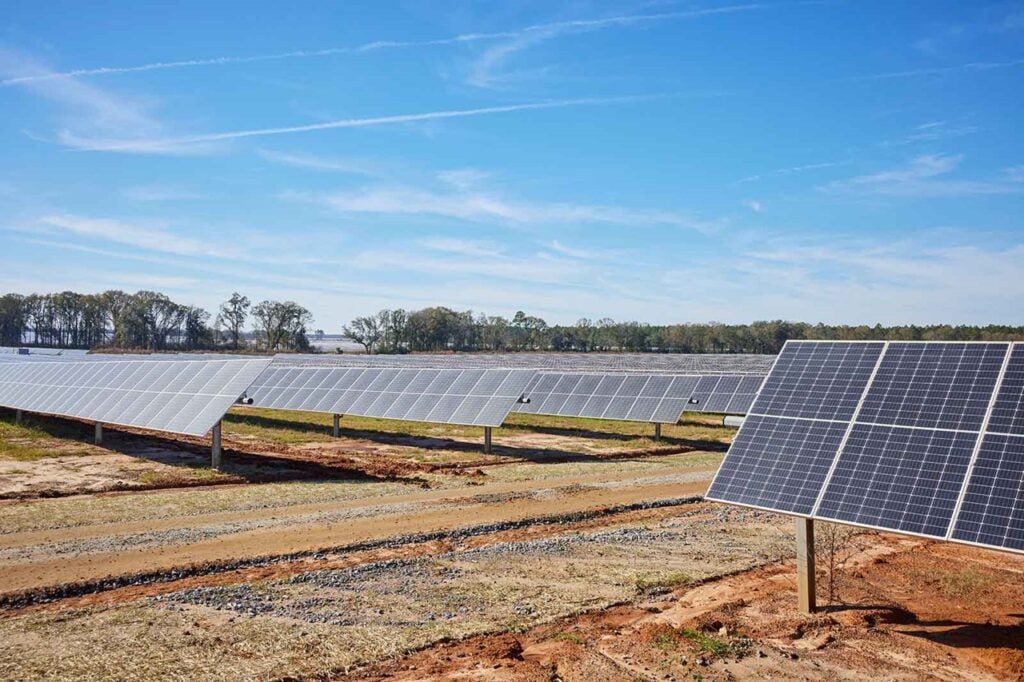
In June, Hickory Park Solar, a 195.5MW solar PV power plant with 40MW/80MWh battery storage (pictured above) went online, developed by European energy company RWE. Georgia Power has signed a 30-year power purchase agreement (PPA) for that plant, which RWE will continue to own and operate.
More recently, it was revealed that the utility has been in talks with startup Form Energy, developer of a novel iron-based battery chemistry energy storage technology, over a potential 15MW/1,500MWh project.
Georgia Power’s transition away from coal
Also approved from the 2022 IRP was Georgia Power’s proposed a pilot distributed energy resource (DER) scheme for 250MW of generation. The ‘DER Customer Program’ enables participating customers to receive a resiliency service via a company-owned, operated and maintained DER, such as a solar and battery energy storage system, with participants able to elect to receive a credit in exchange for the company’s ability to access the DER.
Moreover, Georgia Power has approved the retirement and decertification of all Georgia Power-controlled coal units by 2028, with the exception of one site, Plant Bowen, although it has approved more than 2,000MW of capacity from natural gas power purchase agreements (PPAs) in the coming years.
The utility said it was “incredibly important” to continue investments in renewables and gird infrastructure by “working constructively with the Georgia Public Service Commission” as it looks to build out its renewable energy resources.
Georgia Power files an IRP with the Georgia PSC every three years to outline how it will provide energy to its 2.7 million customers over the next 20 years.
Additional reporting for Energy-Storage.news by Andy Colthorpe.
This story appeared first in its original form on PV Tech.