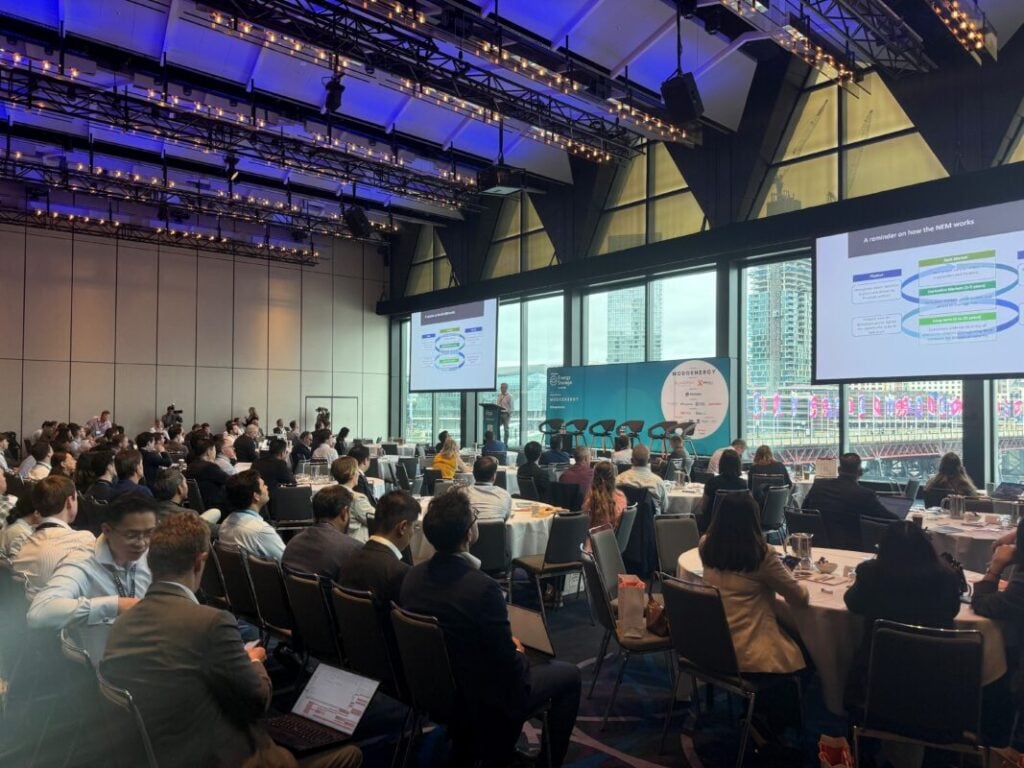
Professor Tim Nelson, former chair of the National Electricity Market (NEM) Review, has urged energy storage developers and market participants to engage with the implementation of sweeping market reforms actively.
These reforms are designed to address what he describes as a “fundamental reorientation of Australia’s power system from fuel storage to energy storage”.
Speaking at our publisher Solar Media’s Energy Storage Summit Australia 2026 in Sydney today (18 March), Nelson outlined how the completion of the NEM Review has shifted focus from policy design to practical implementation, with critical processes now underway that will determine how battery storage projects secure financing and participate in derivative markets over the coming decades.
“The NEM review is no more. It’s kind of yesterday’s news, but there are a few interesting little insights in this presentation that will hopefully give you a little bit more of a feel for some of the practical elements of where it goes from here,” Nelson told the audience.
Try Premium for just $1
- Full premium access for the first month at only $1
- Converts to an annual rate after 30 days unless cancelled
- Cancel anytime during the trial period
Premium Benefits
- Expert industry analysis and interviews
- Digital access to PV Tech Power journal
- Exclusive event discounts
Or get the full Premium subscription right away
Or continue reading this article for free
Central to Nelson’s presentation was the concept that Australia’s electricity system has undergone a structural transformation that existing market mechanisms were never designed to handle.
Where the original NEM, established in 1998, relied on storing fuel before generation in coal bunkers and gas pipelines, the modern grid generates electricity first when weather conditions permit, then stores that energy in batteries and other storage technologies.
“In the new system, the generation comes first, because when we’ve got fuel, whenever it’s windy, whenever it’s sunny, that’s when we generate, and so we’ve flipped it around, we then store the energy in batteries, whether it be pumped hydro, whatever it might be,” Nelson explained.
This reversal, Nelson argued, means financial contracts must evolve to manage not just variable demand but also variable supply.
“Most importantly, the financial contracts need to evolve to deal with not just the variable demand, because we’re all still going to have variable demand. We’re probably going to use more energy in the evening, around 18:00 and 19:00, than we do in the middle of the day. But we’ve also got this variable supply, and managing that requires a different way of thinking about what the risks look like,” Nelson added.
Financing projects has been hampered by a tenor gap between buyers and sellers in the derivatives market, as identified by the NEM Review.
“For those in the room that are trying to bank large-scale storage projects, you go to a bank, the bank says I need you to give me some degree of assurance that you’ve got a long-term revenue plan, a long-term revenue contract,” Nelson said.
“But all of the buyers and the retailers are saying, look, every year, very clever people tell me that it’s probably going to get cheaper next year and the year after. Why would I sign a long-term contract?”
This mismatch has necessitated government intervention through programmes such as the Capacity Investment Scheme, but Nelson emphasised that a more sustainable, market-based solution is essential.
The Australian Energy Market Operator (AEMO) is currently running a contract co-design process through ASL, with applications closing this Friday, that aims to develop standardised financial products suitable for a weather-dependent grid.
Nelson stressed this represents a critical opportunity for industry participants to shape the contracts that will underpin both derivative market liquidity and long-term investment decisions.
“The whole point of getting ASL to run this process was that the expertise of people like yourselves could be leveraged, rather than the government determining what those contracts should look like. The best people to determine what the most appropriate form of the contract should be are the buyer and the seller,” he said.
Rather than government dictating contract structures, the process leverages the expertise of buyers, sellers, generators, and retailers to determine what risk management tools are most appropriate.
Examples discussed included variable renewable energy profile products for bulk solar and wind generation, standardised virtual tolls for storage assets, and cap contracts for firming resources.
Nelson defined firming capacity as “the resources that can continuously dispatch to defend the market price cap,” noting that “at the moment, the market price caps around AU$20,000 (US$14,213), it can go for around eight hours before you have that threshold reach where you see administered pricing.”
The long-term guidance on market price settings from the reliability panel informs the contract co-design process, which, in turn, underpins both the market-making obligation advanced by the South Australian government and the proposed Electricity Services Entry Mechanism (ESEM) for long-term investment support.
“If you don’t have that, then the contracts co-design process cannot establish what long-term value and risk distribution looks like. So those two things are really, really important,” Nelson said.
The ESEM, which Nelson acknowledged as “the most poorly named mechanism,” is designed to address risks the market cannot manage by procuring bulk energy, shaping, and firming contracts for the back end of projects. The timeframe was revised following industry feedback.
“One of the things we heard really loud and clear after the draft report was that the period that we picked, one to seven years, was too long. And so, in the final report, you’ll see that we said it’s something like one to three years. The reason that’s so important is that in the market period, both the buyer and the seller are required to make sure that the project is good.”
Nelson outlined multiple pathways for developers to participate, from simply holding ESEM contracts to cycling them back to the market for physical power purchase agreements (PPAs) or working through intermediaries that aggregate physical PPAs into financial portfolios.
Addressing concerns that the mechanism would force developers to become derivatives experts, Nelson said: “Not at all. The beauty of what we’ve put on the table is that, depending upon your risk appetite, there are many options you’ve got for bringing projects to the table.”