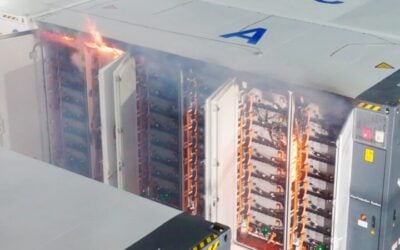
A proprietary explosion control system performed effectively in three recent safety tests conducted on Wärtsilä battery storage equipment, the company has said.
The energy storage arm of the Finnish marine technology and engine power plant provider announced last week (11 September) that testing of its Active Ignition Mitigation System (AIMS) took place earlier this year.
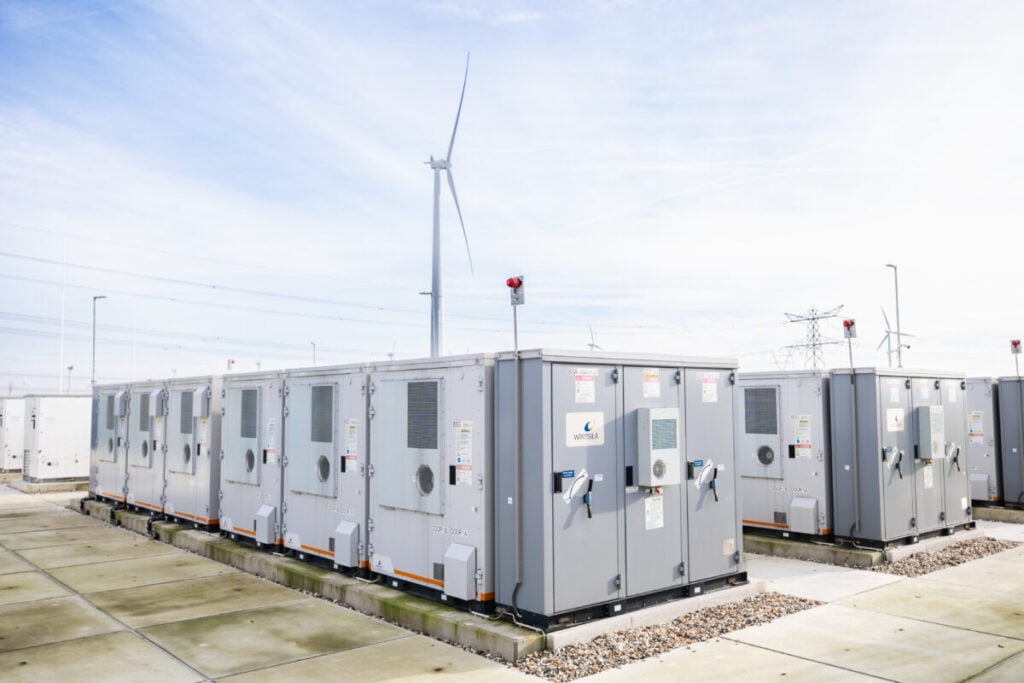
Claimed as a “first-of-its-kind” in the industry by Wärtsilä Energy Storage president and Wärtsilä executive VP Tamara de Gruyter, testing on the company’s Quantum 2 battery energy storage system (BESS) enclosure included the release of flammable gases into the enclosure.
It was part of a trio of tests designed to replicate real-world ‘worst-case’ scenario incidents of thermal runaway in lithium-ion (Li-ion) battery cells and their system-level impacts on the Quantum 2 BESS.
Try Premium for just $1
- Full premium access for the first month at only $1
- Converts to an annual rate after 30 days unless cancelled
- Cancel anytime during the trial period
Premium Benefits
- Expert industry analysis and interviews
- Digital access to PV Tech Power journal
- Exclusive event discounts
Or get the full Premium subscription right away
Or continue reading this article for free
Carried out in July in front of witnesses including representatives of a US utility company, a fire alarm vendor and a third-party consultant, the gas was released for two minutes into locations within the enclosure.
Wärtsilä said the AIMS device, which is engineered to mitigate the build-up of flammable gas that could happen in an abnormal thermal scenario, prevented uncontrolled deflagrations and structural deformations and the Quantum 2 BESS unit remained intact, its integrity uncompromised.
The technology provider’s product manager for fire protection, Mishaal SyedNaveed, described AIMS as a “paradigm shift in energy storage system safety.”
“We believe true safety starts well before gases build up as a result of thermal runaway,” SyeedNaveed said.
Energy storage providers’ safety race
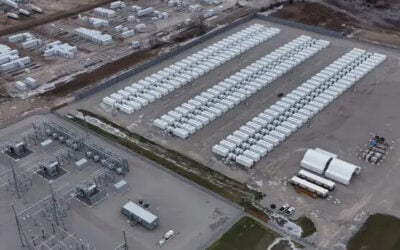
The news comes towards the end of a calendar year that began with one of the industry’s most high-profile fires seen to date, at Moss Landing Energy Storage Facility in California. One entire phase of the world’s biggest BESS project caught fire and was wiped out and local residents had to be evacuated.
Industry experts have subsequently commented that, due to the project’s unique indoor design in a repurposed gas turbine hall and its use of nickel manganese cobalt (NMC) chemistry cells, what happened at Moss Landing is unlikely to be repeated with any BESS project being built today.
No injuries were reported, and air quality reports thus far have not returned any evidence of toxic gas release likely to cause harm. However, as multiple experts have commented, including in Guest Blogs contributed to this site from insurance experts at kWh Analytics, Brown & Brown and Renewable Guard, and another from Clean Energy Associates (CEA) market intelligence consultant Aaron Marks, the fire shook confidence in the industry.
Overall, fire incidents are decreasing in frequency, with around one failure incident per 35GWh of batteries installed, according to the US Electric Power Research Institute (EPRI).
Nonetheless, fires that do occur create unwanted public attention and concern and often directly contribute to local authorities taking a dimmer view on BESS developments in their jurisdictions than they otherwise might have.
Wärtsilä’s explosion control test is the latest in the safety testing announcements from global BESS system integrators. For several years, it was the UL9540A thermal runaway tests that were the most prominently mentioned, while more recently, processes for large-scale fire testing (LSFT), where entire units are set on fire and allowed to burn with their suppression equipment deactivated, have become the headline topic.
A recent Energy-Storage.news article detailed that Chinese companies have become fiercely competitive in their fire testing R&D and safety demonstration efforts, with each seemingly attempting to go further than the last.
A few days ago, the US National Fire Protection Association (NFPA) published the latest edition of the for the installation of stationary energy storage systems NFPA 855 (2026 edition). Though formulated in the US, NFPA standards are typically adopted as best practices or requirements worldwide. The latest edition includes large-scale fire test protocols.