
Earlier this month, Argentina launched its second energy storage tender, following the success of the first one held last year, which awarded more than 700MW of BESS.
The first one, also known as AlmaGBA, sought capacity exclusively for the Buenos Aires area, while the AlmaSADI auction aims to add battery energy storage system (BESS) capacity nationwide.
Similar to the previous auction, it will be held by Argentina’s wholesale market operator, CAMMESA (Compañía Administradora del Mercado Mayorista Eléctrico Sociedad Anónima), which spoke in more detail about the first tender during last year’s Energy Storage Summit Latin America.
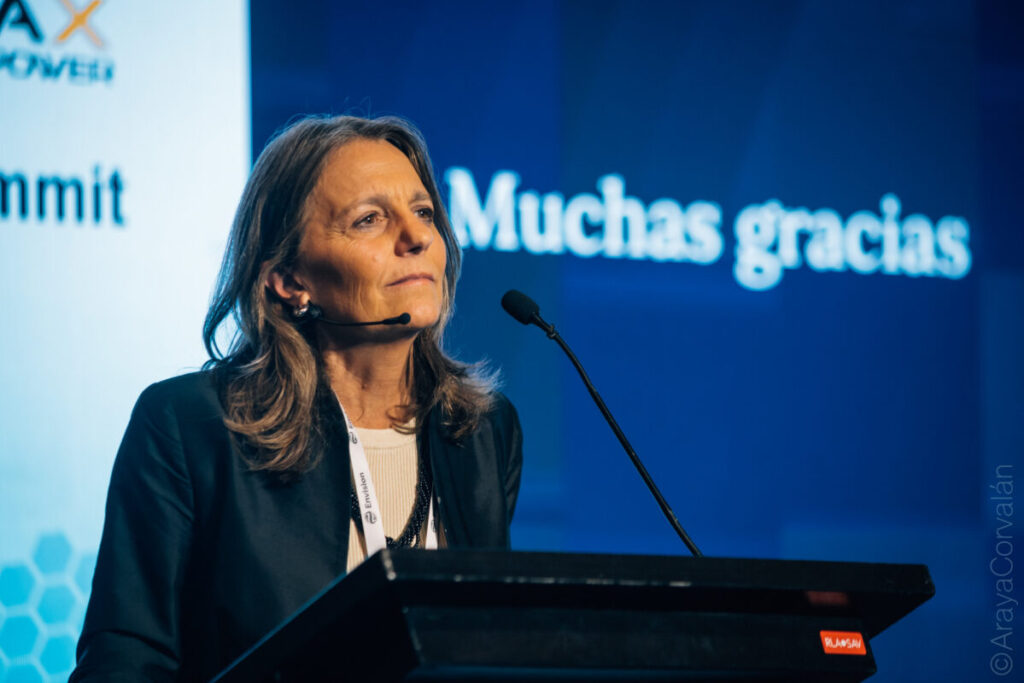
Argentina’s National Energy Secretary, María Tettamanti, spoke exclusively with Energy-Storage.news about this new tender, the inclusion of node-specific information, but also the lessons learned from the previous one and how Argentina aims to attract international players to invest in the Argentinian BESS market.
Try Premium for just $1
- Full premium access for the first month at only $1
- Converts to an annual rate after 30 days unless cancelled
- Cancel anytime during the trial period
Premium Benefits
- Expert industry analysis and interviews
- Digital access to PV Tech Power journal
- Exclusive event discounts
Or get the full Premium subscription right away
Or continue reading this article for free
Energy-Storage.news: What lessons from the first tender have you implemented in this one? And what are the new elements that developers and IPPs need to be aware of for this tender?
María Tettamanti: The main lesson from the AlmaGBA tender was very clear: when there are clear rules, predictability, and a State that puts the system in order instead of intervening discretionally, investment shows up. The market response was conclusive. We received 27 bids from 15 companies, both domestic and international, and awarded a total of 713MW, far exceeding the initial 500MW target. That confirmed not only the high level of market readiness for BESS projects, but also the growing confidence in the direction this Government is setting.
Another key lesson was that the market placed a very high value on the predictability of payments for available capacity, which are not affected by how much future capacity is added to the system. That predictability is essential for any serious investor, because it is what makes long-term financing and investment decisions possible.
While AlmaGBA was specifically designed to solve power shortages during peak demand hours in a concentrated area, AlmaSADI has a broader and more ambitious objective: to strengthen the reliability and stability of the entire Argentine Interconnected System, or SADI. That is why this new tender also rewards primary frequency regulation.
We now have a stated target of 700MW in AlmaSADI, with at least the same 4-hour duration, and we are also providing developers with node-specific information, including granular data on the exact locations in the grid that need stabilisation.
At a deeper level, all of this is part of a broader transformation. This Government came to drive a cultural change: to move away from a system of discretion, distortions, and uncertainty, and toward one based on legal certainty, stable rules, and the right economic signals. That is the framework we are building so that private investment can find in Argentina a serious, predictable, and reliable place to operate.
How have things progressed for the first tender since September? Are there any developments you can share about it?
Since the awarding of 713MW in late 2025, the process has moved forward very efficiently. Twelve projects were awarded, and most of them have already signed their offtake agreements with (utilities) Edenor and Edesur.
Awardees are moving quickly to take advantage of the incentives that reward earlier interconnection. That also shows that when the regulatory design is sound, incentives work and the private sector responds.
But perhaps the most important development is this: AlmaGBA was not only a successful tender in terms of awarded capacity, it also helped break a key barrier in risk perception. It opened the door with both local and international lenders regarding the bankability of BESS projects in Argentina and proved that the model we designed works.
From a broader perspective, this is also a political signal. Argentina is leaving behind a logic in which the rules changed all the time and investors never knew what to expect. Today, we are bringing order, normalising the system, and restoring rationality. That change in direction is already beginning to produce concrete results.
In the previous tender, CAMMESA acted as the final guarantor and operational administrator of the contracts between the generators and distributors. Will this be the same here? If not, how will the financing be structured?
In the previous tender, the dollar-denominated contracts were signed with either Edenor or Edesur, the country’s two largest distribution utilities, because the storage services were intended to serve the population within those concession areas.
In this new tender, however, it is no longer the distributors signing the contracts. CAMMESA acts on behalf of the entire Argentine system, because the goal now is to strengthen the resilience of the full SADI, always under dollar-denominated commitments.
This also reflects an evolution in energy policy. We are designing instruments that are increasingly consistent with a system-wide vision, more transparent, and more closely aligned with the actual needs of the grid. And we do so under one central premise: to provide contractual certainty and legal certainty. For this Government, that is not a secondary issue; it is a basic condition for attracting genuine, long-term investment.
Could you explain the importance of including a map of the node points available across the country and why you included this information for companies to be able to see it easily?
One of the most valuable innovations CAMMESA has incorporated for developers is an extremely transparent indication of the exact interconnection capacity at each point in the country. That logic already contributed significantly to the expansion of renewable generation, with installed wind and solar capacity surpassing 7GW and with the development of one of the most dynamic private PPA markets in the world.
We took that same idea and adapted it to storage. By publishing a transparent node map, we are sending a very concrete signal: this is not about building anywhere, but about building where the system actually needs you.
That reduces development costs for IPPs because it removes uncertainty, avoids blind decision-making, and improves capital allocation. But it also has a deeper meaning: making information transparent is also a way of organising the market. When the State publishes clear and useful information, it stops being an obstacle and starts fulfilling the role it should fulfil: creating the conditions for the private sector to invest better.
That is precisely the cultural change we are seeking to consolidate. Less discretion, less opacity, and more information so that the market can function.
Last year, during the Energy Storage Summit Latin America, you highlighted the interest in attracting international players. Is that the case with this tender? If so, what should they consider when participating in the tender?
Absolutely. With annual demand above 140TWh, Argentina is the third-largest electricity market in Latin America, after Brazil and Mexico. It is a market with scale, resources, and enormous growth potential.
Our objective remains to attract the best international players, create a level playing field, and allow the private sector to determine which technology is best suited to each need. Competition, efficiency, and private investment are central to this Government’s vision.
International players should bear in mind that Argentina is going through a deep regulatory normalisation process. But one point is important: we are not inventing a new framework or improvising rules as we go. We are returning to a rational, predictable, market-oriented system, leaving behind years of intervention that distorted prices, disrupted incentives, and drove investment away.
The political signal is very clear, and so is the path ahead: stable rules, prices that reflect costs, and a market that works. Argentina has everything it takes to become an energy powerhouse. What we are doing now is building the conditions for that to happen.
That is why this tender represents a major opportunity for international players, not only to participate directly, but also to partner with, finance, or acquire awarded projects in a market that is beginning to regain credibility.
Finally, the whole process of the tender will take less than four months, from the first publication to the signing of the agreements. How did you create such a quick tender process?
We achieved this by capitalising on the lessons learned from AlmaGBA and by using standardised documentation. We eliminated unnecessary bureaucracy and focused the process on digital submissions through CAMMESA.
But behind that administrative agility, there is also a political decision. This Government understands that if it wants to attract quality capital, it cannot keep operating with the timelines, procedures, and obstacles of another era. IPPs and international funds move under global standards, and Argentina must be up to that standard if it wants to compete for those investments.
That is why we decided to move forward with a process that is faster, simpler, and more professional. Efficiency in the tender is not just an administrative improvement; it is also a concrete signal of where we want to take Argentina’s energy sector.
Ultimately, the direction is clear: stable rules, prices that reflect costs, and a market that works. Argentina has everything it needs to become an energy powerhouse. And this Government is building, with determination and a long-term commitment, the conditions for that opportunity to finally become a reality.
Our publisher Solar Media will hold the Energy Storage Summit Latin America 2026 in Chile on 27-27 October.