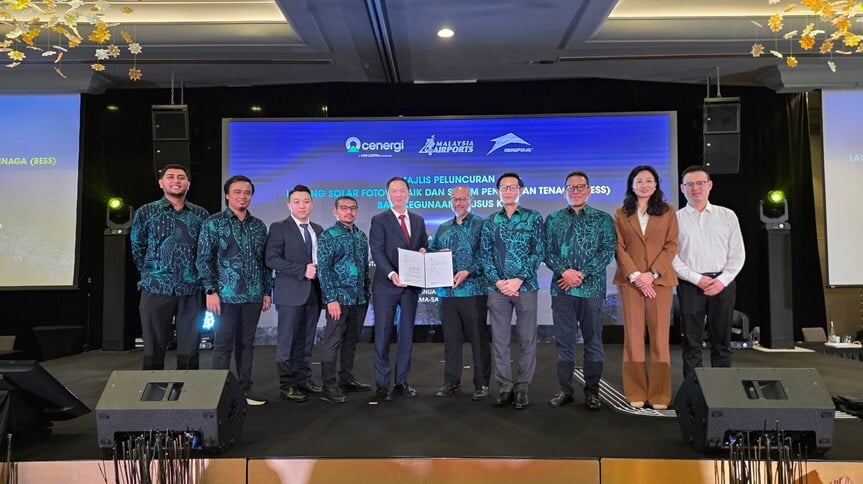
Chinese battery manufacturer EVE Energy has secured a contract with the Malaysian government to deploy an AC/DC integrated 36MWh solar-plus-storage system at Kuala Lumpur International Airport (KLIA).
The project will utilise the company’s 628Ah lithium iron phosphate (LFP) battery cells.
This marks EVE Energy’s expansion into Malaysia’s growing energy storage market, leveraging the company’s large-format battery cell technology that has gained traction in utility-scale applications globally.
EVE Energy’s 628Ah cells offer higher energy density compared to smaller-format alternatives, reducing system complexity and installation costs for large-scale deployments. While many manufacturers have moved toward cells that go well beyond the industry’s ~300Ah benchmark, with larger cells among major drivers of cost reduction, EVE claimed to be the first to mass-produce 600+Ah cells in late 2024.
Try Premium for just $1
- Full premium access for the first month at only $1
- Converts to an annual rate after 30 days unless cancelled
- Cancel anytime during the trial period
Premium Benefits
- Expert industry analysis and interviews
- Digital access to PV Tech Power journal
- Exclusive event discounts
Or get the full Premium subscription right away
Or continue reading this article for free
LFP chemistry cells have become the global industry standard for stationary battery energy storage systems (BESS), providing enhanced safety and cycle-life performance at a lower cost than nickel manganese cobalt (NMC) despite their lower energy density at cell level.
EVE Energy claimed that LFP’s safety profile, in particular, makes it suitable for critical infrastructure applications such as airport operations.
The KLIA deployment combines solar PV generation with battery energy storage in an integrated AC/DC configuration, designed to provide a reliable power supply for airport operations while reducing grid dependency.
The system’s technical specifications position it as a critical infrastructure project supporting Malaysia’s aviation sector, energy resilience, and sustainability objectives.
EVE Energy has experienced growth in energy storage shipments in recent years, with the company’s battery systems gaining adoption across multiple markets.
As previously reported by Energy-Storage.news, the manufacturer’s energy storage shipments have surged, showcasing increased demand for large-format lithium iron phosphate cells in utility-scale applications.
Malaysia’s energy storage sector has developed rapidly, with the government implementing policies to support the deployment of battery storage systems across various applications.
The country’s Energy Commission recently shortlisted bidders in a landmark 1.6GWh BESS programme, indicating substantial planned capacity additions across the Malaysian grid.
The KLIA project follows other significant energy storage developments in Malaysia, including the country’s first large-scale battery storage system inaugurated in Sabah, Borneo.
Meanwhile, the AC/DC integrated configuration optimises energy conversion efficiency and reducing power electronics requirements. This design approach has gained adoption in solar-plus-storage applications where maximising round-trip efficiency and minimising system costs are priorities.
Airport energy storage systems serve multiple functions, including peak demand management, backup power provision, and renewable energy integration.
The project represents EVE Energy’s continued international expansion beyond its primary Chinese market, with the company targeting utility-scale and commercial applications across Southeast Asia.
The KLIA solar-plus-storage system deployment timeline and operational commencement details remain subject to project development schedules and regulatory approvals.