European Union (EU) countries have made limited progress in implementing recommendations on energy storage deployment and electricity network flexibility.
According to a report published last month (14 January) by the European Commission (EC) Joint Research Centre (JRC), there has been a mixed response from EU Member States to the European Commission’s Recommendation on Energy Storage (C/2023/1729) made in March 2023.
The recommendations came as the EU recognised the crucial role energy storage can play in enhancing energy system flexibility for managing supply and demand as shares of renewable energy increase, ensuring grid stability and supporting cross-sector electrification.
This includes supporting a growth in the share of renewable energy in the EU’s electricity system from 47% in 2024 to around 69% by 2030 and 80% by 2050, alongside a need for 288TWh of flexibility—equivalent to about 24% of total EU electricity demand—by 2030 and 2,189TWh, or around 30%, by 2050.
Try Premium for just $1
- Full premium access for the first month at only $1
- Converts to an annual rate after 30 days unless cancelled
- Cancel anytime during the trial period
Premium Benefits
- Expert industry analysis and interviews
- Digital access to PV Tech Power journal
- Exclusive event discounts
Or get the full Premium subscription right away
Or continue reading this article for free
“In this context, energy storage solutions are pivotal to ensuring a resilient and sustainable energy future for the EU,” the report’s authors wrote, referring to a number of studies projecting a potential need for more than 200GW of energy storage by 2030 and 600GW by 2050.
According to trade association Energy Storage Europe (formerly the European Association for Storage of Energy, EASE), cumulative installed capacity hit 100GW late last year on the continent, including non-EU Member States and counting various technologies, including pumped hydro energy storage (PHES), lithium-ion battery energy storage systems (BESS) and others.
Energy Storage Europe and its research partner LCP Delta forecast cumulative capacity across Europe to surpass 215GW by 2030. However, while this meant energy storage is Europe’s fastest-growing clean energy technology and a “strategic necessity,” policies and regulations to support its growth and keep developers and investors interested are a must.
The new JRC report, ‘Implementation of Commission recommendation on energy storage in the Member States,’ found a patchwork of progress.
The idea is to continually assess how well the Member States are doing, and what they could do better in their adoption of storage technologies. With the recommendations in place, such as assessments of electricity system flexibility, the Commission will be better able to determine which countries should have support schemes in place to promote the uptake of energy storage, for example.
A previous JRC report, published in November, found that while energy storage deployment is growing, the technologies remain underutilised.
Majority of EU states are yet to adopt national energy storage strategy
Most European Union (EU) Member States have adopted legal definitions of energy storage, for example, but very few have developed a national strategy for energy storage, as recommended by the EC.
While only three Member States (Austria, Latvia and Lithuania) are yet to take any action on legal definitions, Austria is planning to do so. Whereas only four Member States—Germany, Spain, Ireland and the Netherlands—have developed a national energy storage strategy.
Similarly, the level of progress made by countries to include an analysis of energy storage in their National Energy and Climate Plans (NECPs) is varied.
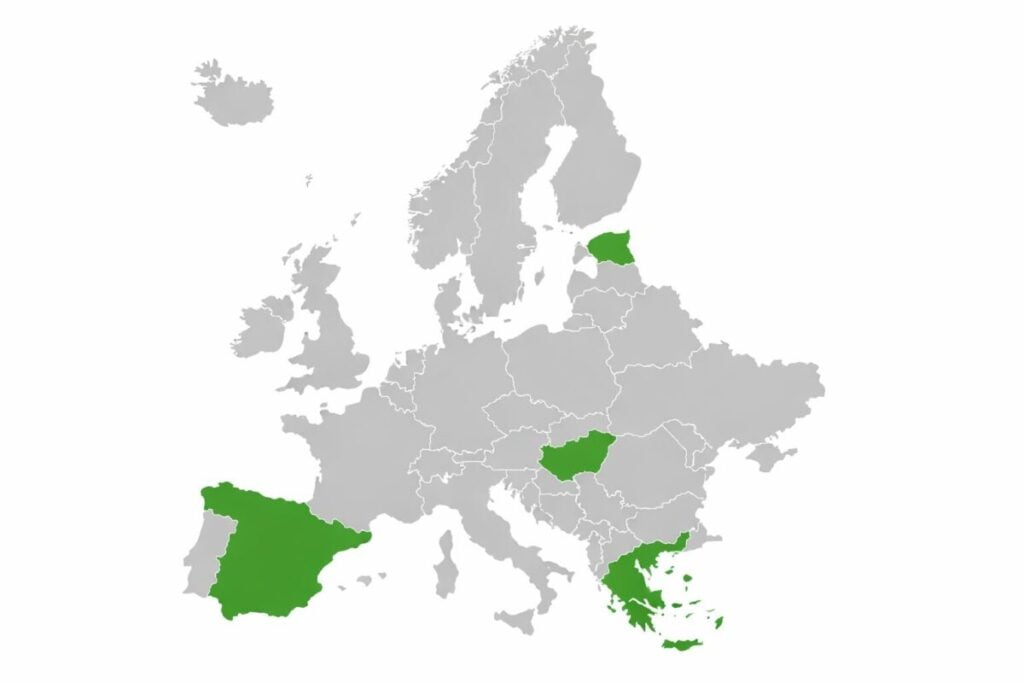
Only four Member States—Greece, Spain, Hungary and Latvia—have established overall quantified targets by 2030 for energy storage in their NECPs, although six have given indicative targets for specific storage technologies—Belgium, France, Ireland, Latvia, Portugal and Romania. Seven other states provided details on planned energy storage projects or pilots.
The remaining ten Member States’ NECPs mention energy storage and the importance of its role without including specific targets. The JRC authors noted that Germany and the Netherlands have developed national energy storage strategies, although they do not have targets as such.
However, only three countries—Spain, Ireland and Portugal—declared comprehensive regulatory frameworks for energy storage by the time data for the report was compiled up to April 2025. That said, most Member States have partially implemented regulatory measures, are in the process of developing them, or are in discussion and planning stages to do so.
Speaking with Energy-Storage.news last November, Jacopo Tosoni, head of policy at Energy Storage Europe, said that system planning at the individual country level has so far not yielded the best outcomes.
For instance, Germany’s forecasts of planned and future energy storage deployments have tended to be well below the eventual real figures that emerge.
This is why the EU said in its Electricity Market Design Reform process that there would be a single methodology to assess flexibility along different near-, medium- and long-term timeframes, Tosoni said.
This would mean that if Member States are not able to meet agreed targets through market drivers alone, the EU could discuss and implement support schemes.
“There are very few countries that have understood where the energy system is going and what it needs,” Tosoni said.
EU Member States are mandated to implement Electricity Market Design rules, including their flexibility assessments, and the policy expert highlighted that they have until July 2026 to adopt reports on these assessments, before setting energy storage deployment targets in early 2027.
While the methodology used is “not perfect,” Tosoni said, with consideration of long-duration energy storage (LDES) requirements falling short, in the view of Energy Storage Europe, the undertaking to assess flexibility and require targets is positive and will play an important role in the creation of support schemes from 2027 onwards.
Read the full EC Joint Research Centre report, ‘Implementation of Commission recommendation on energy storage in the Member States’, here.
This week, Energy-Storage.news publisher Solar Media is hosting the Energy Storage Summit EU 2026 in London, UK, on 24-25 February 2026 at the InterContinental London – The O2. See the official website for more details, including agenda and speaker lists. Also, ESN Premium users can get a 30% discount.