
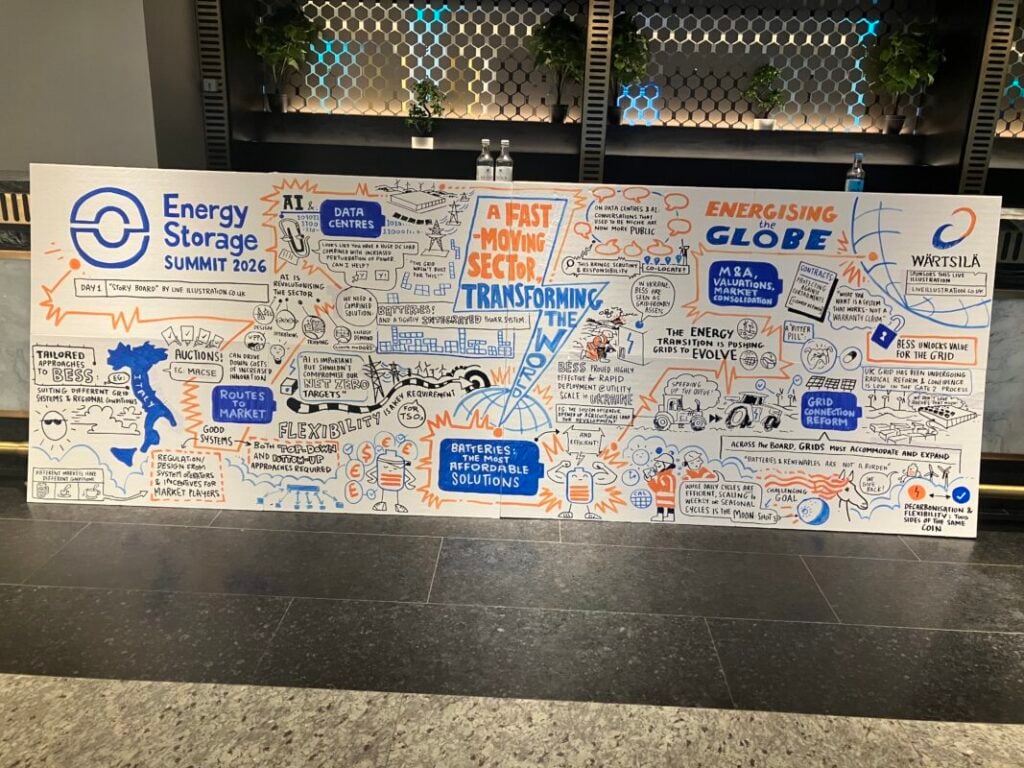
Energy Storage Summit 2026 finished yesterday, having brought the industry together for its first major meeting of the year.
The event has been staged in London, UK, by our publisher Solar Media (now part of Informa Markets) for 11 annual editions now and the evolution of both its scale and the maturity of the market has been remarkable to see.
This is reflected in the topics of discussion and growing base of attendees, with some companies now a decade-plus into project, portfolio and product development, joined by those perhaps just embarking on their first projects—and everything in between.
This meant operational issues spanning the full lifecycle became more important than before, and topics that were only just emerging a couple of years ago, like long-duration energy storage (LDES) and artificial intelligence (AI) data centres, took their place front and centre of discussions.
Try Premium for just $1
- Full premium access for the first month at only $1
- Converts to an annual rate after 30 days unless cancelled
- Cancel anytime during the trial period
Premium Benefits
- Expert industry analysis and interviews
- Digital access to PV Tech Power journal
- Exclusive event discounts
Or get the full Premium subscription right away
Or continue reading this article for free
There was also time of course for networking and socialising: Day One ended with the official afterparty sponsored by Modo Energy and Day Two began with a 5km Fun Run sponsored by Sungrow. Congratulations to Fun Run winner Paolo Sereni, from Renewable Power Capital!
You can read the thoughts and observations of the Energy-Storage.news team, with help from our colleagues across Solar Power Portal, PV Tech and EV Infrastructure News (EVIN) below.
Our Energy Storage Summit 2026 Day One blog is here, covering Tuesday, 24 February 2026.
Greener ways to travel
It’s always nice to see clean energy industry executives put their money where their mouth is and make greener personal choices too.
On the way in, our journalist Cameron Murray bumped into Søren Juel Hansen, energy storage director at developer Nordic Solar, both making their way to the event on Lime rental e-bikes.
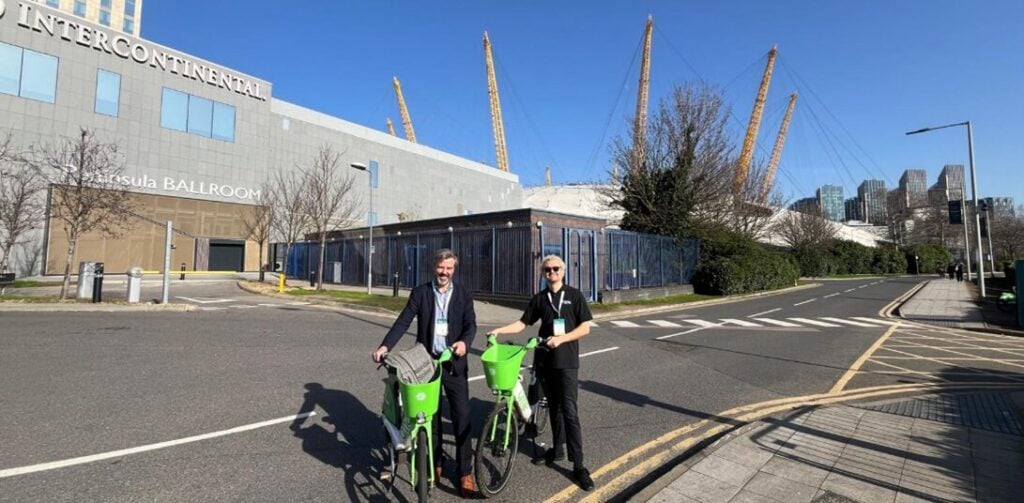
It just so happened that we’d published comments from Hansen on broad industry trends and challenges a few weeks earlier too (Premium access article).
Alternative planet-friendly transportation in the form of the London Underground was also available.
Grid fees and inertia payments: Germany’s mixed regulatory signals
In an on-site interview, Fluence’s managing director for Germany, Julian Jansen, said that a proposal to end an exemption for grid fees by the country’s Federal Network Regulator, the Bundesnetzagentur (BNetzA), instantly “took the wind out of the sails” of an otherwise buoyant market.
Germany was broadly agreed to be the hottest market in Europe at the event last year, and development in terms of both constructed assets and pipelines has been encouraging since then.
“Overall, the [German] market was going through a very positive development,” Jansen said.
The future of grid fees for energy storage as part of a wider reform process is uncertain, and it isn’t just the potential for extra costs that could scare off investors; the uncertainty itself could do so.
This despite the fact that some moves, such as the introduction of a payment mechanism for inertia system stability services, have been very positive, Jansen said.
Read the article, ‘Germany’s grid fees and inertia payments highlight contrasts in energy storage regulation.’
Long-duration energy storage in focus
Day Two had one panels, presentations and workshops dedicated to long-duration energy storage (LDES) practically all day. They covered system need, market design, technology choices and more.
Cameron Murray moderated the ‘Driving LDES Forward: The Perfect Time to Invest?’ session, focused around the UK’s LDES needs and its cap-and-floor scheme.
Key themes were the ideal amount for the goals of the UK government’s Clean Power 2030 plan, the dangers of over-procurement, and why the sector needed support in the first place. The latter is particularly important since lithium-ion projects are the lion’s share of shortlisted projects.
Senior policy advisor at UK energy regulator Ofgem, Mark Horley, gave a presentation on the cap and floor support scheme for LDES.
In defining the scheme and how it will work, Horley was keen to emphasise that the scheme was introduced because the market alone would be “unlikely to deliver, on a merchant basis, the level of LDES we need”. It is not, he said, “here to develop early stage technologies”.
That is interesting in the context of current tensions that have seen BESS developer-investor Zenobē take legal action against Ofgem claiming that the scheme’s design “risks distorting competition” by pitting subsidised LDES projects against unsubsidised lithium-ion BESS projects.
In its original plans for the support scheme, Ofgem considered exclusing BESS from the scheme, figuring that it can already be funded under existing market arrangements. In practice, the scheme is technology neutral.
A full write up of Horley’s comments is available on Solar Power Portal.
Batteries a key provider of flexibility in the renewable energy revenue stack
Battery energy storage systems (BESS) are a key facilitator of flexibility in a renewable energy project or portfolio’s revenue stack, according to speakers at a panel discussion held on day two of the summit.
This flexibility could be of particular importance considering the uncertainty affecting the European investment environment.
“Especially when it comes to grid constraints [and] other unforeseen circumstances, you might want to be flexible to react to those,” said Mikko Preuss, chief commercial officer (CCO) at developer and ‘virtual’ tolling platform operator terralayr. “We see big potential in structuring our revenue stack in a more clever way, to have certain protections built in. in uncertain times, you want optionality going forward.”
Meanwhile, Martin Daronnat, head of flexibility and structured origination at Engie, argued that revenues are rather fragile in Europe at present, and that more hedging could be required in the battery industry to protect revenues.
“As long as capacity prices stay high, all will be well,” he said, referring to the example of Germany. “When those go down, I won’t be surprised if we see revenues go down by 40-50%.
Read the full coverage of the panel discussion here.
Co-location not a ‘silver bullet’ for renewable energy revenue underperformance
With that being said, the audience for another panel was warned that adding energy storage is not an instant solution to mitigate revenue depression for renewable energy plants.
The session, ‘Subsidy, contract and merchant: Which revenue models will deliver Europe’s energy storage pipeline,’ was chaired by Wood Mackenzie analyst Anna Darmani, who noted that the pipeline is largely dominated by standalone storage, with notable exceptions such as Spain.
Co-location with batteries has in some quarters been “overhyped,” according to Tom Smout, head of energy storage at consultancy LCP Delta.
“Co-location has a place, but I think it’s quite overhyped by a lot of people. It can be good business, but for quite boring reasons, where it’s a good way to use the land that you have, with a great connection that you have, and those are meaningful assets. And sometimes good business is just using the assets that you have and realising the value of them.
“But from a system perspective, standalone storage is the most important because it provides the up and down frequency regulation, which is the thing that is technically the best. And then, from a portfolio perspective, if you have a solar asset which is eating a lot of negative prices, you’re better off having a standalone battery as a hedge, rather than putting a battery on site with that solar asset to hedge that asset.
“There’s a place for co-location, but I do sometimes worry that … a lot of people who have or are worried about building stranded solar assets are responding by building batteries that are going to become stranded batteries. Don’t just build a mediocre asset to salvage one that is underperforming; try and build a good asset and balance out your portfolio.”
Looking at ‘forecast’, not ‘promised’ revenues for BESS
Europe’s battery storage sector could benefit from a reassessment of the accuracy of revenue modelling, considering the challenges associated with power price forecasting, according to speakers on a panel of the second day of the summit.
Industry experts discussed the challenges associated with power price forecasting under the heading of ‘Closing the gap between promised revenue and real-world performance’. But according to Joshua Murphy, head of energy storage at IPP Econergy, even working under the predication of ‘promised revenue’ is perhaps assuming too much.
“It’s not ‘promised’ revenues, it’s ‘forecast’,” he said, adding that asset owners need to improve their own understanding of power price forecasting in order to participate in the market. “Ultimately we have to go to the bank with a curve from a provider that will be asset-specific, and that’s how we finance our assets, but we want to have the internal understanding too.”
Instead of trying to nail down a more accurate power price forecast over the span of decades, Simon Ede, senior managing director advisory at Kyos Analytics, encouraged those in the industry to be prepared to draw “a line in the sand” and accept that, at a certain point, an investment decision will simply have to be made.