
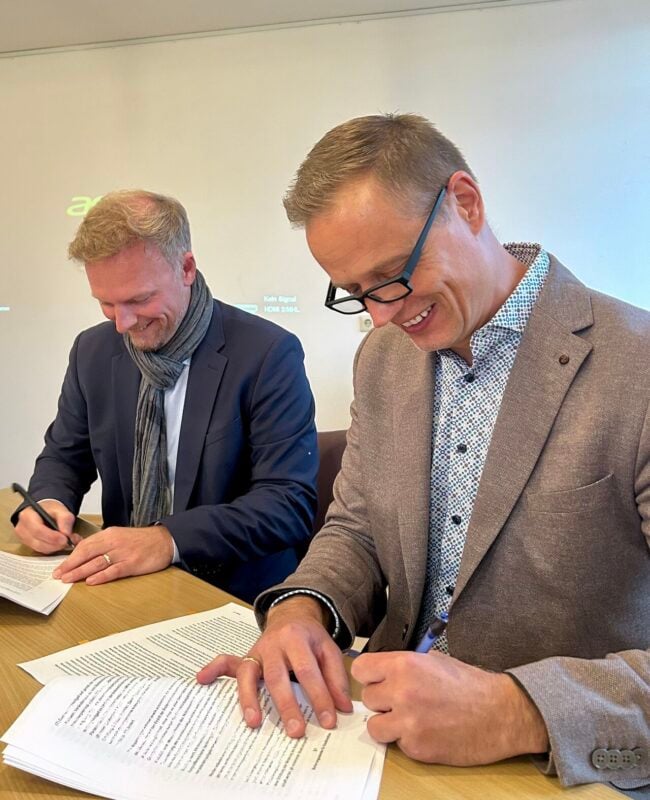

The managing director of Bluestar Energy Capital’s European BESS platform Noveria Energy, Ben Brooks, gave a Q&A to Energy-Storage.news ahead of the Energy Storage Summit 2026 in London next month.
Noveria Energy’s Ben Brooks discusses the big successes and challenges in the battery energy storage system (BESS) industry ahead of the two-day event on 24-25 February.
He will be speaking on the ‘Germany’s Storage Rules: From BKZ to FCAs, What Investors Need to Know’ panel discussion on Day One. See the full agenda here.
Bluestar launched Noveria in mid-2024, and it revealed a 700MW BESS deployment partnership in Germany with energy and commodities firm Vitol’s VPI platform in October last year.
Try Premium for just $1
- Full premium access for the first month at only $1
- Converts to an annual rate after 30 days unless cancelled
- Cancel anytime during the trial period
Premium Benefits
- Expert industry analysis and interviews
- Digital access to PV Tech Power journal
- Exclusive event discounts
Or get the full Premium subscription right away
Or continue reading this article for free
In this article, he touches on the state of play in the BESS market today plus the evolution of financing, project delivery, key regulatory developments and more.
One key takeaway is that community acceptance of BESS is generally good when the developer effectively manages noise and visual impacts and clearly articulates the local economic benefits of a project, Brooks says.
Energy-Storage.news: How would you characterise the current state of the European energy storage market, in terms of the key trends, major successes and achievements and challenges still to
be overcome?
Been Brooks: The European BESS market has grown rapidly, driven by falling cell costs, increasing renewables penetration and a phase out of conventional rotating synchronous generators.
From being a relatively niche investment class in the recent past, BESS is now well known and understood by most institutional investor’s investment committees and is readily financeable through both debt and equity. 4-hour systems are now commonplace and are transforming the day ahead and intraday electricity markets.
On the ground, community acceptance is generally good when the developer effectively manages any noise and visual impact and clearly articulates the positive contribution that distributed energy systems make to the underfunded budgets of local municipalities.
Grid connection capacity is scarce due to legacy first-come-first-served queue management, and outdated legislation that hinders grid operators’ ability to provide locational and time of day price signals through grid fees or flexible connection agreements (FCAs).
The labour market for electrical engineers and the production capacity of high voltage components is also very tight and will delay projects that fail to factor extended timescales into their development plans.
How is the financing of BESS projects evolving?
The larger pan-European lenders have established dedicated renewables and BESS teams and are comfortable lending against both merchant and contracted revenues.
An increasing number of bankable long-term revenue forecasters, coupled with robust benchmarks and optimiser-led market data transparency provide confidence to financial institutions. Equity financing for projects with reliable COD dates, backed up by de-risked project schedules, is available.
What is the current mix of ‘full wrap’ and ‘multi-contracting’ for BESS project delivery, and is this/how is this expected to change going forward?
The majority of BESS projects are being developed and realised through a two-contract model. One company provides the BESS and medium voltage equipment, while another provides installation and cold commissioning as well as HV substation, cable route and grid operator works. We don’t expect this to change materially going forward, although there will continue to be projects built through a full EPC model.
How is BESS supply and technology evolving to meet key market challenges?
Lithium-ion technologies manufactured in Asia remain dominant due to cost and guarantee-backed degradation curves and cycling limits. As the market, particularly in Germany, moves to 4-hour systems we expect LFP to remain dominant, however there are certainly interesting use cases for other ‘challenger chemistries’.
What are the key policy questions and grey areas that industry and government still need to find solutions for, to unlock storage’s full potential for the grid?
Unlocking the full potential of storage requires a restructuring of grid fees: the current model of lump-sum, upfront payments to grid operators needs to be rebalanced against ongoing charges to create clear price signals that incentivise batteries to operate in ways that relieve congestion, particularly at the distribution level.
Equally, the lack of digitalisation and granular load measurement within DSOs is a major barrier to integrating flexible assets like BESS, as visibility and data are essential for effective grid planning and management. As the marginal cost of electricity production decouples from the price of gas, policymakers must ensure that grid fee frameworks for consumers and industry remain fair and controlled, so that the
benefits of the energy transition are shared equitably across society.
Grid and long interconnection backlogs are commonly cited as a major challenge: what measures do you see being taken to alleviate this, and how would you assess/estimate their impact?
Moving from a ‘first come, first connected’ model to a ‘first ready, first connected’ (FRFC) model is crucial to ensuring that early market entrants without funding or experience in developing, constructing and operating large energy systems do not block grid access. Germany TSO 50Hertz has done some excellent work in driving that conversation in Germany, and we are looking forward to changes coming in 2026.
How is the role of TSOs in the energy storage market evolving?
TSOs are moving from passive grid operators to active flexibility procurers, increasingly integrating BESS into grid stability strategies rather than relying purely on the rotating mass of large steam turbines in conventional power plants to stabilise the grid. The investment required at the TSO level is so significant that capital restructuring and renationalisation is happening in many European countries.