
China’s biggest energy storage companies were out in force at a recent trade expo in Beijing, with integrated offerings, bigger battery cells, data centre solutions, sodium-ion and solid state products among the new products and tech on show.
The 14th Energy Storage International Summit and Exhibition (ESIE 2026) took place last week (31 March to April 3) at the Beijing Capital International Convention & Exhibition Center.
From full-stack integration and scenario-specific applications to core technological breakthroughs and enhanced safety standards, the summit sent a clear signal: China’s energy storage industry is leaving behind unregulated rapid expansion and entering a critical phase of high-quality development, powered by technology competition and scenario-focused innovation.
Serving as the industry‘s annual barometer, the event brought together key players including CATL, Sungrow, HiTHIUM, Jinko Storage, Trina Solar, Envision, LONGi, Narada Power, Pylontech and Clou Electronics. They presented end-to-end solutions, cutting-edge innovations, and future trends across the entire energy storage value chain.
The event was co-hosted by the China Energy Storage Alliance (CNESA), the China Energy Research Society, and the Institute of Engineering Thermophysics under the Chinese Academy of Sciences,
Try Premium for just $1
- Full premium access for the first month at only $1
- Converts to an annual rate after 30 days unless cancelled
- Cancel anytime during the trial period
Premium Benefits
- Expert industry analysis and interviews
- Digital access to PV Tech Power journal
- Exclusive event discounts
Or get the full Premium subscription right away
Or continue reading this article for free
Full-scenario, full-stack integration: reconstructing the energy storage value system
The most distinctive hallmark of ESIE 2026 was the proliferation of full-scenario, full-stack integrated solutions. Rather than competing on individual components, China’s energy storage industry players are now vying for system-level capabilities to tackle long-standing bottlenecks in cross-scenario adaptability and operational efficiency.
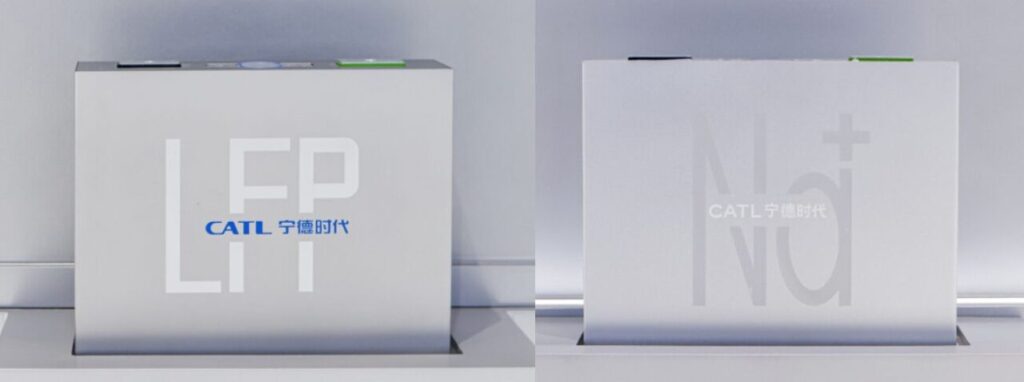
With “Sodium-Lithium Dual Stars: Forging Full-Scenario Energy Storage Solutions” as its core theme, CATL debuted its first dedicated sodium-ion cell for grid-scale storage—a standout highlight of the exhibition.
Engineered to share the same enclosure platform as its flagship 587Ah lithium-ion cell, the new cell ensures maximum interoperability between lithium and sodium systems. Boasting a capacity exceeding 300Ah, an efficiency of 97%, and a cycle life of over 15,000 cycles, it can cover 2-8 hour utility-scale storage and AI data centre (AIDC) scenarios, with commercial rollout slated for 2026.
Meanwhile, CATL announced that aforementioned 587Ah lithium-ion high-capacity storage cell, launched in 2025 and produced at its Lighthouse + Zero-Carbon Factory in Jining, Shandong, has shipped more than 5GWh cumulatively. The facility achieves a daily output of over 220,000 units, with cell defect rates controlled at the PPB (parts per billion) level, demonstrating its mass manufacturing capabilities.
Sungrow unveiled what it said is the world’s first full-scenario energy storage power conversion platform. Built on its “Three-Electronics Fusion” super-ecosystem integrating power electronics, electrochemistry and grid support, the company launched the next-generation “1+X” modular PCS (Power Conversion System). This platform incorporates eight core technologies including DC management, efficient power conversion and full-scenario grid-forming.
Through standardised modular design and unified interfaces, it achieves flexible configuration and universal adaptation of energy storage power conversion systems, addressing the industry pain points of lengthy non-standard customisation cycles and low compatibility, and redefining industry standards for energy storage power conversion.
Envision and LONGi expanded full-scenario applications through AI empowerment and PV-storage integration respectively.
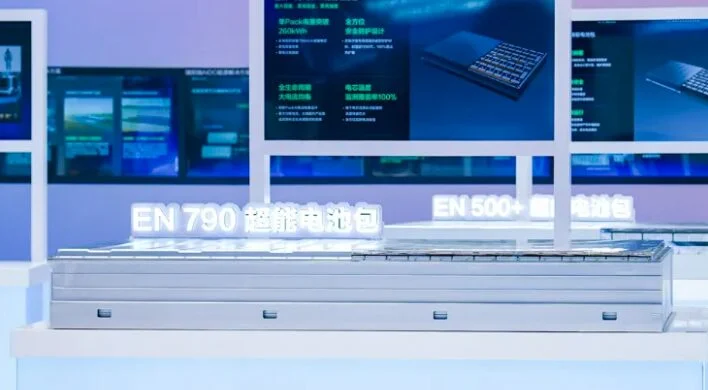
Under the theme “Pioneering AI Energy Systems,” Envision released a 12.5MWh AI storage system equipped with a next-generation AI-adaptive PCS. Announcing mass production of the world’s largest prismatic wound cell at 790Ah, it simultaneously rolled out its first sodium-ion storage cell, and deployed the world’s first 100% green power direct-supply AIDC project, setting a new benchmark for full-scenario solutions.
LONGi directly tackled the “patchwork” problem of fragmented PV-storage systems by officially launching its “Full-Stack LONGi ONE” PV-storage Integration Strategy. Through self-developed full-stack native fusion technology, it eliminates silos between PV and storage systems, creating a full-scenario product matrix covering utility-scale power plants to industrial and commercial parks, bringing the end to the “patchwork era” for PV-storage systems. It entered the energy storage industry by acquiring system integrator PotisEdge last year.
AIDC Becomes the New Hotspot: Deep Integration of Energy Storage and Computing Power Demand
Fuelled by the explosive growth of AI computing power, AIDC (AI data centres) has emerged as the hottest niche segment at this year’s exhibition. Hundreds of China’s energy storage and sector-adjacent companies unveiled dedicated products and tailored solutions, pushing energy storage beyond traditional power applications and into the heart of the digital economy.
Industry data underscores this rapid ascent. In the first two months of 2026, new energy storage installations for China’s AI computing centers accounted for over 40% of the nation’s total new capacity, making it the largest single application scenario for energy storage. Global demand is projected to hit 100GWh in 2026, with gross margins 15%-20% higher than traditional energy storage projects, cementing its position as the industry’s most profitable growth sector.
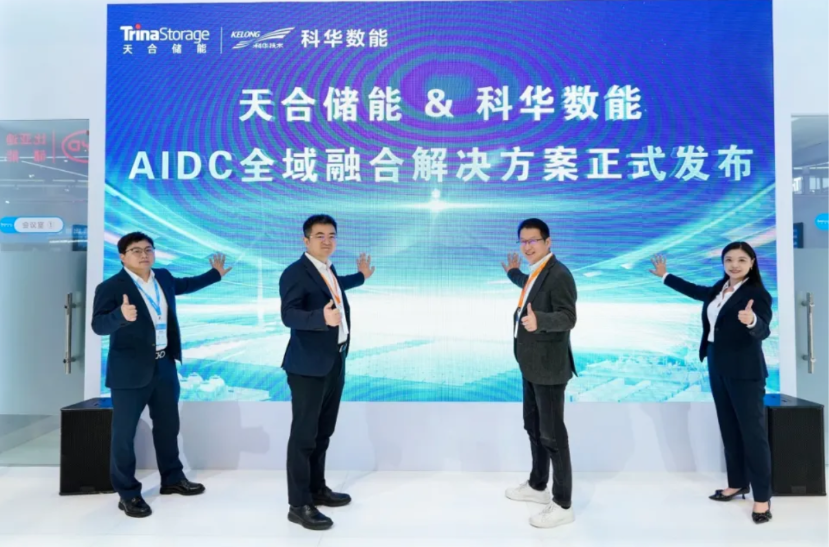
Trina Storage, in partnership with Kehua Digital Energy, launched a purpose-built, end-to-end integrated solution for AIDC at the event. Built on advanced source-storage grid-forming technology and optimised for precision power distribution and intelligent load management, the solution establishes a seamless, full-link energy ecosystem spanning generation, storage, distribution, and consumption. It is engineered to meet the stringent, high-reliability power supply demands critical for AIDC operations.
Narada Power introduced the AIOn X-Rate, a next-generation backup power system designed exclusively for AIDC environments. Through dual breakthroughs in advanced materials and system architecture, the platform delivers three defining advantages: ultra-high power, unparalleled safety, and exceptional cycle life. It supports 10C ultra-high rate discharge with zero-latency response, delivers over 600kW per cabinet, achieves a cell power density exceeding 1,900W/kg, and supports over 200,000 cycles of 500ms pulse discharge, making it perfectly suited for the ultra-high frequency regulation demands of AIDC, it said.
CATL has further expanded the technological landscape by positioning AIDC as a key application scenario for its newly launched sodium-ion storage cells, further diversifying the technology options available for this high-growth market.
The large cell race: mass production unlocks new pathways for cost optimisation
Scaling up storage cell specifications has emerged as a definitive industry consensus. Mainstream formats are rapidly evolving from legacy 280Ah and 314Ah models to 500Ah+ and 600Ah+ high-capacity platforms. This year’s exhibition became the epicenter of the large-format cell mass production race, with numerous leading manufacturers unveiling next-generation high-capacity cells and integrated systems—signaling a decisive industry shift toward full-scale manufacturing.
Envision is leading the global charge with the launch of the world’s largest prismatic wound cell, at an unprecedented 790Ah. The company confirmed the cell has entered full mass production and initiated global deliveries, setting a clear technological roadmap for the next generation of large-format storage cells.
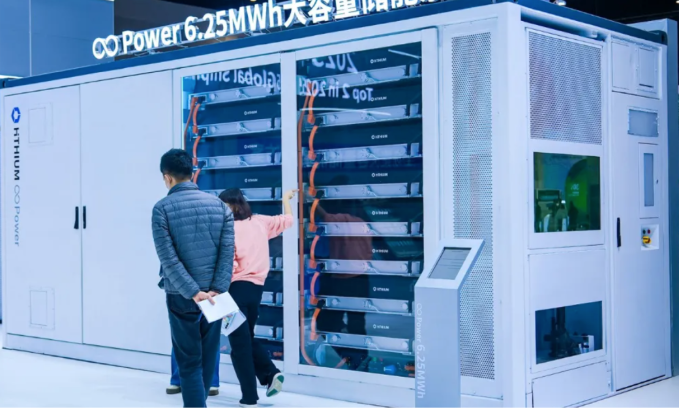
Hithium showcased its ∞Power 6.25MWh 2h/4h energy storage system, featuring self-developed high-capacity storage cells that flexibly adapt to varying duration requirements. Clou Electronics unveiled its next-generation large-scale storage system, the Aqua-C3.0 Ultra, equipped with 587Ah cells and a self-developed 2000V PCS, breaking free from the constraints of 20-foot containers to usher in a new era of 10-foot+ lightweight storage systems.
Companies including Pylontech, Inpow Battery, and EnergyInf are also making significant moves. Pylontech introduced 588Ah and 601Ah large-format cells alongside new sodium-ion and solid-state cell products.
Inpow Battery, a subsidiary of GAC Group, launched its “Da Fang Wu Yu” series 587Ah storage cells, with the Qiankun Edition semi-solid-state cell representing the industry’s first semi-solid-state large-format storage cell. Its 6.5GWh semi-solid-state battery mass production line will pioneer the large-scale manufacturing of semi-solid-state storage cells. EnergyInf focused on showcasing its 587Ah storage cells and liquid-cooled storage systems, rounding out its large-format cell product portfolio.
The mass production of large-format cells not only enhances system integration efficiency but also drives continuous cost optimisation in energy storage, laying the foundation for the industry’s large-scale development.
Safety upgrades: building a solid foundation for high-quality industry development
As the energy storage industry undergoes rapid scaling, safety has emerged as a core competitive differentiator. At this exhibition, numerous companies unveiled pivotal safety test results, collectively part of an industry-wide upgrade of energy storage safety standards.
HiTHIUM officially announced the successful completion of large-scale fire testing for its ∞Power 6.25MWh 4-hour long-duration energy storage (LDES) system, and has obtained official certification from international authority UL Solutions. This achievement represents the world’s first open-door fire test of a long-duration energy storage system featuring kiloampere-hour (kAh) cells, setting a new industry benchmark for safety verification in the long-duration energy storage sector.
CRRC Energy Storage has released pivotal results from six extreme safety tests, including large-scale fire testing. Conducted in full compliance with the latest international standards—UL 9540A:2026, NFPA 68/69, and NFPA 855:2025—the company completed a comprehensive suite of safety limit tests, powerfully demonstrating its technological leadership in energy storage safety. These continuous safety breakthroughs are building a robust foundation for the high-quality development of the energy storage industry and providing critical assurance for its large-scale commercial deployment.
Grid-forming tech
As the penetration of renewable energy continues to rise, power grids are evolving away from the traditional “mechanical-electromagnetic-grid” coupling model toward a new “energy-power conversion-grid” paradigm, now dominated by power electronic converters. The resulting decline in grid strength and system inertia has given rise to new grid stability challenges.
To address these challenges, Chint Power showcased two key innovations: its two-stage string-based low-voltage coupled grid-forming energy storage solution, and its industrial and commercial (I&C) energy efficiency solution. As the company explained, the grid-forming solution is built around liquid-cooled battery cabins and integrated energy storage power conversion and step-up units. It supports both 5MWh and 6.25MWh battery cabin configurations, and is fully compatible with both 314Ah and 587Ah cells. Featuring a modular design, the system can be flexibly scaled to meet the specific requirements of individual projects. With independent cluster-level management for each battery string, it significantly simplifies operation and maintenance.
Conclusion: a profound value reconstruction
This year’s exhibition clearly outlines the trajectory of China’s energy storage sector: evolving from product-centric competition to system-level competition, from isolated scenario applications to full-scenario coverage, and from mere technological breakthroughs to holistic safety upgrades. The industry is undergoing a profound value reconstruction.
Full-stack solutions are resolving critical adaptability challenges, AIDC scenarios are unlocking new growth frontiers, large-format cell mass production is driving relentless cost optimisation, grid-forming technology is enabling next-generation grid transformation, and safety upgrades are solidifying the bedrock of sustainable development.
These transformations are part of the Chinese energy storage industry’s pivot from policy-mandated storage to market-driven profitability, and from a supporting role in power grids to an essential backbone for global computing power infrastructure.