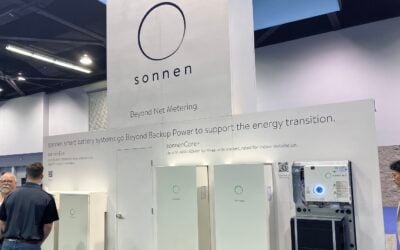
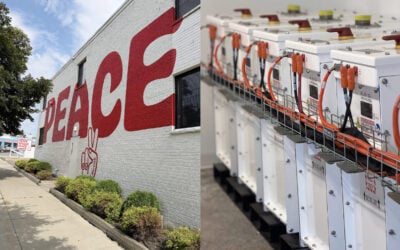
BMW i’s stationary energy storage product will be available with 22kWh or 33kWh capacity using lithium-ion batteries used in i3 electric vehicles. Image: BMW.
BMW has announced plans to launch a stationary energy storage product for both residential and small commercial applications using the high-voltage batteries used in i3 electric vehicles, including those repurposed from existing EVs.
The German company made the announcement at the Electric Vehicle Symposium & Exhibition 29 in Montreal, claiming it will be the first automotive manufacturer to utilise a complete automotive high-voltage battery for energy storage.
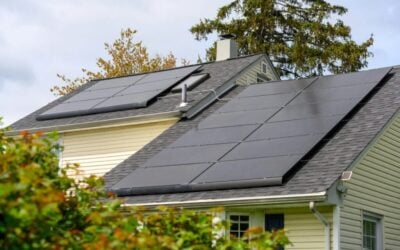
The system can use both new and second life BMW i3 high-voltage batteries and can be integrated with charging stations and solar PV systems to allow customers to offset peak energy costs and access backup energy reserves.
Cliff Fietzek, manager connected eMobility at BMW of North America, said: “The remarkable advantage for BMW customers in using BMW i3 batteries as a plug and play storage application is the ability to tap into an alternative resource for residential and commercial backup power, thus using renewable energy much more efficiently, and enabling additional revenues from the energy market.”
Try Premium for just $1
- Full premium access for the first month at only $1
- Converts to an annual rate after 30 days unless cancelled
- Cancel anytime during the trial period
Premium Benefits
- Expert industry analysis and interviews
- Digital access to PV Tech Power journal
- Exclusive event discounts
Or get the full Premium subscription right away
Or continue reading this article for free
The ‘plug and play’ lithium-ion battery systems will be available with 22kWh or 33kWh capacity and uses real-time energy readings to measure available energy supply and demand and calculate the optimal time to charge or discharge the system.
The storage system also includes a voltage converter and power electronics to manage the energy flow between renewable energy sources, the property interface, and the high-voltage battery from the BMW i3.
BMW says the re-use of batteries from BMW’s i3 range of electric vehicles for home and commercial energy storage is an expansion of the sustainability concept of its offering. Following in-vehicle usage, the BMW i3 battery retains most of its original capacity and so can continue to offer years of emissions free power storage.
Rob Healey, manager of EV infrastructure for BMW North America, added: “With a battery storage system electrified by BMW i our customers can take the next step towards a sustainable energy lifestyle. Coupled with the home charging and solar energy programs, the system enables BMW drivers to embrace holistic sustainability beyond e-mobility.”
The new product offering follows a similar launch by Nissan, which announced in May that that it would sell used LEAF battery units as a new residential battery storage system.