Battery storage is the technology best suited to handling the power fluctuations that artificial intelligence (AI) training loads can create at data centres, ESN Premium has heard.
Hugh Scott, chief technology officer at US system integrator FlexGen told the site that AI training loads have “changed the game” for data centres, turning what were typically steady and predictable loads for computation and HVAC auxiliary power, into a ramp rate challenge for grid operators.
“In AI training clusters, power can swing 50–100% of nameplate load several times per second,” Scott said in an interview.
“That level of ramp rate is challenging for grids, and it’s simply outside the operating envelope for most onsite generation assets, especially turbines, which cannot absorb that without risking damage.”
Try Premium for just $1
- Full premium access for the first month at only $1
- Converts to an annual rate after 30 days unless cancelled
- Cancel anytime during the trial period
Premium Benefits
- Expert industry analysis and interviews
- Digital access to PV Tech Power journal
- Exclusive event discounts
Or get the full Premium subscription right away
Or continue reading this article for free
FlexGen business development manager Jason Abiecunas highlighted the big picture in an article last year, saying that hyperscale data centres create unprecedented fluctuations, and the energy capacity needed to keep the data centres of all types going will be “eye-watering in terms of the amount of capacity [to be] added to the grid”. The CTO put some numbers on the power fluctuation challenge.
Beyond raw megawatts
In other words, while energy use for data centres has become a hot talking point across the economy and society in many parts of the world, in solving this sudden electrical load growth for the first time in decades, the distinction needs to be made between the addition of new energy capacity (either to the grid or at islanded behind-the-meter installations) and handling the power fluctuations caused by AI.
Even momentary disturbances to the 99.999% uptime availability guarantees that data centre tenants contract for can be costly, Scott said, even if the interruption lasts, say, just 20 milliseconds. Analysts estimate the revenue impact of outages at AI-focused facilities can be up to US$1 million per megawatt per day.
FlexGen, which works primarily on large-scale battery energy storage system (BESS) projects with a focus on the software and controls that, in the company’s own words, “turn them on and keep them on,” including its HybridOS energy management system (EMS) platform, formed a partnership with electrical contractor Rosendin last year to offer integrated technology solutions for data centre developers.
“Batteries are the only technology that can react at sub-cycle speed. Behind-the-meter (BTM) batteries absorb the fast transients, protect the grid from rapid swings, and protect the data centre’s own generators from operating outside their limits,” Hugh Scott told Energy-Storage.news.
“Data centres — especially AI training facilities — are forcing the industry to rethink how large loads integrate with the grid. Flexibility is becoming as important as raw megawatts.”
The uninterruptible power systems (UPS), traditionally banks of lead-acid batteries, that data centres have relied on in the past, are also no longer adequate to handle that uptime requirement as the scale grows, according to the CTO.
“Traditional rack-level UPS systems weren’t designed for the power densities we’re now seeing, which is 120kW per rack today, and heading toward 500–600kW,” he said, whereas moving the UPS function to a campus-level BESS provides data centres with the same ride-through capabilities for faults and outages while maintaining “vastly higher power levels” and freeing up floor space.
“We’re integrating Rosendin’s BESS-based UPS design with FlexGen’s patents around soft grid interconnection and transient frequency stabilisation, both of which directly address the short-duration, high-magnitude disturbances that AI data centres now create.”
FlexGen’s patents include a break-before-make automatic transfer switch (ATS) that the company claims can selectively connect a utility’s grid or distributed generation resources to a load bus.
In a switching transition, the ATS technology ensures momentary disconnection of both grid and generation sources from the load bus before either is reconnected, while power converters ensure the system also supplies power to the load bus during the transition period.
The company’s frequency stabilisation patent meanwhile includes one or more generators connected to an island grid, along with energy storage and a converter tied to both energy storage system and grid. Meanwhile, a control circuit directs the converter to move power into or out of the energy storage unit in response to load changes on the facility’s island grid. This helps keep the generator operating at its set operating point. The generator’s own control system will adjust output to meet demand, while the control circuit ensures the control system stays within the designed dynamic response limits as loads fluctuate.
“At the centre of all of this is software,” Hugh Scott said.
“Modern energy management systems (EMS) coordinate batteries, generators, and grid interactions at millisecond timescales. Technologies that originated in microgrids, such as seamless islanding, low-voltage ride-through, and multi-source orchestration, are now essential for keeping data centres online as load patterns become more volatile.”
Data centre developers, energy storage technology providers, renewable and conventional energy developers and, of course, the tech companies that will rely on them have begun to recognise this key role of energy storage.
Although this has led to a sudden resurgence of interest in nuclear and gas, batteries paired with renewables can be the fastest and cheapest way to add energy capacity, even if the enormous need for capacity means many data centres will opt for an ‘all of the above’ strategy, including nuclear and gas.
OpenAI and Oracle, two of the biggest players, recently signed a deal for a 1GW+ campus in Michigan, US, which utility DTE will power with a mix of resources, including new battery storage.
Around the same time as that announcement last November, BESS technology provider Prevalon Energy partnered with software and engineering firm Emerson to support hyperscale, colocation and enterprise data centres, and another, ON.Energy, paired up with power conversion system (PCS) manufacturer EPC Power to target the growing market.
Among dozens of other announcements, perhaps the most eye-catching was the US$4.75 billion-plus-debt deal agreed a couple of weeks ago for Google parent company Alphabet to acquire data centre and energy project developer Intersect Power.
Four ways batteries can solve data centre pain points
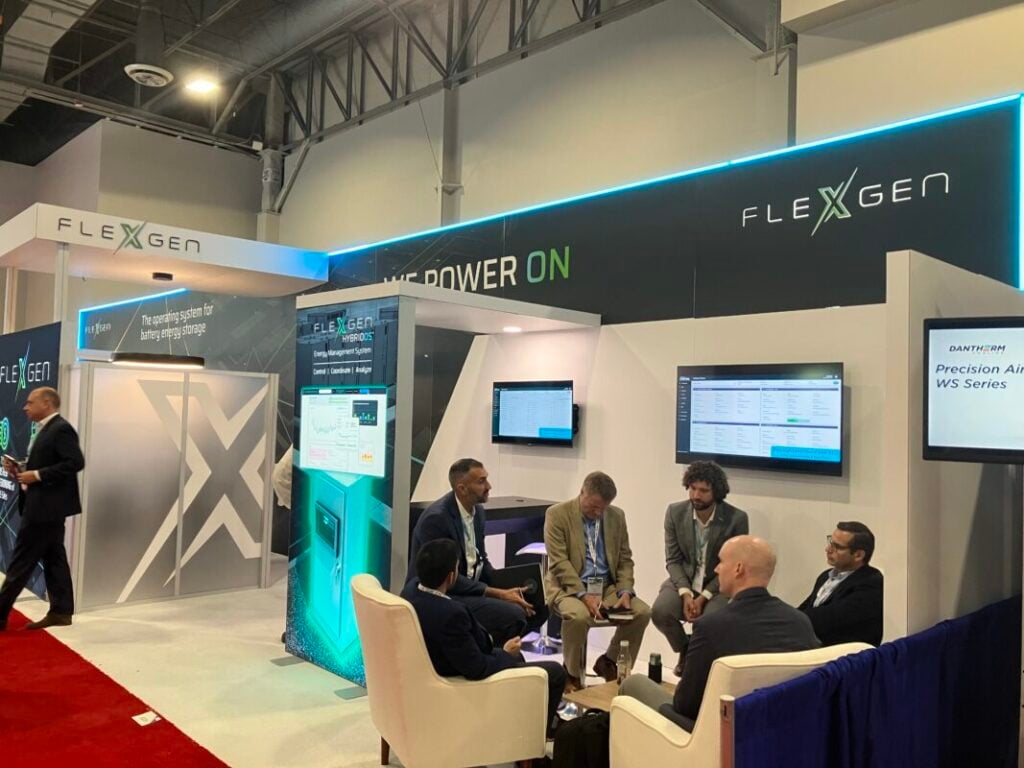
In our previous interview, which took place at the RE+ clean energy trade show in Las Vegas last September, Jason Abiecunas said batteries can help solve four main problems for data centres, which CTO Hugh Scott handily elaborated on in a follow-up email to our conversation.
Battery storage can, Scott said:
1. Enable faster grid interconnection
Interconnection queues are long because utilities must plan for the full requested capacity. When a data centre brings its own batteries, it reduces the firm capacity the utility must reserve. In some cases, an interruptible interconnection, backed by batteries, can move a project forward months or even years faster.
2. Help reduce and manage the cost of power
Batteries allow data centres to avoid buying power during expensive periods. Peak shaving, demand reduction, and time-of-use arbitrage are standard tools, and in many markets, they materially reduce the cost per MWh.
3. Add reliability and resilience
With onsite batteries, a data centre can operate through grid faults, perform black starts, ride through low-voltage events, and maintain power quality even during rapid load swings. When paired with gas, solar, or nuclear, batteries also allow partial or full off-grid operation.
4. Power quality management
This is becoming one of the biggest issues. AI loads introduce ultra-fast ramps that are incompatible with most generation assets and stress local grid components. Batteries absorb these transients, allowing both the grid and onsite generation to operate within their designed limits.
“The physics problems are real, but solvable. The combination of fast-responding storage, intelligent controls, and thoughtful interconnection design will determine how quickly new data centres can be built without compromising grid reliability,” Scott said.
The Energy Storage Summit USA will be held from 24-25 March 2026, in Dallas, TX. It features keynote speeches and panel discussions on topics like FEOC challenges, power demand forecasting, and managing the BESS supply chain. ESN Premium subscribers receive an exclusive discount on ticket prices. For complete information, visit the Energy Storage Summit USA website.