
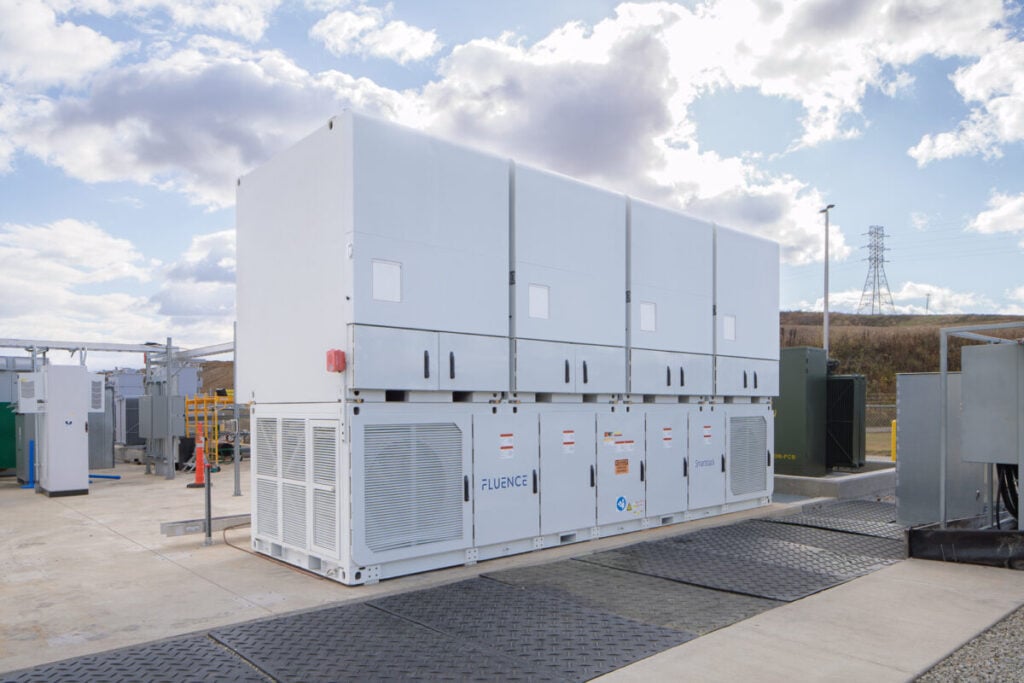
Sam Markham, manager – policy and market growth at Fluence Australia, believes grid-forming battery energy storage systems (BESS) are essential to deliver a safe, secure and affordable decarbonised power system in line with government renewable energy objectives.
Australia’s energy transition is entering a more complex phase, where our path to delivering a decarbonised power system not only relies upon the volume of energy needed to meet demand, but also on the non-energy essential system services needed to support a safe and secure power system.
Essential system services are the supporting elements that make sure energy is delivered to end-users safely and securely.
Recent developments, including delayed thermal power station closures and new regulatory reform proposals, highlight the critical role of essential system services in maintaining a secure, reliable electricity system as thermal generation like coal and gas retires.
Try Premium for just $1
- Full premium access for the first month at only $1
- Converts to an annual rate after 30 days unless cancelled
- Cancel anytime during the trial period
Premium Benefits
- Expert industry analysis and interviews
- Digital access to PV Tech Power journal
- Exclusive event discounts
Or get the full Premium subscription right away
Or continue reading this article for free
Delayed closures reflect system readiness concerns
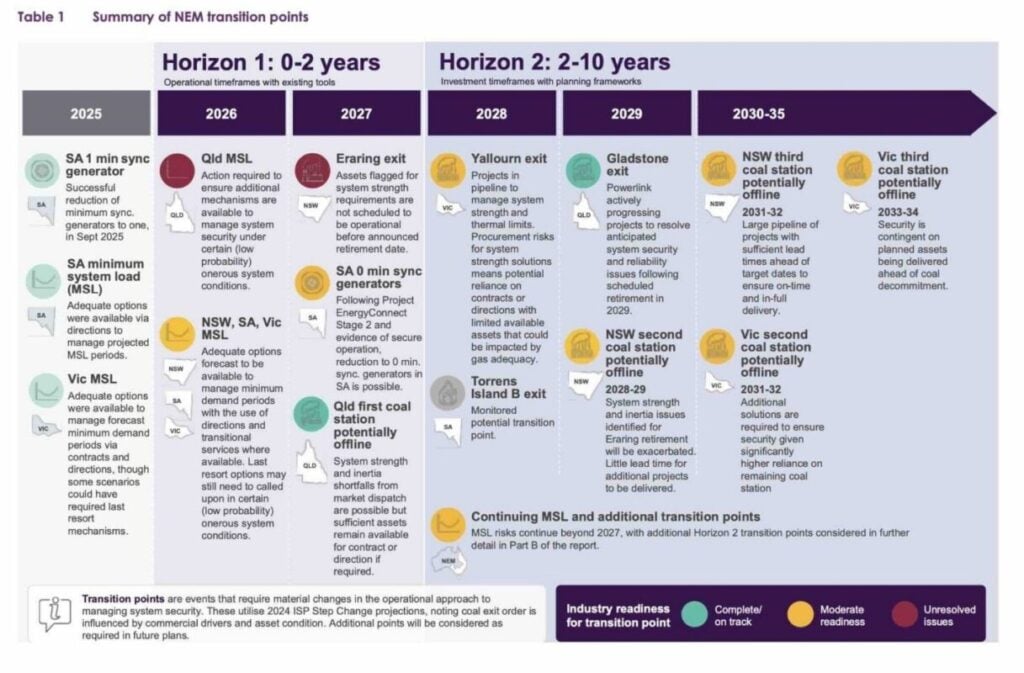
In December, the Australian Energy Market Operator (AEMO) published its 2025 Transition Plan for System Security (TPSS), which reinforced the need for governments to focus on both reliability (delivering enough megawatts of capacity) and essential system services (the stabilising characteristics needed to safely operate the power system).
AEMO’s TPSS identified multiple transition points over the coming decade where the system may not be sufficiently prepared to manage the withdrawal of synchronous generation without additional technical capabilities in place.
AEMO highlighted challenges around system strength (the ability of the power system to maintain and control the voltage waveform at any given location), inertia (a fast and automatic injection of energy to suppress rapid frequency deviations in the power system and slow the rate of change of frequency), and fault response (how generating systems and the network behave when a fault occurs) as thermal units retire.
Then, Australia’s largest coal-fired power station, Eraring, confirmed a further two-year delay to its planned closure, extending operations until 2029. The announcement cites concerns about the ability to safely manage the power system in a high-inverter-based generation grid.
Together, these developments indicate that Eraring’s delay is unlikely to be an isolated case and signals that the existing frameworks need to be enhanced to deliver the technical requirements of a renewables-led system.
What are essential system services and why they matter
Essential system services, including voltage waveform stability, fault current and inertia, are foundational to operating a safe and secure power system. These are just three of many characteristics needed to support the safe and reliable delivery of energy to end users.
Historically, reliability and security were inextricably linked, as essential system services were provided by traditional forms of generation like coal, gas, and hydro as by-products of their electricity output. But as those assets age and retire, new sources of decarbonised electricity have different characteristics.
Australia’s power system is dominated by new entrants like utility-scale solar, wind and BESS that are inverter-based. This inverter-based generation interacts with the power system differently to traditional generation. These inverter-based resources don’t produce essential system services as a byproduct of energy, and the way AEMO manages the power system is changing as a result.
To meet renewable energy targets, governments must expand their focus to include the delivery of essential system services. Getting the right mix of investment to deliver enough capacity to meet demand and the essential system services to support the power system, is crucial to avoid governments continuing to be forced to pay thermal assets to delay their closures rather than focusing on new investment.
Without considering both reliability and essential system services, the energy transition will be slower and more costly for energy consumers.
Policy reform critical to continue decarbonising the grid
While recently introduced reforms have made progress towards addressing essential system services in the National Electricity Market (NEM), more is needed. Improvements to the existing system strength, inertia and Network Support and Control Ancillary Services (NSCAS) frameworks are not only crucial to decarbonising the power system, but also to lay the foundation for an enduring and efficient market in the longer term.
Against this backdrop, AEMO and Australia’s peak energy industry bodies have recently stepped up with calls for reform. In the past three months, the Australian Energy Market Commission (AEMC) has received two new rule change requests, one from AEMO and another collaborative initiative from the Clean Energy Council (CEC) and the Australian Energy Council (AEC).
The requests seek to enhance existing security frameworks by setting clearer guardrails for procuring non-network ESS options, including timeframes, tender or bilateral contract use, and contract tenor. It also seeks to introduce clearly defined technical specifications for services to increase regulatory certainty and transparency (currently only available for inertia).
These enhancements are critical to deliver the essential system services necessary to give governments confidence to operate an entirely inverter-based power system safely, securely and affordably.
Grid forming BESS offers fast-to-deploy essential system services
The leading technologies considered by Transmission Network Service Providers (TNSPs) to date are synchronous condensers (large rotating electrical machines that provide essential grid‑stabilising services such as system strength, voltage control, and inertia) and “non-network options” such as grid-forming BESS and other forms of longer duration storage.
Relative to traditional network upgrades, non-network options like grid-forming BESS are fast to deploy and capable of delivering both energy and advanced services, making them well positioned to play a growing role in providing essential system services.
The introduction of NEM-wide technical specifications for the full range of essential system services must be based on broad industry engagement focusing on power system outcomes. Technical specifications along with improved incentives for TNSPs to consider non-network options would also enhance innovation and ensure that new investments in grid-forming BESS can provide maximum support for the grid.
Clear and bankable procurement frameworks are critical to ensure that eligible non-network options, like grid-forming BESS, contribute to all the needs of the power system in addition to energy. NEM-wide technical standards and procurement processes would help to rapidly deliver essential system services at the lowest cost for energy consumers and give governments the confidence to close thermal assets as soon as practicable.
Australia is world-leading in facing this challenge
Australia’s isolated grids in the NEM and Western Australia’s Wholesale Electricity Market (WEM), along with significant penetration of inverter-based renewables (wind, rooftop solar and utility-scale solar) and aging coal-fired power plants make our grids some of the first to navigate this challenge at scale.
While some other grids internationally are navigating rapid decarbonisation, the NEM alone has a peak demand of over 34GW, has some of the highest reliability standards, is not interconnected with any other markets, and is one of the longest, stringiest grids in the world. This presents a significant opportunity for the uptake of inverter-based generation across the entire market, but also a complex challenge in navigating the closure of thermal assets.
This phase of the energy transition, and the market reforms that go along with it, gives Australia an opportunity to learn from other grids that are moving along the same pathway, and define the blueprint of decarbonisation that other grids worldwide may follow.
Industry and governments must work together to enhance policy frameworks quickly. Ultimately, defining and procuring essential system services will determine not only how rapidly thermal assets can retire, but also how quickly and affordably we can decarbonise the power system.
The Energy Storage Summit Australia 2026 will be returning to Sydney on 18-19 March. Sam Markham will be discussing grid-forming technologies in the ‘BESS and Grid-Forming Technologies: Moving from Theory to Bankability‘ panel discussion on day one of the Summit.
To secure your tickets and learn more about the event, please visit the official website. ESN Premium subscribers receive an exclusive discount on ticket prices.
About the Author
Sam Markham is a policy and market growth manager at Fluence, focusing on emerging policy issues and market opportunities for energy storage within Asia Pacific. Sam has extensive wholesale electricity market design, policy development and regulatory market monitoring experience in government rule-making and regulator roles.
In previous roles, Sam led a team of modelling and economic experts to advise governments on reform opportunities to tackle key economic issues in the NEM such as addressing future investment challenges in the NEM, improving resilience to financial crises, and incentivising demand-side participation in wholesale operations.