
Opportunity is ahead for Europe’s growing fleet of residential battery storage systems in electricity trading, writes Chris Bernkopf, CEO of flexibility and trading platform Podero.
Europe is building storage at a pace that would have seemed extraordinary five years ago. Germany alone has deployed hundreds of thousands of residential batteries. Grid-scale BESS projects are springing up across the continent. And every week, new announcements arrive from markets we used to think of as laggards.
On so many fronts, it’s great news. But a lot of that capacity is either not trading at all or trading into the same small pool of ancillary services markets. They’re at risk of becoming saturated to the point where the economics no longer work.
We’ve built the storage, but we haven’t yet built the smart trading stack to go with it.
Try Premium for just $1
- Full premium access for the first month at only $1
- Converts to an annual rate after 30 days unless cancelled
- Cancel anytime during the trial period
Premium Benefits
- Expert industry analysis and interviews
- Digital access to PV Tech Power journal
- Exclusive event discounts
Or get the full Premium subscription right away
Or continue reading this article for free
Where BESS is leaving money on the table
For grid-scale battery operators, frequency control reserve (FCR) and automatic frequency restoration reserve (aFRR) ancillary services used to deliver solid, foreseeable returns. But today, those markets are increasingly oversupplied.
Jon Ferris, Head of Flexibility at LCP Delta, put it well when we spoke recently: the big batteries have been forced into multi-market optimisation; stacking frequency response, reserve products, day-ahead and intraday, all at once. It’s complex, requires sophisticated trading infrastructure, and returns are harder to come by.
Meanwhile, across Europe, residential solar-plus-battery systems are largely operating in pure self-consumption mode: charge from solar during the day, discharge to the home. It’s an enormous fleet of dispatchable storage that is effectively invisible to electricity markets. And unlike a grid-scale battery, a fleet of distributed residential batteries has the agility to respond to more local or fast-moving trading opportunities, such as the continuous intraday market.
The intraday opportunity for residential storage
Intraday prices are volatile in a way that day-ahead prices are not. A cold snap, a wind forecast revision, a plant outage – any of these can move quarter-hourly intraday prices significantly relative to the day-ahead reference.
On one day in October 2025, we recorded intraday bid prices approaching €1,000/MWh (US$1153/MWh) for certain delivery periods against a day-ahead reference of €129/MWh. That differential represents real, tradeable value.
Grid-scale BESS operators and large industrial players have been active in intraday markets for years. But nobody has been doing bottom-up aggregation of residential batteries for continuous, physical-delivery intraday trading at scale.
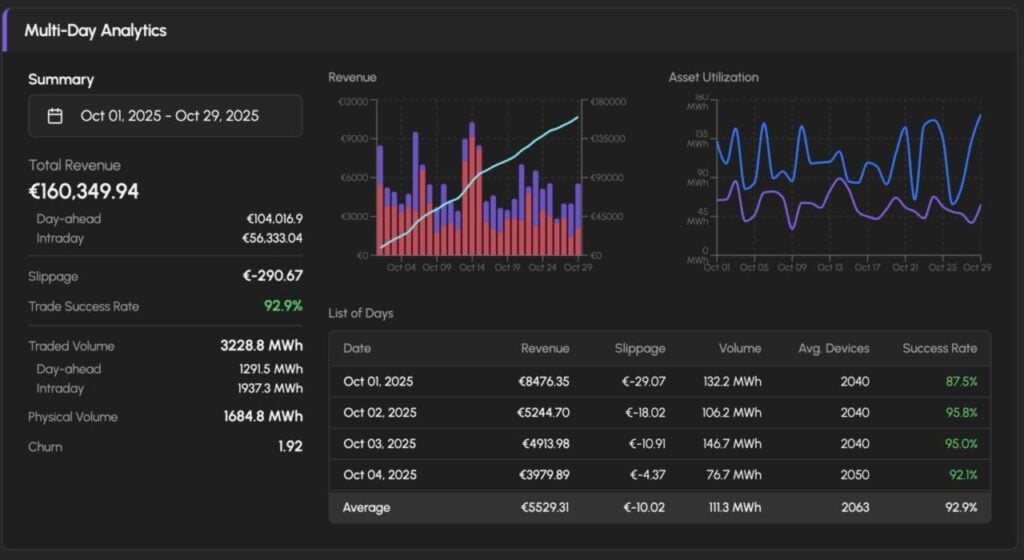
We are building this category at Podero. The model works by treating a large number of individually modest home batteries as a single, coordinated asset. When our trading system identifies an opportunity on the continuous intraday market—a price spike in a specific delivery period, for instance—it calculates how much flexibility is available across the fleet at that moment, accounting for each household’s state of charge, their preferences, and the health of their device.
It then shifts the charge and discharge behaviour of thousands of batteries in a coordinated way, creating a position large enough to be meaningful in the market. Each position we take on the continuous market is backed by a physical battery fleet capable of adjusting its charge or discharge behaviour. We’re shifting the load profile of real devices, then extracting the value of that shift on the intraday market, though always prioritising household preferences and device health.
Why this matters for the grid, not just for revenues
There’s an easy version of this conversation that focuses entirely on utility revenue and consumer bill savings. I don’t want to stop there, because the system benefit story is just as compelling.
A weather-driven, renewable-heavy grid typically produces more intraday volatility. The period between day-ahead gate closure and real-time delivery is often when forecasts get revised, and imbalances emerge. That’s exactly when aggregated residential storage could be providing system-level value.
Equally, local congestion management, peak shaving, and voltage support are all problems that would benefit from market access to distributed, intelligent storage assets.
What needs to change
The markets exist and the hardware is installed. What’s missing is the integration layer that connects residential battery fleets to trading infrastructure – and the commercial appreciation that investing in the consumer proposition will pay back.
When households trust that their battery is being managed intelligently—storing solar power, exporting it and charging later, or charging from the grid when it’s cheap for later use when prices are high and solar output is low—they are far more likely to participate in coordinated battery trading.
As more households join, the fleet grows, and its value increases. It’s time to treat residential storage as a trading asset class, involve trading desks in residential flex programmes, and take a more nuanced approach to market design and participation.
About the Author
Chris Bernkopf is CEO of Podero, a residential device flexibility and trading platform used by European utilities to unlock next-generation energy products. Bernkopf is a serial founder and engineer who previously built Alpas (YCombinator W21), a software company that helps companies like BASF, ABB, and SBB source mechanical parts faster and cheaper. His background is in physics and data science (CERN), as well as in sales and software engineering for the educational AI and electric mobility spaces.