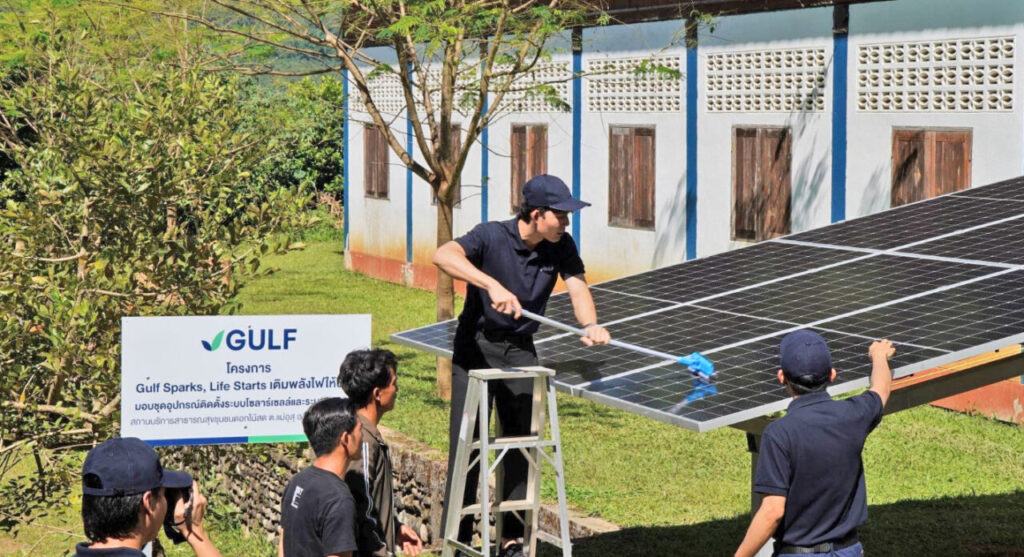
A consortium of development finance institutions led by the Asian Development Bank (ADB) and IPP Gulf have signed a US$820 million loan agreement for a solar and storage portfolio in Thailand, they announced today (28 November).
The loan will finance the construction of 12 renewable energy projects, eight of which are solar PV-only and four of which are solar and storage, overall totalling 649MW of solar capacity and 396MWh of battery energy storage system (BESS) capacity.
The eight standalone solar PV plants total 393MW of capacity while the solar and storage plants amount to 296MW of solar and 396MWh of BESS.
The projects are being developed by Gulf Renewable Energy Company Limited, a subsidiary of independent power producer (IPP) Gulf Energy Development Public Company Limited (Gulf) one of the largest IPPs in Thailand with around 14.5GW of capacity online today.
Try Premium for just $1
- Full premium access for the first month at only $1
- Converts to an annual rate after 30 days unless cancelled
- Cancel anytime during the trial period
Premium Benefits
- Expert industry analysis and interviews
- Digital access to PV Tech Power journal
- Exclusive event discounts
Or get the full Premium subscription right away
Or continue reading this article for free
At least two of the solar and storage projects being financed will provide electricity to Thailand’s transmission system operator (TSO) and bulk energy distributor EGAT (Electricity Generating Authority of Thailand) under a 25-year deal. The BESS for those projects will primarily provide solar energy load shifting.
Longer project documents from ADB about those projects indicate they will both be using BESS units with a nominal capacity of 2,752kWh though it did not reveal the provider. That capacity matches up with BESS products from several China-based companies, including inverter and BESS company Sungrow and lithium-ion OEM Sunwoda.
One of the solar plus storage projects detailed will have 34 of those BESS units, totalling around 94MWh of capacity, while the other will just have one.
Gulf tied up with Sungrow earlier this year for 3.5GW of projects in Thailand, although Sungrow has not been specified as the technology provider for these projects.
ADB was mandated lead arranger and bookrunner and provided US$260 million of the loan total from its capital resources with the remaining US$529 million from other development finance institutions. They are the Asian Infrastructure Investment Bank, DEG – Deutsche Investitions- und Entwicklungsgesellschaft (German Development Finance Institution), the Export-Import Bank of China and KEXIM Global (Singapore), as well as others not named in the press release.
ADB will also provide blended concessional finance of US$31.35 million from its Clean Technology Fund to allow for what it described as the ‘higher execution and operating risks’ of solar–plus-storage projects.
The state of the energy storage market in broader Southeast Asia was a big focus of Solar Media’s Energy Storage Summit Asia 2024, held in Singapore in July this year.
See the ADB’s document library for the Gulf solar and storage projects here.