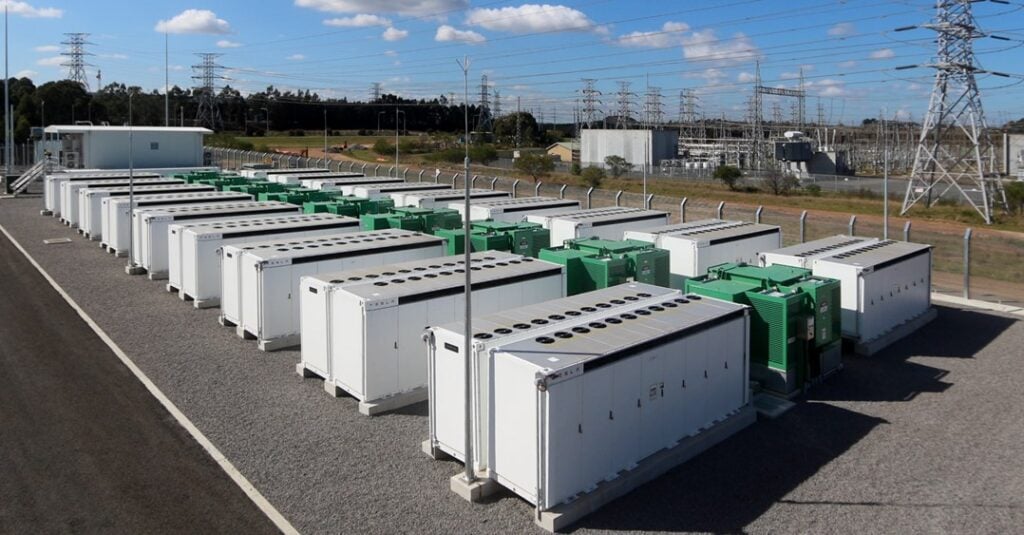
Transgrid has shortlisted nine utility-scale battery storage projects, totalling up to 2GW, to provide critical system strength services to New South Wales’ (NSW) transmission network in Australia.
The transmission network operator announced the shortlist following completion of technical modelling to determine required capacity and priority locations across the NSW grid.
However, Transgrid has not disclosed which battery storage systems have been selected.
Negotiations are now underway to secure system strength services from the grid-forming battery systems, which are expected to begin coming online in the second half of 2026.
Try Premium for just $1
- Full premium access for the first month at only $1
- Converts to an annual rate after 30 days unless cancelled
- Cancel anytime during the trial period
Premium Benefits
- Expert industry analysis and interviews
- Digital access to PV Tech Power journal
- Exclusive event discounts
Or get the full Premium subscription right away
Or continue reading this article for free
“Third-party owned batteries are integral to our system strength plan, because they enable us to accelerate the strengthening of the grid without the cost associated with acquiring new plant or major network upgrades,” said Jason Krstanoski, TransGrid’s executive general manager network.
The initiative represents the first tranche of Transgrid’s system strength procurement strategy, which ultimately aims to secure 5GW of stabilising services from third-party-owned battery storage systems by 2033.
Indeed, this approach addresses the critical challenge facing NSW’s power system as 80% of the state’s coal capacity retires over the next decade, removing the traditional sources of system strength that have underpinned grid stability.
The shortlisted battery systems form part of Transgrid’s comprehensive response to maintaining what the company describes as the grid’s “heartbeat” as the energy transition accelerates.
Historically, the NSW grid has relied on coal generators to provide system strength as a byproduct of their normal operation, creating an urgent need for alternative solutions as these plants close.
Transgrid’s broader System Strength Plan, finalised in July 2025 after assessing more than 100 individual solutions over three years, identifies a preferred portfolio worth AU$8.8 billion (US$6.11 billion) in net market benefits.
The plan combines 5GW of grid-forming battery storage systems with ten synchronous condensers on the backbone network, modifications to 650MW of existing synchronous generators, and targeted solutions for renewable energy zones.
The Australian Energy Market Operator (AEMO) has identified grid-forming battery storage systems as a priority action for 2026, recognising their potential to form the operational foundation of power systems with high renewable energy penetration.
These advanced battery systems can independently provide voltage and frequency control, unlike traditional grid-following batteries, which require a stable grid reference to operate effectively.
The grid-forming battery storage systems will complement synchronous condensers in providing system strength services, with the battery fleet expected to deliver the equivalent strength of 17 additional synchronous condensers.
Market opportunity for developers
Krstanoski emphasised that the procurement process focuses on battery storage systems that already exist or are in advanced development stages at specific network locations, enabling Transgrid to address system strength gaps as they emerge.
The direct negotiation approach aims to ensure competitive pricing and contract terms while selecting the optimal battery fleet for NSW consumers.
“System strength presents an additional opportunity for batteries to provide value to the energy system, and contracting for this service will help stabilise the grid and make NSW a better place to invest in this technology,” Krstanoski said.
Krstanoski added that the initiative comes as Australia has emerged as the third-largest global market for large-scale battery systems, according to analysis by Rystad Energy. This growing investment pipeline has provided Transgrid with a substantial pool of potential projects to evaluate for system strength services.
Transgrid has noted that its requirements will continue to evolve as the energy transition progresses, with the company planning to engage a wider pool of battery owners in future procurement rounds.
As the designated System Strength Service Provider for NSW, Transgrid is responsible for ensuring sufficient system strength services are available to maintain power system stability across the state.
Interested in Australia? Read Energy-Storage.news’ Energy Storage Summit Australia coverage and related content.