
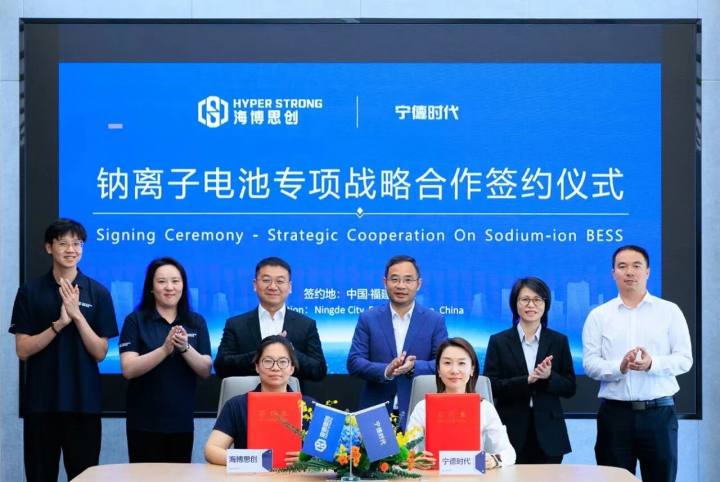
Sodium-ion may be increasingly competitive for projects where total lifecycle economics matter more than initial procurement cost alone, the CEO of HyperStrong told Energy-Storage.news after the system integrator signed a 60GWh supply and co-operation agreement with CATL.
Dr. Jianhui Zhang, founder, chairman and CEO of battery energy storage system (BESS) integrator HyperStrong discussed the firm’s approach to using sodium-ion battery cells in its product in this Q&A. The deal with CATL sparked huge industry reaction and discussion.
Zhang touched on the challenges in developing a sodium-ion BESS product but also the potential he sees for the technology, and in what market segments. Read the full Q&A further down.
The sodium-ion BESS product specifications are still to be fully ironed out, he said. The firm has designed its manufacturing processes and enclosure design to be flexible and allow for the ‘dropping in’ of new chemistries, but some extra system-level optimisation will be needed to accommodate sodium-ion.
Try Premium for just $1
- Full premium access for the first month at only $1
- Converts to an annual rate after 30 days unless cancelled
- Cancel anytime during the trial period
Premium Benefits
- Expert industry analysis and interviews
- Digital access to PV Tech Power journal
- Exclusive event discounts
Or get the full Premium subscription right away
Or continue reading this article for free
This is because its voltage platform and electrochemical behaviour is different to lithium-ion, lithium iron phosphate (LFP) batteries, the dominant chemistry for grid-scale BESS today.
However, sodium-ion has some advantages over LFP and thus may become more competitive than it in some applications, he added.
Sodium-ion ‘relatively compatible’ with mainstream BESS manufacturing
Energy-Storage.news: How will the sodium-ion batteries fit into HyperStrong’s existing products and architecture?
Dr. Jianhui Zhang: Our approach is to integrate sodium-ion technology into existing storage platform architectures rather than develop a completely isolated product ecosystem.
From a system integration perspective, sodium-ion batteries are relatively compatible with today’s mainstream storage manufacturing and integration frameworks. However, because their voltage platform and electrochemical behaviour differ from LFP batteries, targeted optimisation is still required at the system level.
For HyperStrong, the long-term direction is not to build separate architectures for every chemistry, but to evolve toward more flexible multi-chemistry storage platforms.
Will an entirely new BESS design be built around the cells?
At this stage, we do not see the need for a completely new BESS architecture.
Most of the core system framework can remain consistent with existing utility-scale storage platforms, while key adaptations are made in areas such as BMS strategy, thermal management, operational logic, and lifecycle optimisation.
The focus is less about redesigning the hardware platform from scratch, and more about improving system-level adaptability for different battery technologies.
Does it require investments in HyperStrong’s own assembly/manufacturing or can it easily drop into your existing processes?
Existing assembly and manufacturing systems already provide a good compatibility foundation for sodium-ion integration.
That said, as the technology moves toward larger-scale commercialisation, some engineering and manufacturing optimisation will still be necessary to further improve consistency, operational reliability, and lifecycle performance.
We see these early-stage investments as strategically important. For emerging storage technologies, operational experience and real-world engineering data are critical to accelerating commercialisation and long-term bankability.
Could you give some guidance on the likely metrics/size/power ratings, cycle life and performance warranties for the sodium-ion BESS?
The technology is still progressing from demonstration-stage deployment toward broader commercial scaling, so final product specifications will continue evolving alongside system validation and operational data accumulation.
What we are seeing so far is strong potential in long cycle life, wide-temperature adaptability, and system safety performance—particularly in high-utilisation and long-duration storage applications.
For storage projects, especially utility-scale assets with 15-year-plus operating expectations, the market is increasingly focused on lifecycle reliability and long-term operational stability rather than simply headline specification figures. That is where we expect sodium-ion technology to demonstrate growing value as commercialisation progresses.
Which market segments are you seeing the most demand for sodium-ion BESS from?
The strongest interest currently comes from applications that require high operational stability, high cycling intensity, and long asset lifetimes.
This includes utility-scale standalone storage projects, long-duration energy storage, high-frequency dispatch applications, data centers, and emerging ‘AI + energy’ infrastructure scenarios.
We are also seeing increasing market attention from projects focused on long-term operational value optimisation, particularly where storage assets are expected to operate for 15 years or longer.
In what applications is it more cost-competitive than LFP?
Today, LFP still benefits from a more mature supply chain and stronger near-term cost advantages.
However, sodium-ion technology may become increasingly competitive in applications where total lifecycle economics matter more than initial procurement cost alone.
In long-duration storage, high-cycling scenarios, and projects with extended operational lifetimes, factors such as safety performance, operational stability, temperature adaptability, and long-term asset management efficiency become increasingly important.
In addition, sodium resources are abundant and geographically diversified, which may provide advantages in supply-chain resilience and long-term raw material cost predictability—areas that global storage investors are paying closer attention to.
What potential does sodium-ion have for the energy storage industry?
We see sodium-ion batteries as an important complementary technology pathway for the future energy storage industry.
The market is unlikely to be dominated by a single battery chemistry over the long term. Instead, different technologies will coexist and create differentiated value across different applications.
Sodium-ion technology has strong potential in areas such as long-duration storage, high-safety applications, and long-lifecycle infrastructure projects. It may also help strengthen supply-chain resilience and diversify the industry’s technology base.
As renewable penetration continues to increase globally, long-term operational reliability, lifecycle efficiency, and grid resilience are becoming increasingly important. Sodium-ion technology aligns well with these long-term market trends.
