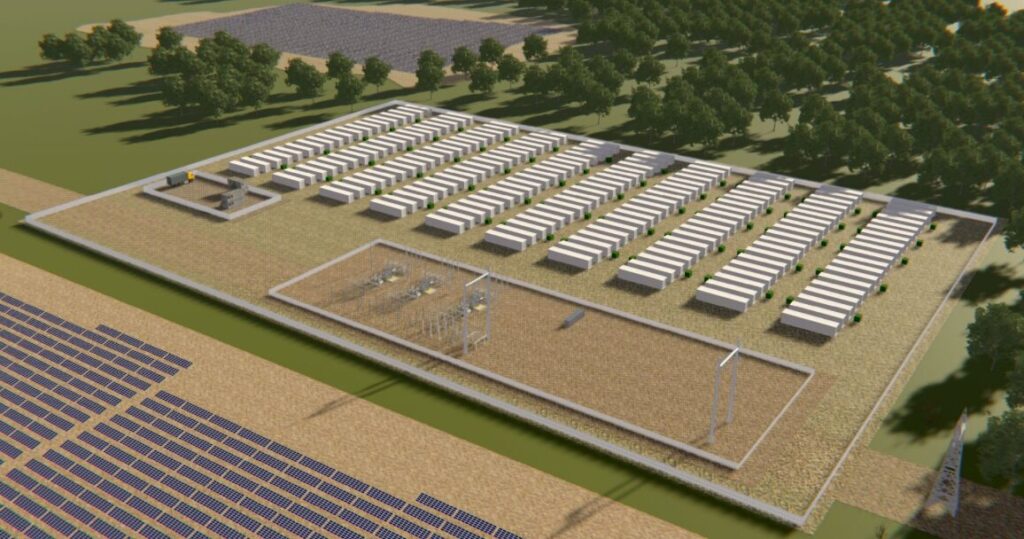
Ark Energy has received approval from the Australian Energy Market Operator (AEMO) and transmission network service provider Transgrid to connect its 3,148MWh Richmond Valley solar-plus-storage site to the National Electricity Market (NEM).
The Queensland-headquartered developer confirmed last week (5 June) that it had received its 5.3.4.A/B letters for the project, which are the formal certificates under the National Electricity Rules confirming that a generating system meets Generator Performance Standards.
This followed a process that included design adjustments, power system modelling, hundreds of simulations, network studies, and collaborative workshops.
Ark Energy confirmed the project will connect to the local 330kV network via a new Richmond Valley Switching Station to be constructed on site.
Try Premium for just $1
- Full premium access for the first month at only $1
- Converts to an annual rate after 30 days unless cancelled
- Cancel anytime during the trial period
Premium Benefits
- Expert industry analysis and interviews
- Digital access to PV Tech Power journal
- Exclusive event discounts
Or get the full Premium subscription right away
Or continue reading this article for free
The Richmond Valley project will incorporate grid-forming inverter technology and is set to be one of the first hybrid solar-plus-storage developments in the NEM to operate through a single point of connection, a configuration that simplifies dispatch and grid services delivery compared with separately connected generation and storage assets.
Construction on Stage 1 is targeted to commence later in 2026, featuring a 200MWac solar PV power plant co-located with a long-duration 275MW/2,200MWh lithium iron phosphate (LFP) battery storage system. The full approved configuration includes 435MW of solar PV and a 475MW/3,148MWh BESS.
Ark Energy CEO Michael Choi said the grid connection approval brings the project a step closer to financial close.
“This is a flagship project for Ark Energy and once operational, it will make a significant contribution to electricity supply and grid stability for NSW and the NEM,” Choi said.
A long development journey reaches a turning point
The Richmond Valley project has been in development since 2019 and has progressed through a combination of state and federal approvals. The New South Wales (NSW) Independent Planning Commission granted approval in October 2025.
The approved configuration expanded the battery system’s power output to 475MW while extending energy storage capacity to 3,148MWh from the original 2,200MWh proposal, with the project’s 730,000 bifacial solar modules featuring single-axis tracking technology and the co-located battery system designed to provide frequency regulation and peak demand management across the NEM.
The project received federal environmental clearance under the EPBC Act in December 2025, completing the approvals chain ahead of the grid connection process.
Ark Energy signed a BESS supply agreement with Seoul-headquartered Hanwha Energy in March 2025 for the Richmond Valley project, confirming the use of LFP chemistry for the storage system.
An Early Contractor Involvement agreement with Elecnor Australia, executed in September 2025, covers preliminary engineering and design work, including site studies, solar PV design, and balance-of-plant for the battery system.
The project holds a Long-Term Energy Service Agreement (LTESA) from the NSW government, awarded in 2023, providing a revenue floor that underpins its financing case.
It was one of three Ark Energy developments included in the Australian government’s inaugural National Renewable Energy Priority List released last year.
Australia’s rigorous grid connection process
The grid connection approval is notable given Australia’s stringent certification requirements, which form part of AEMO’s Grid Protection Scheme approval process.
AEMO’s certification process requires developers to demonstrate that their projects can withstand extreme grid conditions and maintain stability under various operational scenarios.
Speaking to ESN Premium last year, Tom Best, chief operating officer of BESS developer Eku Energy, said that the procedure for developers in Australia to connect to the transmission grid and access the NEM frequency control ancillary services (FCAS) and energy trading markets is extremely stringent, representing one of the longest and most costly grid compliance processes among all markets in which his company operates.
AEMO’s technicians subject plants to numerous scenarios, ultimately pushing them or their models to breaking point, which necessitates that project designers conduct extensive studies.
Once completed, the process is documented in a Grid Protection Scheme, which must be approved by both the Network Service Provider and AEMO before the market operator issues the 5.3.4A letter of compliance.
The process continues beyond this approval, as any alterations made during construction that might impact electrical characteristics must be updated through a procedure known as R1.
Interested in Australia? Read Energy-Storage.news’ Energy Storage Summit Australia coverage and related content.